The Best Attraction in Malaysia. Makam Mahsuri is an atttraction and Langkawi is a destination in Malaysia. The best food beach, historical building, landmarks, museum, zoo, art and agriculture. Discover Malaysia attraction now from the best local cuisine in every state, explore Taman Negara, beautiful mountain etc. We will provide all 14 states in Malaysia about the attractions you must visit. Read on!
Nestled in Tanjung Rambutan, Perak, Bukit Kinding Resort is a paradise for thrill-seekers and nature lovers, offering breathtaking landscapes and adrenaline-pumping activities. More than just a resort, this eco-adventure park promises an unforgettable experience of outdoor fun, team-building, and relaxation, making it one of Perak’s top eco destinations.
Introduction
Bukit Kinding Resort has earned its reputation as one of Perak’s premier eco-adventure destinations. Located just 30 minutes from Ipoh, the resort combines outdoor adrenaline with tranquil relaxation. Visitors are drawn to its 486-meter Flying Fox, jungle trekking trails, aqua zorbing, and cozy chalets. Beyond adventure, Bukit Kinding embraces cultural heritage, nearby towns, and natural wildlife, making it a holistic getaway for locals and international travelers alike.
History
Bukit Kinding Resort’s story began as a vision to create an eco-adventure hub in Perak. Established in the early 2000s, it was designed to highlight the natural beauty of the Kinta Valley while offering modern facilities for recreation. Managed by Fuze Outdoor and Adventure Consultants, the resort quickly became known for its innovative activities and record-breaking Flying Fox. Over the years, it expanded to include chalets, bungalows, campsites, and indoor facilities such as gyms and spas. Its growth mirrored Perak’s rise as a tourism hub, with Bukit Kinding serving as a symbol of adventure tourism in Malaysia.
Highlights
Malaysia’s Longest Flying Fox
The Flying Fox zipline spans 486 meters, certified by the Malaysia Book of Records. Riders soar across the Kinta Valley, enjoying panoramic views of lush greenery and distant skylines. This double zipline is a must-try for thrill-seekers.
Sunset Campsite
The resort’s sunset campsite offers bonfires and stargazing with views of Ipoh’s skyline. It’s a favorite among campers and families seeking evening relaxation.
Chalets and Bungalows
Bukit Kinding provides cozy accommodations ranging from rustic chalets to spacious bungalows. Each is designed to blend with the natural surroundings, offering comfort without compromising the eco-adventure vibe.
Attractions
Paintball and Jungle Trekking
Paintball arenas and jungle trekking trails cater to groups and individuals. The trekking paths highlight Perak’s biodiversity, with sightings of tropical birds, monkeys, and native flora.
Aqua Zorbing and Kayaking
Water-based activities like aqua zorbing, freestyle kayaking, and stand-up paddling provide fun for all ages. These activities are conducted in safe, supervised environments.
Indoor Facilities
The resort features a multi-purpose hall, badminton courts, karaoke rooms, gym, and spa. These facilities make it suitable for corporate events, weddings, and family gatherings.
Trekking and Adventure
Rope Courses and Rock Climbing
Bukit Kinding’s rope courses and climbing walls challenge both beginners and seasoned adventurers. Safety harnesses and professional guides ensure a secure experience.
Mountain Biking
Mountain biking is one of the recognized adventure activities at Bukit Kinding Resort, designed to complement its eco-adventure theme. Riders can explore trails that weave through the hilly terrain of Tanjung Rambutan and the broader Kinta Valley landscape. The routes are surrounded by tropical jungle, giving cyclists the chance to experience Perak’s biodiversity firsthand. Wildlife sightings such as hornbills, macaques, and monitor lizards are commonly reported, adding a natural thrill to the ride.
The biking experience here is less about competitive trail stats and more about immersion in nature. Visitors often combine cycling with other activities like jungle trekking, camping, or kayaking, making it part of a holistic adventure package. The resort’s proximity to Ipoh City also allows riders to enjoy cultural attractions and local cuisine after a day outdoors, creating a balanced mix of sport, nature, and leisure.
Nearby Attractions
Nearby Towns and Cultural Festivals
Bukit Kinding is close to Ipoh City, famous for its colonial architecture and food scene. Visitors can also explore Lost World of Tambun and Banjaran Hot Springs. Local festivals such as Perak’s Pesta Tanglung (Lantern Festival) add cultural depth to the trip.
Wildlife Species
The surrounding forests host diverse species including hornbills, civet cats, and tropical butterflies. Birdwatchers particularly enjoy the early morning treks.
Conclusion
Bukit Kinding Resort is more than a resort—it’s an adventure. With Malaysia’s longest Flying Fox, diverse trekking trails, water sports, and cultural immersion, it offers a complete eco-adventure experience. Whether you’re planning a corporate retreat, family holiday, or solo escape, Bukit Kinding delivers both adrenaline and serenity.
Summary
Attraction: #BukitKindingResort
Location: #Perak
Attraction Type: #Food
Source: visitperak.com.my
Why Visit:
Stunning hilltop location – A peaceful hideaway surrounded by greenery
Malaysia’s longest Flying Fox – Certified at 486 meters, offering breathtaking valley views
Adventure-filled activities – From rock climbing to aqua zorbing and rope courses
Perfect for corporate events & family getaways – Offering tailored packages for all visitors
Quick Info
Attribute
Details
Name
Bukit Kinding Resort, Perak
Address
Lot 26302, Jalan Chemor, Bukit Kinding, Tanjung Rambutan, 31250 Perak, Malaysia
GPS Position
4.6860° N, 101.1225° E (alternative listing: 4.7029° N, 101.1499° E depending on source)
State
Perak
Operating Hours
9:00 AM – 6:00 PM daily (some listings show 9:00 AM – 7:00 PM)
Facility Type
Eco-Adventure Resort & Outdoor Park
Special Attractions
Flying Fox (Malaysia’s longest at 486m), Paintball, Aqua Zorbing, Jungle Trekking
Outdoor Activities
Archery, Mountain Biking, Rock Climbing, Camping
Indoor Facilities
Function Hall, Badminton Court, Gym, Spa, Karaoke, Restaurant
Nearby Attractions
Ipoh City, Lost World of Tambun, Banjaran Hot Springs, Kinta City Shopping Centre
Accessibility
Easily accessible via North-South Highway (Tanjung Rambutan interchange) and public transport from Ipoh
Best Time to Visit
Morning or sunset for scenic beauty
Contact
+605-533 1122
Visitor Reviews
Variasamy Budusamy, Kuala Lumpur – ★★★★★ “I tried the Flying Fox and it was unforgettable. The staff gave clear safety instructions, and the view of the valley while gliding was breathtaking. It felt both thrilling and safe, which made me want to go again.”
Sangkaram Panniselvam, Singapore – ★★★★☆ “Our family stayed in one of the chalets. It was clean and cozy, though the air-conditioning took a while to cool down. The jungle trekking was fun, and we spotted hornbills along the trail. My kids loved the aqua zorbing.”
Yahsan Ismael Sayed, Morocco – ★★★★★ “I joined a corporate team-building retreat here. The rope courses and paintball were excellent for bonding. The sunset campsite was magical, with bonfires and clear skies. It felt like a perfect mix of work and leisure.”
Puteri Siti Sarah, Johor Bahru – ★★★★☆ “The spa and poolside facilities were relaxing after a long trek. The Flying Fox was thrilling, but the queue was a bit long. Still, the overall experience was worth it, and I’d recommend it to friends.”
Michael Teuku, Sydney – ★★★★★ “Our group booked a weekend package. The staff customized activities for us, including kayaking and mountain biking. Everything was well-organized, and the natural surroundings made it feel like a true escape from city life.”
Nestled in Gopeng, Perak, Gua Tempurung is one of Malaysia’s most fascinating limestone cave systems, believed to be over 400 million years old, with some claims suggesting it could be 1.5 billion years old. This breathtaking natural wonder spans two kilometers, featuring stalactites, stalagmites, majestic chambers, and intricate rock formations that attract adventurers, researchers, and nature lovers alike.
Discover the Secrets of One of the Oldest Caves in the World
Why Visit:
One of Malaysia’s largest cave systems – Stretching over two kilometers
Stunning geological formations – Featuring stalactites, stalagmites, and honeycomb tunnels
Historical significance – Possibly one of the world’s oldest caves
Adventure-filled exploration – Perfect for cave trekking, eco-tourism, and photography
Ready to embark on a cave adventure? Plan your visit to Tempurung Cave today!
Geological Significance & Studies
Is Tempurung Cave Really 1.5 Billion Years Old?
✔ Estimated at 400 million years old – Based on initial studies by the Perak state government
✔ Potentially much older – Chinese geologists suggest the presence of “meat rock,” which takes 1.5 billion years to form
✔ Ongoing research – Authorities may conduct detailed studies to verify its true age
Unique Cave Formations
✔ Gigantic chambers – Including Gergasi Cave, Alam Cave, and Tin Mine Cave
✔ Limestone artistry – Stunning marble formations found only in this region
✔ Historic mining site – Evidence of tin mining activities within the cave
Activities & Visitor Experience
Cave Exploration & Adventure
✔ Guided tours – Experience various trekking levels from easy walks to intense spelunking
✔ Extreme adventure – Enjoy river crossings, underground tunnels, and rock scrambling
✔ Eco-tourism hotspot – Ideal for nature photography, exploration, and geology studies
Nearby Attractions
✔ Ulu Geroh Rafflesia Trail – A trekking haven home to Malaysia’s giant rafflesia flower
✔ Pangkor Island – Famous for beaches, seafood, and rich cultural heritage
✔ Gopeng Heritage Town – Discover local history, street food, and nature retreats
Tempurung Cave isn’t just a geological marvel—it’s an adventure-filled experience, offering underground river crossings, hidden chambers, and scientific wonders. Whether you’re exploring its vast tunnels, trekking its limestone formations, or discovering its ancient history, this cave is a must-visit destination for nature enthusiasts and thrill-seekers alike.
Embark on an epic cave adventure—plan your visit to Tempurung Cave today!
Summary
Attraction: #TempurungCave
Location: #Perak
Attraction Type: #Cave
Source: Peraknews
Why Visit:
One of Malaysia’s largest cave systems – Stretching over two kilometers
Stunning geological formations – Featuring stalactites, stalagmites, and honeycomb tunnels
Historical significance – Possibly one of the world’s oldest caves
Adventure-filled exploration – Perfect for cave trekking, eco-tourism, and photography
Quick Info
Attribute
Details
Name
Tempurung Cave, Perak
Address
Pusat Pelancongan Gua Tempurung, 31600 Gopeng, Perak, Malaysia
Discover the enchanting Felda Residence Hot Spring in Sungkai, Perak, where natural geothermal waters meet lush rainforest surroundings. This wellness retreat offers therapeutic pools, private baths, spa treatments, and family-friendly activities like egg boiling. With nearby cultural festivals, wildlife encounters, and scenic trekking trails, it’s more than a hot spring—it’s a complete rejuvenating escape.
Introduction
Nestled in the heart of Sungkai, Perak, Felda Residence Hot Spring—also known as Sungai Klah Hot Springs—has become one of Malaysia’s premier wellness destinations. Spread across 6.5 hectares of rainforest, this retreat blends natural healing with modern hospitality. Visitors are drawn to its mineral-rich geothermal pools, spa village, and family-friendly facilities. Whether you’re seeking relaxation, cultural immersion, or light adventure, this destination offers a holistic travel experience.
History
The origins of Felda Residence Hot Spring trace back to the discovery of geothermal activity in the Sungai Klah area. Initially, the hot springs were used by local villagers for cooking and bathing. Over time, the site was developed into a structured wellness park under the Federal Land Development Authority (FELDA). By the early 2000s, it was transformed into a full-fledged resort, combining traditional Malay hospitality with modern amenities. Today, it stands as a symbol of how Malaysia has embraced eco-tourism, offering both therapeutic benefits and cultural experiences.
Highlights
Therapeutic Hot Springs
The naturally flowing geothermal pools are rich in minerals such as sulfur and magnesium, believed to aid in relaxation and skin health. Guests can choose between public pools or private family baths, ensuring a personalized experience.
Spa and Wellness Village
The spa village offers traditional Malay massage and Ayurvedic treatments. These therapies are designed to complement the healing properties of the hot springs, creating a complete wellness journey.
Family-Friendly Facilities
From swimming pools to water slides, Felda Residence Hot Spring caters to families. The famous egg-boiling activity using 100°C geothermal waters is a favorite among children and adults alike.
Facilities
Accommodation
Felda Residence Hot Spring provides villa‑style rooms ranging from deluxe units to spacious three‑bedroom villas. Each room is equipped with air conditioning, private balconies or terraces, and modern bathrooms. Larger villas are designed for families or groups, offering multiple beds and living areas with nature views.
Three‑Bedroom Villa
The three‑bedroom villa accommodates up to six guests with one king‑size bed and four single beds. It includes a living area, private bathrooms, and direct access to nearby pools, making it ideal for family vacations.
Dining
Guests can enjoy local and international cuisine at three on‑site dining venues: Meranti Coffee House, Rumbia Café, and Tempayan Café. These restaurants serve a mix of Malay specialties, Western dishes, and buffet options.
Meranti Coffee House
The Meranti Coffee House is the main restaurant, offering buffet breakfasts and à la carte meals. It is popular for its refined local cuisine and relaxed atmosphere, making it a convenient choice for guests.
Recreation
The resort features multiple swimming pools, hot spring baths, a water park for children, and an Animal Village where kids can interact with small animals. Families can also enjoy private jacuzzis designed for group relaxation.
Family Jacuzzi
The Family Jacuzzi is a private thermal pool designed for small groups. It allows families to enjoy the mineral‑rich waters in a more intimate setting, away from the larger public pools.
Events and Meetings
Felda Residence Hot Spring caters to corporate and social events with facilities such as the Lawang Ballroom, Serai Boardroom, and Halia Rooms. These venues can host between 35 and 500 guests depending on the setup.
Lawang Ballroom
The Lawang Ballroom is the largest event space, capable of hosting up to 500 guests in a theatre‑style arrangement. It is equipped with standard meeting amenities, making it suitable for conferences, weddings, and large gatherings.
Nearby Attractions
Gepai Falls
Located about 15 km from Sungkai, Gepai Falls is a popular natural waterfall surrounded by lush rainforest. It’s a favorite spot for picnics and swimming, offering cool waters and shaded areas. The falls are easily accessible by car, making them a convenient side trip for visitors staying at Felda Residence Hot Spring.
Address: Jalan Paku, 35500 Bidor, Perak, Malaysia
Sungkai Town
Just a short drive away, Sungkai town offers local delicacies such as Nasi Bamboo Sungai Klah, a unique dish cooked in bamboo. The town also has small markets and eateries where visitors can experience authentic Perak cuisine and hospitality.
Cultural Festivals in Ipoh
About 50 km north, Ipoh city hosts cultural events like the Perak Arts Festival and traditional food fairs. These festivals showcase local music, dance, and crafts, making them an enriching addition to a hot spring getaway.
Sungai Klah Hot Springs Park
Adjacent to Felda Residence, the Sungai Klah Hot Springs Park itself is a major attraction. It features geothermal pools, egg‑boiling activities, spa services, and landscaped gardens. Families can enjoy both relaxation and recreation in one destination.
Trekking and Adventure
Jungle Trails
While Felda Residence Hot Spring itself focuses on wellness, nearby areas such as the Titiwangsa Range offer trekking opportunities. Trails range from beginner-friendly walks to more challenging hikes, providing panoramic views of Perak’s landscapes.
Main Trails Available
Trail
Description
Felda Residence Nature Walk
A short, beginner‑friendly trail within the hot spring grounds. It passes landscaped gardens, orchards, and shaded paths, making it ideal for families and casual walkers.
Sungkai Jungle Trek
Located near the resort, this trail offers light jungle trekking with views of rainforest flora and fauna. It is suitable for visitors seeking mild adventure alongside their wellness retreat.
River Exploration
Although rafting is not a core activity at the hot spring, the nearby Sungkai River offers opportunities for light water exploration. Visitors can enjoy riverside picnics or short guided excursions.
Conclusion
Felda Residence Hot Spring is more than a wellness retreat—it’s a complete travel experience. From therapeutic pools and spa treatments to rainforest exploration and cultural immersion, it offers something for every traveler. The mineral-rich waters, family-friendly activities, and serene surroundings make it a must-visit destination in Perak.
Summary
Attraction: #FeldaResidenceHotSpring
Location: #Perak
Attraction Type: #HotSpring
Source: tourismperakmalaysia.com
Why Visit:
Naturally flowing hot springs – Offering a unique thermal bathing experience
Stunning rainforest surroundings – A tranquil escape with views of oil palm plantations and durian orchards
Adventure challenges – Take on river rafting or explore Sungkai’s trekking trails
Quick Info
Attribute
Details
Name
Felda Residence Hot Spring, Sungkai
Address
35600 Sungkai, Perak Darul Ridzuan, Malaysia
GPS Position
3.9110° N, 101.3864° E
State
Perak
Operating Hours
8:00 AM – 7:00 PM Daily
Facility Type
Hot Springs Resort & Wellness Retreat
Special Attractions
Natural Hot Springs, Private Baths
Nearby Attractions
Sungkai River, Ulu Slim Hot Springs, Titiwangsa Range
Accessibility
Connected via major highways & public transport
Best Time to Visit
Morning or Sunset for the best experience
Contact
+605‑438 8802
Visitor Reviews
Farah Zainal, Shah Alam – ★★★★★ “The mineral pools were soothing, and I loved the rainforest backdrop. It felt like a true escape from city life. The private bath gave us a peaceful family moment.”
Ravinathan Menon, Ipoh – ★★★★☆ “The hot spring experience was excellent, especially the egg‑boiling activity. The only downside was the crowd during weekends, but overall, it was worth the trip.”
Melissa Chong, Singapore – ★★★★★ “The spa treatments were top‑notch, and the staff were very attentive. I enjoyed the blend of traditional Malay massage with the natural hot spring setting.”
Hafizuddin Abdullah, Johor Bahru – ★★★★☆ “The pools were clean and well‑maintained. My children loved the water slides, while I appreciated the calm atmosphere in the private villa. Food choices could be wider.”
Siti Nur Aini, Kota Bharu – ★★★★★
Felda Residence Hot Spring isn’t just a relaxation retreat—it’s a complete wellness escape, offering natural geothermal healing, adventure experiences, and serene landscapes. Whether you’re enjoying therapeutic water, or indulging in traditional massages, this hot spring retreat is a rejuvenating experience not to be missed.
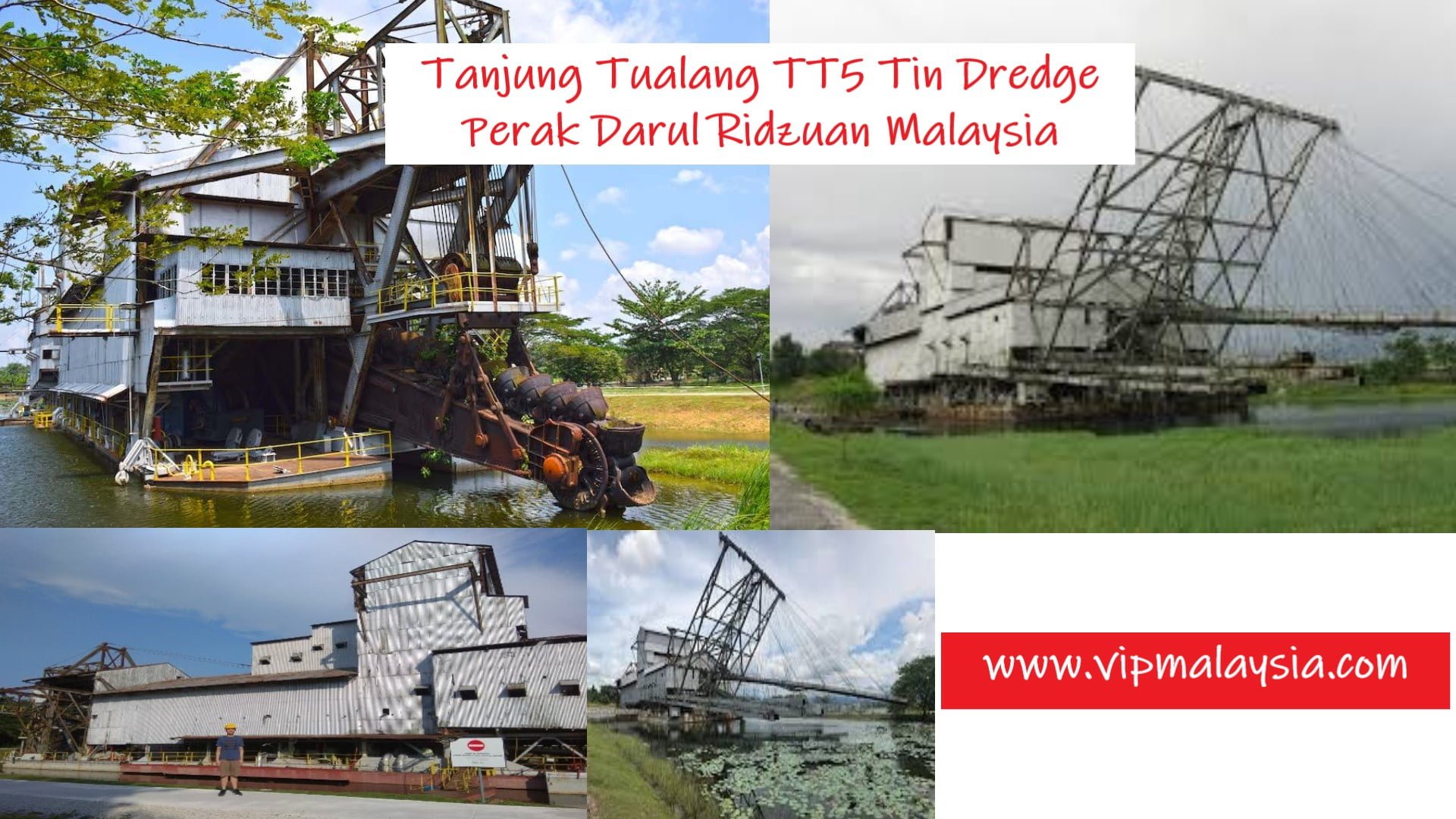
Step into Malaysia’s industrial past at TT5 Tanjung Tualang Tin Dredge, the last surviving tin dredge in the country. This colossal floating factory from 1938 offers guided tours, tin panning, and family-friendly adventures, making it a must-visit heritage site in Perak.
Introduction
Nestled in Batu Gajah, Perak, TT5 Tanjung Tualang Tin Dredge stands as a monumental reminder of Malaysia’s tin mining glory. Once the backbone of the nation’s economy, tin mining transformed Perak into the wealthiest state in Malaya. Today, TT5 is not only a preserved engineering marvel but also a vibrant attraction blending history, education, and adventure. Visitors can explore its machinery, learn about the tin rush, and enjoy outdoor activities in the scenic Kinta Valley National Geopark.
History
The Rise of Tin Mining in Perak
Tin mining in Perak began in 1848 in Taiping, sparking a rush that reshaped the region. By the early 20th century, Perak was known as the wealthiest state in Malaya, with Ipoh earning the nickname “City of Millionaires.” Foreign investments poured in, and by 1940, over 120 dredges operated across the state, symbolizing industrial might.
Engineering Excellence and Operation
TT5 was built in England in 1938 by F.W. Payne & Sons and shipped to Malaysia for assembly. Weighing 4,500 tons, it was upgraded in 1963 to improve efficiency. For 44 years, TT5 extracted tin until August 1982, when global tin prices collapsed. In 1997, it was saved from demolition and donated to the Perak State Government. Since 2018, TT5 has been recognized as part of the Kinta Valley National Geopark, cementing its role as a heritage landmark.
F.W. Payne & Sons was a British engineering company founded by Francis William Payne. Originally, Payne and his brother Raymond worked as consulting engineers in Dunedin, New Zealand, specializing in alluvial mining and dredging. After Raymond’s death, Francis William Payne established the firm in London under the name F.W. Payne & Son, with his son F.G. Payne joining as junior partner. The company became notable for designing and building dredges, including Malaysia’s last surviving tin dredge, TT5, constructed in 1938.
Visitor Facilities
TT5 offers parking, restrooms, and a visitor center with ticketing and souvenirs. Guided tours typically last 1–2 hours, with tickets priced around RM21 per person.
Highlights
Guided Dredge Tours
Visitors can walk through the dredge’s control rooms and machinery, gaining insight into how tin was extracted. Informational panels and audio guides narrate the process, making the experience both educational and immersive.
Tin Panning Experience
Hands-on tin panning lets visitors relive the miners’ work. This interactive activity is popular among families and school groups, offering a tangible connection to Malaysia’s industrial past.
Heritage Gallery
The visitor center houses exhibits on tin mining history, showcasing photographs, tools, and artifacts. It contextualizes TT5 within the broader story of Perak’s economic rise.
Trekking and Adventure
ATV Rides and Outdoor Fun
ATV rides are available for thrill-seekers, offering a fun way to explore the dredge’s grounds. Families can enjoy fishing, camping, and BBQ areas, making TT5 a versatile destination for both history buffs and outdoor enthusiasts.
Nearby Attractions
Weekend Bazaars and Cultural Events
Occasional bazaars feature local crafts, traditional games, and food stalls, adding a festive atmosphere. Cultural festivals in nearby towns, such as Ipoh’s heritage tours and Batu Gajah’s temple celebrations, complement the TT5 experience.
Weekend Community Bazaars at TT5
TT5 occasionally hosts bazaars featuring local crafts, traditional games, and food stalls. These events are designed to engage the community and provide visitors with a festive atmosphere alongside the heritage experience.
Batu Gajah, close to TT5, is known for its temple festivals, which often include traditional performances and community gatherings. These events provide visitors with a deeper cultural immersion when paired with TT5’s industrial heritage.
Wildlife and Scenic Landscapes
The dredge sits within the Kinta Valley National Geopark, home to diverse flora and fauna. Birdwatchers often spot kingfishers and herons along the waterways, while the surrounding landscapes provide picturesque backdrops for photography.
Nearby Towns
Nearby Towns
Ipoh
Ipoh, located about 30 minutes from TT5, is celebrated for its colonial architecture, cave temples, and vibrant food scene. Known as the “City of Millionaires” during the tin boom, it remains a cultural hub with heritage tours and culinary delights that attract both locals and tourists .
Batu Gajah
Batu Gajah is home to Kellie’s Castle, an unfinished colonial mansion built by Scottish planter William Kellie-Smith in the early 1900s. The castle blends Moorish, Indo-Saracenic, and Scottish architectural styles, and is famous for its mysterious tunnels and Malaysia’s first planned elevator .
Tanjung Tualang Village
Tanjung Tualang Village is renowned for its freshwater prawns, making it a popular stop for visitors after exploring TT5. The village’s eateries serve freshly caught prawns prepared in various styles, offering a culinary highlight that complements the heritage experience of the dredge.
Address: Tanjung Tualang, Kinta District, Perak, Malaysia
Phone (local council): Batu Gajah District Council – 05-366 4000
Tanjung Tualang Village is a mukim in the Kinta District of Perak, Malaysia, historically known as one of the major tin-mining towns during the early 1900s. The village derived its name from the tualang tree and later from the Toh Allang Chinese Tin Ltd company. By the mid-20th century, Tanjung Tualang was home to several large tin dredges, making it a significant site in Malaysia’s mining industry. Today, the area is famous for its freshwater prawns (udang galah), earning it the nickname “Freshwater Prawn Town.” It remains a popular stop for visitors heading to TT5 Tanjung Tualang Tin Dredge, combining heritage tourism with culinary experiences.
Conclusion
TT5 Tanjung Tualang isn’t just a remnant of Malaysia’s tin mining past—it’s a living history, offering interactive tours, thrilling outdoor activities, and deep cultural insights. Whether you’re exploring the dredge machinery, trying your hand at tin panning, or enjoying the scenic landscapes, this heritage site is a must-visit for anyone in Perak.
Step into Malaysia’s tin mining legacy—visit TT5 Tanjung Tualang today!
Ipoh Heritage Trail, Kellie’s Castle (Batu Gajah), Gopeng Eco Park
Accessibility
Best reached by car via major highways; limited public transport, taxis or ride-hailing recommended
Best Time to Visit
Morning or late afternoon for cooler weather and better photography
Contact
+6014-904 3255
Visitor Reviews
Name: Marsha Hussin Locality: Kuala Lumpur, Malaysia Review: “TT5 is a fascinating place to learn about Malaysia’s tin mining history. The guided tour was informative, and the tin panning was fun for my kids. We also enjoyed the nearby seafood in Tanjung Tualang. Highly recommended!” Rating: ★★★★☆
Name: Faezah Zakaria Locality: Penang, Malaysia Review: “The dredge is massive and impressive. Walking through the machinery felt like stepping back in time. The camping area was well-maintained, and the staff were friendly. A great mix of history and adventure.” Rating: ★★★★★
Name: Nurul Shuhada Locality: Johor Bahru, Malaysia Review: “I loved the heritage gallery and the audio guides. The bazaar added a lively touch to our visit. TT5 is a must-see if you’re in Perak.” Rating: ★★★★☆
Sungai Kampar in Gopeng, Perak is Malaysia’s premier white-water rafting destination, offering 22 thrilling rapids, lush rainforest scenery, and a rich historical backdrop rooted in tin mining heritage. Just 45 minutes from Ipoh, this river promises an unforgettable adventure for beginners and thrill-seekers alike.
Introduction
Nestled in the heart of Perak, Sungai Kampar has become a magnet for adventure enthusiasts seeking both adrenaline and natural beauty. The river flows through dense tropical rainforest, offering rafters a chance to experience Grade I–III rapids that balance excitement with safety. Beyond rafting, the area is steeped in history, culture, and biodiversity, making it a holistic travel experience.
History
Sungai Kampar’s story is deeply tied to Perak’s tin mining boom of the 19th and 20th centuries. Gopeng was once a bustling mining town, attracting workers from China and beyond. The river served as both a lifeline and a challenge, carrying tin ore and shaping the livelihoods of local communities. Over time, as mining declined, Sungai Kampar transformed into a hub for eco-tourism. Today, rafters not only ride its waves but also trace the legacy of Perak’s industrial past, where heritage museums and old mining sites still stand as reminders of a bygone era.
Gopeng is a historic town located in the Kampar District, Perak, Malaysia, about 20 km south of Ipoh. Once a major tin-mining hub in the Kinta Valley during the 19th century, Gopeng was an important settlement before Ipoh rose to prominence around 1890. The town has deep cultural roots, with significant Hakka Chinese influence under leaders like Chung Keng Kwee, and it was also one of the earliest places where the Orang Asli came into contact with outsiders. Today, Gopeng is known for its eco-tourism attractions such as Gua Tempurung, Gopeng Heritage House, and the Gaharu Tea Valley, while retaining its colonial-era charm and mining heritage.
Chung Keng Kwee (鄭景貴; 1827–1901) was a prominent Hakka Chinese immigrant in British Malaya, best known as the Kapitan China of Perak. Appointed by the British in 1877, he played a pivotal role in the founding and administration of modern Taiping. He rose to prominence as the leader of the Hai San secret society during the Larut Wars (1861–1874), where rival factions clashed over tin mining rights. Beyond his influence in mining, he was a millionaire philanthropist, funding schools, temples, and community projects, and was respected by both Chinese and European communities. His innovations in tin mining, including the use of hydraulic machinery and steam pumps, made him one of the most successful entrepreneurs of his era. He also built the old fort at Teluk Batu to safeguard his mining operations and left a lasting legacy in Perak’s economic and cultural development.
Highlights
Thrilling Rapids
The river boasts 22 rapids, ranging from gentle Class I waves to exhilarating Class III drops. Each rapid offers a unique challenge, ensuring both beginners and seasoned rafters find excitement.
22-Rapid Journey
Journey Stage
Class Range
Features & Experience
Warm-Up Section (early rapids)
Class I
Gentle waves and calm stretches, perfect for beginners to practice paddling and commands.
Building Momentum (mid rapids)
Class II
Moderate rapids with small drops, splash zones, and teamwork challenges that boost adrenaline.
Thrill Zone (core rapids)
Class II–III
Stronger waves, technical paddling required, thrilling turns and drops with fast currents.
Final Challenge (last rapids)
Class II–III
Exciting turbulence and group challenges before calmer waters, ending with rainforest views.
Safety and Guidance
Professional rafting operators provide helmets, life jackets, and safety briefings. Rafters learn paddling commands, capsize drills, and rescue techniques before embarking on the journey.
Scenic Rainforest Views
The rafting route winds through lush rainforest, where visitors can spot butterflies, hornbills, and macaques. The serene backdrop contrasts beautifully with the adrenaline of the rapids.
Nearby Attractions
Gopeng Heritage Town
Gopeng offers a glimpse into Perak’s tin mining past. The Gopeng Museum showcases artifacts, photographs, and mining equipment, while the town’s colonial architecture adds charm.
Gopeng Museum (Muzium Gopeng)
The Gopeng Museum is a private heritage museum located in Gopeng, Perak, Malaysia. It was opened to the public on 18 April 2009 (World Heritage Day) and was founded by Bernard Yaw Ban Yew, Wong Kuan Cheong, Phang See Kong, and Tan Yoke Chun. The museum is housed in a historic building along Jalan Eu Kong, originally built by Eu Kong, the founder of the famous Eu Yan Sang medical hall.
The museum showcases the history of Gopeng, particularly its tin mining heritage, cultural development, and the lives of early settlers including the Orang Asli, Rawa, Mandailing, Chinese, and Tamils. Exhibits include mining equipment, photographs, and artifacts from the town’s colonial and industrial past. An annex called the Gopeng Heritage House complements the museum with displays of antiques and traditional household items.
Address: Muzium Gopeng, Jalan Eu Kong, 31600 Gopeng, Perak, Malaysia
Phone: +60 12-598 7857 / +60 16-542 1287
Opening Hours: Friday to Tuesday, 9:00 AM – 5:00 PM (closed Wednesday & Thursday)
Ipoh City
Located about 45 minutes away, Ipoh is famous for its limestone caves, street art, and culinary delights. Visitors often combine rafting with a food tour of Ipoh’s renowned hawker stalls.
Ipoh is the capital city of Perak, Malaysia, located along the Kinta River about 200 km north of Kuala Lumpur and 150 km southeast of George Town, Penang. Established in the late 19th century after the discovery of rich tin deposits, Ipoh rapidly grew into one of the world’s leading tin mining centers, earning nicknames such as the “City of Millionaires” and the “Bougainvillea City.” Today, Ipoh is Malaysia’s fourth-largest city with a population of over 750,000, known for its preserved British colonial architecture, limestone hills and cave temples, vibrant street art, and culinary specialties like Ipoh white coffee. Its strategic location makes it a major transportation hub in West Malaysia, served by the North-South Expressway, railway connections, and Sultan Azlan Shah Airport.
Perak hosts vibrant festivals such as the Ipoh International Run and traditional Chinese New Year celebrations, adding cultural depth to any rafting trip.
The Ipoh International Run (IIR) is a long‑standing annual road race organized by the Majlis Bandaraya Ipoh (Ipoh City Council). First introduced in 1985, it has become one of Perak’s signature sporting events, attracting thousands of local and international participants. After a hiatus since 2017, the run was revived in 2024 as part of the “Visit Perak Year” campaign. The event features multiple categories including 21 km, 10 km, and 5 km races, with divisions for men, women, veterans, and school participants. The 2024 edition is scheduled for 28 July 2024 at Stadium Indera Mulia, Ipoh, with flag‑off times starting as early as 3:30 AM for the half marathon. The run not only promotes healthy living but also serves as a tourism draw, showcasing Ipoh’s vibrant culture and hospitality.
Trekking and Adventure
Jungle Trekking
Surrounding Sungai Kampar are trails that lead into pristine rainforest. Trekkers encounter waterfalls, rare orchids, and diverse wildlife.
Main Hiking Trails
Trail Name
Features
Gunung Bujang Melaka
Hard trail, ~8 miles, 7.5 hours; steep continuous climb with roped sections, foggy summit views.
Gunung Relau
Hard trail, ~5.2 miles, 5.5 hours; starts near Berangkai waterfalls, streams and orchards, requires permit.
Moderate trail, ~2.5 miles, 2.5 hours; forest hike with steep sections, panoramic views at summit.
Westlake Garden Trail
Easy trail, ~0.5 miles; short walk suitable for families, popular local recreation spot.
Dragon Hill Kampar (Peak 505)
Short but steep hike (~1.7 miles); popular with locals, offers panoramic views and connecting trails.
Bukit Memban Di Awan
Easy hike (~0.9 miles); beginner‑friendly, summit marked with a signboard at 445m elevation.
Body Rafting and River Jumps
Some operators offer body rafting, where adventurers float through calmer sections of the river, or attempt river jumps into natural pools.
Body rafting is an adventure activity where participants navigate river currents and rapids using only their bodies, without the aid of a raft or boat. Equipped with safety gear such as helmets and life jackets, rafters float, slide, and swim along natural river flows, often through canyons or gorges. Unlike traditional rafting, which uses inflatable rafts, body rafting emphasizes direct contact with the water, making it a more immersive and adrenaline‑filled experience. It is commonly practiced in rivers with moderate rapids and clear safety protocols.
Nearby Attractions
Gopeng Rainforest Resort
Gopeng Rainforest Resort is a popular eco‑friendly retreat located near Sungai Kampar in Perak. It serves as a base for adventure seekers, especially those coming for white‑water rafting, caving, and jungle trekking. The resort offers rustic accommodations designed to blend with nature, giving visitors a chance to experience the rainforest environment up close.
Guests can join guided tours led by experienced local guides, exploring waterfalls, caves, and traditional villages. The resort emphasizes sustainability and community involvement, making it not just a place to stay but also a gateway to learning about the natural and cultural heritage of Gopeng.
Address: Lot 15912, Kampung Geruntum, 31650 Gopeng, Perak, Malaysia
Phone: +60 12-510 7555 / +60 12-516 8200
Kellie’s Castle
Kellie’s Castle is an unfinished mansion located near Batu Gajah, Perak. Built by Scottish planter William Kellie Smith in the early 20th century, the castle was intended as a grand residence but was left incomplete after his sudden death. Its mix of Moorish, Indo‑Saracenic, and Western architecture makes it one of Malaysia’s most unique historical landmarks.
Today, Kellie’s Castle is a tourist attraction filled with mystery and legend. Visitors explore its corridors, hidden rooms, and rooftop viewpoints while hearing stories of ghost sightings and colonial history. The castle’s romantic yet eerie atmosphere adds to its charm, making it a favorite spot for history lovers and photographers.
Kinta Nature Park
Kinta Nature Park is a birdwatcher’s paradise located in Batu Gajah, Perak. Once a tin mining area, it has been transformed into wetlands and lakes that attract a wide variety of bird species. The park is home to herons, egrets, and migratory birds, making it an important conservation site in the region.
Visitors can enjoy peaceful walks along the trails and observe birds in their natural habitat. The park also provides opportunities for photography and environmental education, highlighting the importance of preserving wetlands. Its tranquil setting makes it a relaxing escape for nature lovers and families.
Address: 31000 Batu Gajah, Perak, Malaysia
Caving in Gua Tempurung
Gua Tempurung is one of the largest limestone caves in Peninsular Malaysia, stretching about 4.5 km with 1.9 km accessible to the public. Estimated to be 400 million years old, the cave features spectacular stalactites, stalagmites, underground rivers, and five giant domes, each with unique characteristics of temperature, water levels, and limestone formations. Guided tours are available in both dry and wet formats, ranging from easy walks along lit pathways with over 600 steps to adventurous treks involving wading through underground rivers and crawling through tight passages.
Conclusion
Sungai Kampar isn’t just a river—it’s an adventure-packed destination, offering thrilling rapids, stunning nature, and a safe yet exciting rafting experience. Whether you’re tackling fast currents, floating through scenic landscapes, or bonding with your group, this rafting trip is one for the bucket list.
Challenge the rapids—plan your white water rafting experience at Sungai Kampar today!
Summary
Attraction: #SungaiKampar
Location: #Perak
Attraction Type: #Attraction
Source: tourismperakmalaysia.com, ipoh-city.com/
Why Visit:
Stunning natural surroundings – Glide through lush rainforests and clear river waters
Beginner-friendly yet thrilling rapids – Perfect for all experience levels
Guided rafting experience – Enjoy a safe and adrenaline-pumping adventure
Close to Ipoh’s attractions – Only 45 minutes from the city center
Quick Info
Attribute
Details
Name
Sungai Kampar White Water Rafting, Perak
Location / Address
Razak House, Jalan Sungai Itek, 31600 Gopeng, Perak, Malaysia
GPS Coordinates
4.4761° N, 101.1628° E
State
Perak
Operating Hours
9:00 AM – 6:00 PM (Daily)
Facility Type
White Water Rafting Adventure Park
Highlights
22 Rapids, River Challenges, Guided Tours
Nearby Attractions
Ipoh City, Gopeng Heritage Town, Ulu Geroh Rafflesia Trail
Accessibility
Connected via major highways & public transport
Best Time to Visit
Morning or early afternoon for optimal water conditions
Contact Numbers
Visitor Reviews
Melinda Mell, Kuala Lumpur – ★★★★★ “I had an amazing time rafting at Sungai Kampar. The guides were professional, and the rapids were thrilling yet safe. The rainforest scenery was breathtaking.”
Roshan Syukur, Penang – ★★★★☆ “The rafting was exciting, and the safety briefings made me feel confident. I wish the trip included more wildlife spotting, but overall it was a fantastic adventure.”
Dorrish Transman, Singapore – ★★★★★ “Perfect for a weekend getaway! The combination of rafting, jungle trekking, and visiting Ipoh made this trip unforgettable. Highly recommended for families.”
Mohd Muiz Haji Badri, Johor Bahru – ★★★★☆ “The rapids were fun, and the guides were very experienced. The facilities at the resort were comfortable, though the drive from Ipoh took closer to 45 minutes.”
Deep within Gopeng, Perak, lies Gua Tempurung, one of Malaysia’s longest limestone caves. With five massive domes, a 1.9 km accessible stretch, and a history tied to tin mining and wartime hideouts, this underground wonder offers both geological marvels and thrilling adventures.
Introduction
Nestled in the lush landscapes of Gopeng, Perak, Gua Tempurung is a limestone cave system that has fascinated explorers, historians, and nature lovers alike. Stretching over 4.5 km in total length, with 1.9 km open to visitors, the cave is celebrated for its towering stalactites, stalagmites, and underground rivers. Its age is often cited as 400 million years, referring to the limestone itself, making it one of the oldest geological formations in Malaysia. Beyond its natural beauty, Gua Tempurung carries a rich history, from being a communist hideout during the Malayan Emergency to serving as a tin mining site in the 1970s. Today, it stands as a premier tourist destination, offering guided tours that range from easy walks to extreme spelunking adventures.
History
Gua Tempurung’s story is as captivating as its geological formations. Archaeological evidence suggests the cave has existed since 8000 BC, though the limestone itself dates back hundreds of millions of years. During the 1950s and 1960s, the cave became a strategic hideout for communist insurgents during the Malayan Emergency. Later, in the 1970s, tin mining operations left behind traces of Malaysia’s industrial past, visible in certain chambers. Today, the cave is preserved and managed as a tourist attraction, balancing conservation with accessibility.
Visitor Facilities
The cave is equipped with lighting, stairways, bridges, and rest areas. Nearby towns like Ipoh and Gopeng offer accommodations ranging from eco-parks to luxury resorts, ensuring comfort after a day of adventure.
Highlights
Golden Flowstone Cavern
This dome rises nearly 90 meters high, featuring a smooth golden limestone cascade that glimmers under artificial lighting. It is one of the most photographed sections of the cave, offering breathtaking views for visitors.
Alam Cavern
Standing at 72 meters, Alam Cavern is renowned for its echo effects. Visitors often test the acoustics by calling out, experiencing the cave’s natural resonance.
Gergasi Cavern
Known as the “Giant Cavern,” it houses a 15-meter limestone column that towers majestically, resembling a colossal pillar.
Tin Mine Cavern
This section bears the marks of tin mining activities from the 1970s. Visitors can still see excavation remnants, offering a glimpse into Malaysia’s mining heritage.
Battlefield Cavern
A rugged chamber filled with fallen stalactites and rock formations, including the famous Fallen Warrior, a collapsed structure resembling a warrior figure.
What to Explore
Details
Visitor Tips
Golden Flowstone Cavern
A dome nearly 90 m high with golden limestone cascades that shimmer under lighting.
Best for photography; bring a tripod for long‑exposure shots.
Alam Cavern
Echo chamber rising 72 m, famous for its natural acoustics.
Try calling out to hear the resonance; great for kids and groups.
Gergasi Cavern
Houses a 15 m limestone column resembling a giant pillar.
Wear sturdy shoes; the floor can be slippery near this formation.
Tin Mine Cavern
Evidence of 1970s tin mining operations still visible.
Guides explain mining history; ideal for history enthusiasts.
Battlefield Cavern
Rugged chamber with collapsed stalactites, including the Fallen Warrior.
Flashlights recommended; formations are dramatic but dimly lit.
Underground River
A 1.6 km river flows through the cave, part of wet tours.
Expect to get wet; waterproof bags and extra clothes are advised.
Guided Walkway Tours
Illuminated paths and ~600 steps for easy exploration.
Suitable for families; tours last 40–50 minutes.
Extreme Cave Trekking
Wet tours with river crossings, slides, and tight passages.
Only for fit adventurers; tours last 2–3 hours with ranger guidance.
Attractions
Gunung Tempurung and Gunung Gajah
The limestone hills above the cave, visible from the North-South Expressway, are iconic landmarks. They provide lush greenery and karst scenery that frame the cave’s entrance.
Destination Comparison
Destination
Description
Gunung Tempurung
A limestone karst hill near Gua Tempurung, visible from the North‑South Expressway. It is directly tied to the cave system and popular for trekking, cave exploration, and photography. Easily accessible via Gua Tempurung tours and nearby facilities.
Gunung Gajah
A limestone massif in Perak, named for its elephant‑like shape (“Gajah” means elephant). Known for rugged cliffs and dense vegetation, it is less developed for tourism and best suited for adventurous hikers seeking offbeat landscapes. Accessibility is moderate, with routes from Ipoh (about 75 km) and Teluk Intan (25 km), making it a rewarding stop for adventurous travelers seeking offbeat landscapes and cultural immersion.
Underground River
A 1.6 km river flows through the cave, forming part of the wet adventure tours. Its cool waters add to the thrill of exploration.
Fish Species in the Underground River
The Underground River at Gua Tempurung is part of Perak’s freshwater ecosystem, which hosts species typical of limestone cave rivers. Surveys of Perak’s rivers list members of the Cyprinidae family (carps and minnows such as Rasbora spp. and Barbonymus gonionotus), along with catfish (Hemibagrus nemurus) and knifefish (Notopterus notopterus). These species are adapted to shaded, slow‑moving waters and are representative of the biodiversity found in subterranean streams.
Additionally, freshwater eels (Anguilla spp.) have been recorded in Perak’s river systems, occasionally appearing in cave rivers due to their migratory nature. The presence of such species highlights the ecological connectivity between the underground river and larger waterways in the region, making Gua Tempurung an important site for observing freshwater biodiversity in a unique cave environment.
Easy Walkway Tours
Visitors can enjoy illuminated pathways and climb over 600 steps, making it accessible for families and casual travelers. These tours highlight formations resembling animals and mythical figures.
Extreme Cave Trekking
For thrill-seekers, wet tours involve wading through underground rivers, sliding down slick limestone, and crawling through tight passages. These ranger-guided tours last 2–3 hours and require stamina and courage.
Photography Opportunities
The interplay of natural cave lighting and shadows creates dramatic scenes, perfect for photography enthusiasts. Long-exposure shots capture the shimmering flowstones and intricate textures.
Nearby Attractions
Gopeng Heritage Town
Just minutes away, Gopeng offers colonial architecture, museums, and vibrant street food. The Gopeng Heritage House showcases artifacts from the mining era, while local hawker stalls serve Perak delicacies.
Gopeng Heritage Town in Perak is a historic settlement that flourished during Malaysia’s tin mining boom, now preserved as a cultural destination showcasing colonial architecture, traditional shophouses, and museums. Its centerpiece, the Gopeng Heritage House, located at No. 6, Jalan Sungai Itek, 31600 Gopeng, Perak, Malaysia and reachable at +6012-501 3201, offers visitors a glimpse into the lifestyle of wealthy tin mine owners and the community’s rich heritage through antique furniture, mining relics, and cultural exhibits.
Ulu Geroh Rafflesia Trail
A jungle trek leading to sightings of the Rafflesia, the world’s largest flower. The trail also offers encounters with butterflies, hornbills, and lush rainforest scenery.
Ulu Geroh Rafflesia Trail in Perak is a jungle trekking route located about 12 km from Gopeng, renowned for sightings of the Rafflesia, the world’s largest flower. The trail winds through durian orchards, rubber and oil palm estates, and forest reserves, and is guided by the indigenous Semai Orang Asli, who share their deep knowledge of the rainforest. Trekking typically involves a lorry ride followed by a 1.5‑hour hike, where visitors may encounter blooming Rafflesia, Rajah Brooke butterflies, and diverse jungle wildlife. The bloom of the Rafflesia lasts only 4–5 days, making timing crucial for visitors seeking this rare spectacle.
Pangkor Island
Located off Perak’s coast, Pangkor Island is a beach paradise with clear waters, fishing villages, and cultural festivals. It’s a perfect extension to a cave exploration trip.
Pangkor Island (Malay: Pulau Pangkor) is a tropical island located in the Strait of Malacca, within the Manjung District of Perak, Malaysia. Covering about 18–21 km², it is home to fishing villages, sandy beaches such as Coral Bay and Pasir Bogak, and lush forested hills. Historically, Pangkor was a refuge for fishermen, merchants, and pirates, and later became significant during the Dutch colonial era, with the construction of the Dutch Fort in 1670 to control the tin trade. It was also the site of the Pangkor Treaty of 1874, which marked the beginning of British colonial influence in Perak. Today, Pangkor Island thrives on tourism and fishing, offering visitors duty‑free shopping, water sports, cultural temples, and nearby resorts such as Pangkor Laut.
Gua Tempurung is more than just a cave—it is a living museum of geology, history, and adventure. From its towering domes and underground rivers to its wartime past and mining heritage, the cave offers a multifaceted experience. Whether you seek a leisurely stroll or an adrenaline-pumping trek, Gua Tempurung delivers unforgettable memories. Its proximity to cultural towns and natural trails makes it a must-visit destination in Perak.
Wear sturdy shoes, bring flashlight for dim areas, waterproof bags for wet tours
Facilities Available
Parking, restrooms, souvenir stalls, food kiosks
Travel Distance
~25 km south of Ipoh (30–40 min drive)
Visitor Reviews
Siti Sarah, Kuala Lumpur – ★★★★★ “I joined the wet adventure tour, and it was exhilarating! Crawling through tight passages and sliding down limestone rocks was unforgettable. The guides were professional and ensured safety throughout.”
Stephanie Lee Fong, Penang – ★★★★☆ “The cave is stunning, especially the Golden Flowstone Cavern. I wish there were more information boards inside, but overall, it was a fantastic experience with my family.”
Normazliza Hassan, Johor Bahru – ★★★★★ “Loved the easy walkway tour. The lighting made the formations look magical, and my kids enjoyed spotting shapes in the rocks. Facilities were clean and well-maintained.”
Scott, Sarawak – ★★★★★ “As a local, I’ve visited Gua Tempurung multiple times. Each trip feels different. The history of the communist hideout adds depth to the adventure. Highly recommended for tourists.”
Step into the unfinished grandeur of Kellie’s Castle in Batu Gajah, Perak—a colonial mansion steeped in mystery, ghostly legends, and breathtaking architecture. Discover its hidden tunnels, Moorish arches, and lush surroundings while immersing yourself in Malaysia’s colonial past. Plan your visit today and uncover the secrets of Kellie’s Castle.
Introduction
Kellie’s Castle, often called “Malaysia’s Haunted Castle,” is one of the country’s most intriguing landmarks. Nestled on a hilltop overlooking the Raya River and surrounded by lush Perak plantations, this unfinished mansion is a blend of Moorish Revival, Indo-Saracenic, and Roman architectural styles. Its story is not just about bricks and mortar but about ambition, tragedy, and enduring mystery. Visitors are drawn to its ghostly legends, underground tunnels, and the romantic yet eerie aura that continues to captivate travelers from around the world.
The Legacy
William Kellie Smith
William Kellie Smith, a Scottish planter, arrived in Malaya in 1890 at the age of 20. Initially working as a civil engineer, he soon ventured into rubber planting and tin mining, amassing significant wealth. By 1910, he built Kellas House, the precursor to Kellie’s Castle. His fortune allowed him to dream of a grand mansion that would symbolize his success and love for his family. He even funded a Hindu temple for his workers, where his statue still stands among the deities—a rare honor that reflects his respect for his laborers.
Kellas House
Kellie’s Castle
Built in 1910 as William Kellie Smith’s first estate residence, located near Batu Gajah.
Construction began in 1915 as a grand mansion blending Moorish Revival, Indo-Saracenic, and Roman styles.
Served as the family’s main home before Kellie envisioned a larger, more opulent castle.
Intended to feature 14 rooms, Malaysia’s first elevator, rooftop courtyard, and wine cellar.
More modest in scale, reflecting Kellie’s early success in rubber and tin industries.
Left unfinished after Kellie’s death in 1926, now famous for ghostly legends and hidden tunnels.
Historical significance lies in being Kellie’s first architectural project in Malaya.
Today, it stands as a cultural landmark and tourist attraction in Perak.
The Unfinished Castle and Its Mysteries
Construction of Kellie’s Castle began in 1915, with artisans and materials imported from India. The mansion was designed to include 14 rooms, Malaysia’s first elevator, a rooftop courtyard, wine cellar, and secret tunnels. However, tragedy struck when the Spanish flu claimed the lives of several workers in 1918. Later, in 1926, Kellie Smith died of pneumonia in Portugal, leaving the castle unfinished. The abandoned structure soon became shrouded in ghostly tales, with many believing Kellie’s spirit still roams its corridors.
Highlights
Architectural Grandeur
The castle’s design is a fusion of Moorish arches, Indo-Saracenic domes, and Roman columns. Imported bricks and marble give the mansion a distinctive elegance. Visitors marvel at the unfinished tower, grand hallways, and Gothic-inspired details that make Kellie’s Castle a unique architectural gem in Malaysia.
Ghostly Legends
Stories of Kellie’s spirit wandering the halls, mysterious apparitions, and unexplained sounds have earned the castle its haunted reputation. These legends add an air of mystery, making it a popular destination for thrill-seekers and paranormal enthusiasts.
Attractions
Castle Exploration and Historical Insights
Walking through Kellie’s Castle is like stepping back in time. Visitors can explore hidden corridors, rooftop courtyards, and rumored escape tunnels. Guided tours provide deeper insights into Malaya’s colonial past, offering context about the life of William Kellie Smith and the hardships faced during construction.
Castle Exploration
Details
Grand Hallways
Visitors can walk through expansive corridors adorned with Moorish arches, Gothic elements, and British colonial details, showcasing the eclectic architectural blend.
Hidden Corridors
The castle features rumored escape tunnels and secret passageways, adding mystery and intrigue to the visitor experience.
Rooftop Courtyard
The rooftop area offers panoramic views of Perak’s lush plantations and the Raya River, intended as a social gathering space.
Colonial Insights
Guided tours provide historical context about William Kellie Smith, the colonial era, and the unfinished legacy of the mansion.
Rooftop Courtyard
The rooftop courtyard offers sweeping views of the Perak countryside. It was intended as a space for entertainment and social gatherings, symbolizing Kellie’s vision of grandeur.
Underground Tunnels
Rumored escape tunnels connect the castle to Kellie’s Temple. Though not all are accessible, they fuel the imagination of visitors intrigued by mystery and secrecy.
The Elevator Shaft
The unfinished elevator shaft is a reminder of Kellie’s ambition to install Malaysia’s first elevator—a symbol of modernity in colonial Malaya.
Nearby Attractions
Batu Gajah Town
Batu Gajah is a historic town known for its colonial-era architecture and traditional Perak cuisine. Visitors can explore old government buildings, churches, and mansions that reflect its tin mining past. The town is also famous for local delicacies such as curry mee and Ipoh white coffee.
Address: Majlis Daerah Batu Gajah, Jalan Haji Abdul Wahab, Kampung Bendera, 31000 Batu Gajah, Perak, Malaysia
Phone: +605-363 2020 / +605-366 5930
Tanjung Tualang Tin Dredge
The Tanjung Tualang Tin Dredge No. 5 (TT5) is Malaysia’s last remaining tin dredge, built in 1938 and operated until 1982. It is now preserved as a heritage site within the Kinta Valley National Geopark. Visitors can join guided tours, try tin panning, and learn about Perak’s industrial history.
Address: 9th KM, Jalan Tanjung Tualang, 31000 Batu Gajah, Perak, Malaysia
Phone: +60 14-904 3255 Website: tt5perak.com
Kellie’s Temple
The Sri Maha Mariamman Temple near Kellie’s Castle was built for estate workers and is unique for featuring a statue of William Kellie Smith among its deities. The temple is believed to be connected to the castle via a secret tunnel, adding to its mystique.
Address: Jalan Gopeng, 31610 Batu Gajah, Perak, Malaysia
Phone: +60 14-944 1527
Trekking and Adventure
Exploring the Surroundings
The lush plantations and scenic Raya River provide opportunities for trekking and photography. Adventurers can hike nearby trails, enjoy panoramic views of the castle, and immerse themselves in the natural beauty of Perak. Wildlife enthusiasts may spot species such as hornbills, macaques, and monitor lizards in the surrounding forests.
Raya River
Details
Location
The Raya River flows through Batu Gajah in Perak, Malaysia, near Kellie’s Castle, and joins the larger Perak River system.
Length & Basin
It is part of the Perak River basin, which stretches about 400 km and covers 14,900 km², making it the second longest river system in Peninsular Malaysia.
Ecological Importance
The river supports diverse ecosystems, including wildlife from the Belum-Temenggor Forest Reserve such as hornbills, elephants, and tapirs.
Cultural Significance
Historically, settlements and colonial estates were established along its banks, with Kellie’s Castle overlooking the river as a symbol of ambition and mystery.
Cultural Festivals and Local Experiences
Visitors often time their trips to coincide with Perak’s cultural festivals, such as Thaipusam at nearby temples or local food fairs in Ipoh. These experiences enrich the journey, blending history with living traditions.
Conclusion
Kellie’s Castle is more than just an unfinished mansion—it is a monument to ambition, tragedy, and enduring mystery. Its unique architecture, ghostly legends, and scenic location make it a must-visit destination in Perak. Whether you are a history buff, adventure seeker, or cultural explorer, Kellie’s Castle offers an unforgettable experience that blends the past with the present.
Batu Gajah Town, Tanjung Tualang Tin Dredge, Kellie’s Hindu Temple
Accessibility
Connected via major highways & public transport
Best Time to Visit
Morning or sunset for stunning views
Contact
+605-365 3381
Visitor Reviews
Lessie Cassie, Penang – 5 Stars “The castle is breathtaking! Walking through the hallways felt like stepping into another era. The rooftop view was stunning, and the ghost stories made the visit even more thrilling.”
Selvaram Raja Moonir, Kuala Lumpur – 4 Stars “Loved the architecture and the historical insights from the guided tour. The tunnels were fascinating, though some areas felt a bit too commercialized.”
Ramadhan Mustaqim, London – 5 Stars “A highlight of my trip to Malaysia! The mix of history, mystery, and adventure made Kellie’s Castle unforgettable. Highly recommend visiting with a guide.”
Seri Arni Hassanal, Melaka – 4 Stars “The castle is impressive, especially the Moorish arches and unfinished elevator shaft. The legends added excitement, though I wish more tunnels were open to explore.”
Standing tall at 25 meters with a distinct tilt, Menara Condong Teluk Intan in Perak is Malaysia’s answer to the Leaning Tower of Pisa. Built in 1885 as a water reservoir, this pagoda-style tower has transformed into a cultural icon, drawing visitors with its unique architecture, rich colonial history, and vibrant local surroundings.
Introduction
Located in the riverside town of Teluk Intan, Perak, Menara Condong is one of Malaysia’s most fascinating landmarks. From afar, the tower appears to have three levels, but inside it reveals eight wooden floors, each steeped in history. Originally constructed to store water for droughts and fire emergencies, the tower has evolved into a heritage site that symbolizes the town’s resilience and multicultural past. Today, it is a must-visit destination for travelers seeking both architectural wonder and cultural immersion.
History
Early Construction
Menara Condong was built in 1885 by Chinese contractor Leong Choon Cheong, also known locally as Ah Cheong. The structure was designed with wood and brick, topped by a steel water tank. Its purpose was practical: to serve as a reservoir for the town and provide water for fire-fighting.
Leong Choon Cheong (also known locally as Ah Cheong) was a Chinese contractor and architect credited with designing and building the Menara Condong Teluk Intan in 1885. He worked alongside S. Sabapathy, an assistant engineer from the Public Works Department in Teluk Anson (now Teluk Intan). The tower was originally constructed as a water reservoir and fire-fighting resource, but over time became a landmark due to its distinctive tilt and pagoda-inspired design.
The Leaning Factor
Over time, the combination of soft alluvial soil and the immense weight of the water tank caused the tower to tilt westward. This tilt gave the tower its iconic “leaning” appearance, making it one of the few leaning towers in Asia.
Colonial and Wartime Role
During the British colonial era, the tower doubled as a town clock tower, with its bell imported from London. In World War II, Japanese soldiers used the tower as a watchtower, adding another layer of historical significance.
British colonial era in Malaya refers to the period between the late 18th century and 1957 when the Malay Peninsula and Singapore came under British control. The British first established a foothold in Penang in 1786, followed by Singapore in 1819 and Malacca in 1824 after the Anglo-Dutch Treaty. Collectively known as British Malaya, these territories included the Straits Settlements (directly ruled by the Crown), the Federated Malay States, and the Unfederated Malay States (ruled indirectly through treaties with local sultans). This era profoundly shaped Malaya’s political, economic, and social structures, introducing tin and rubber industries, modern administration, and legal frameworks, while also laying the foundation for multicultural society. Independence was achieved on 31 August 1957 with the formation of the Federation of Malaya.
Heritage Recognition
In 2015, Menara Condong was officially declared a National Heritage Site, ensuring its preservation for future generations. Today, it stands as both a historical monument and a vibrant cultural attraction.
Highlights
Unique Architecture
The tower’s design resembles a Chinese pagoda, with tiered roofs and intricate decorative elements. This architectural style reflects the multicultural influences of Teluk Intan, blending Chinese craftsmanship with colonial utility.
The Clock and Bell
The clock mechanism and bell were imported from London’s Ludgate Hill. The bell was historically used to announce time to townsfolk, reinforcing the tower’s role as a community timekeeper.
Ludgate Hill is a street and small hill in the City of London, England, historically significant as the site of the former Ludgate city gate, which was demolished in 1760. It is one of the three traditional hills of London, alongside Tower Hill and Cornhill, and is closely associated with St Paul’s Cathedral, which sits at its summit. The name “Ludgate” is thought to derive from the Old English hlid-geat meaning “postern” or “swing gate.” Today, Ludgate Hill connects St Paul’s Churchyard with Ludgate Circus, continuing into Fleet Street, and remains a notable historic thoroughfare in central London.
Interior Experience
Visitors can climb the wooden staircases inside, exploring each of the eight floors. The interior showcases the original wooden beams and structural ingenuity that have kept the tower standing for over a century.
Exploring the Tower
Walking up the tower’s staircases is an adventure in itself. Each level offers a different perspective, from the structural beams to the panoramic views of Teluk Intan.
The Floors
Floor
Function / Details
Ground Floor
Entrance area with decorative landscaping, marble flooring, and seating. Historically housed a well with 4.3m depth to stabilize the structure.
First Floor
Originally part of the water reservoir system, now serves as an exhibition space showcasing the tower’s history.
Second Floor
Contained structural supports for the steel water tank; today used for heritage displays.
Third Floor
Houses the large clock mechanism imported from James Wilson Benson of Ludgate Hill, London.
Fourth Floor
Provides access to the bell chamber; the bell historically chimed every 15 minutes and could be heard up to 5 km away.
Fifth Floor
Observation level offering views of Teluk Intan town and the Perak River.
Sixth Floor
Reinforced wooden beams and staircases; part of the tower’s structural integrity.
Seventh Floor
Secondary observation deck, often used by Japanese soldiers during WWII as a watchtower.
Eighth Floor (Top)
Originally held the steel water tank; now functions as a heritage landmark and viewing platform.
Jalan Ah Cheong
Named after the tower’s builder, this street honors Leong Choon Cheong’s contribution to Teluk Intan’s history.
Plaza Activities
The plaza surrounding the tower often hosts cultural events, photography exhibitions, and local performances, making it a lively spot for visitors.
Evening Illumination
At night, the tower is beautifully lit, creating a picturesque backdrop for evening strolls and photography.
Nearby Attractions
Teluk Intan Waterfront
The Teluk Intan Waterfront is a popular riverside attraction along the Perak River, offering visitors a serene environment with scenic views and refreshing breezes. It has become a favorite spot for both locals and tourists to enjoy evening strolls, photography, and leisure activities. The area is also known for its firefly cruises, boat rides, and nearby sunflower gardens, making it a vibrant hub that blends natural beauty with cultural experiences .
Beyond its natural charm, the River Front Teluk Intan provides modern amenities such as a children’s playground, public facilities, and easy accessibility from the town center. It serves as a social gathering place where families relax, joggers exercise, and visitors immerse themselves in the tranquil riverside atmosphere. Despite occasional noise from parked cars, the waterfront remains a well-loved destination that reflects Teluk Intan’s commitment to creating enjoyable public spaces for its community.
River Front Teluk Intan (Waterfront Park)
Address: 6, Jalan Mahkota, Pekan Teluk Intan, 36000 Teluk Intan, Perak, Malaysia
Waterfront Restaurant Teluk Intan
Address: 1937, 58, Jalan Perak, Taman Malaysia, 36000 Teluk Intan, Perak, Malaysia
Phone: +60 16-590 0709
Historical Shophouses
Nearby streets feature traditional Malaysian-Chinese shophouses, with colorful facades and colonial-era charm. These buildings provide insight into the town’s trading past.
Local Food Delicacies
Teluk Intan is famous for its mee rebus and unique chee cheong fun, a steamed rice noodle dish filled with preserved vegetables and dried shrimp.
Famous Foods in Teluk Intan
Food
Description
Chee Cheong Fun
Teluk Intan’s signature rice noodle dish, filled with dried shrimp and pickled green chili, best known at Liew Kee (Ah Lek).
Mee Rebus
A noodle dish served with thick, spicy-sweet gravy made from potatoes, shrimp, and soybeans, popular at local hawker stalls.
Nasi Kandar
Rice served with a variety of curries and side dishes, famously offered at Nasi Kandar Krishnan.
Rojak
A fruit and vegetable salad mixed with sweet-spicy sauce, often topped with crushed peanuts.
Laksa
Spicy noodle soup with fish-based broth, garnished with herbs and vegetables.
Chinese Biscuits
Traditional handmade pastries sold in old shophouses, often filled with lotus paste or red bean.
Fresh Fried Prawns
Large prawns fried in giant woks, a specialty of Teluk Intan’s seafood stalls.
Nasi Lemak
Coconut milk rice served with sambal, anchovies, peanuts, and boiled egg, a staple breakfast dish.
Satay
Skewered and grilled meat served with peanut sauce, widely available at night markets.
Cendol
A shaved ice dessert with coconut milk, palm sugar, and green rice flour jelly, perfect for cooling down in Teluk Intan’s tropical heat.
Nearby Towns
Travelers can extend their journey to nearby towns such as Bidor and Tapah, known for their local markets and fruit orchards. These towns provide a deeper look into Perak’s rural charm.
Bidor
Bidor is a charming town in Perak, often considered a hidden gem for travelers. Known for its duck noodles (Mee Itik Bidor), durians, and traditional kopitiams, the town offers a blend of cultural heritage and natural beauty. Visitors can explore firefly tours, coconut farms, and hot springs nearby, making it a relaxing stopover between Kuala Lumpur and Ipoh.
The highlight of Bidor is its culinary scene, especially the famous Pun Chun Restaurant serving duck noodles. Beyond food, Bidor Rail Museum and nearby hot springs provide cultural and leisure experiences. The town’s slow-paced lifestyle and authentic markets reflect its multicultural roots.
Tapah
Tapah, another town in Perak, is often referred to as the gateway to Cameron Highlands. It is strategically located along the North–South Expressway, making it a convenient stop for travelers heading to the highlands. Tapah is known for its local markets, fresh produce, and as a transport hub connecting smaller towns.
Visitors can enjoy Tapah’s bustling morning markets, which sell tropical fruits and local delicacies. The town also offers access to nearby waterfalls and forest reserves, making it ideal for nature lovers. Its role as a transit point adds to its importance in Perak’s travel landscape.
Cultural Festivals
Teluk Intan hosts annual festivals celebrating its diverse heritage. Visitors may encounter Chinese New Year parades, Malay cultural performances, and Indian festivals, all within the town’s vibrant community.
Wildlife Encounters
The Perak River and surrounding areas are home to species such as herons, kingfishers, and monitor lizards. Birdwatchers and nature enthusiasts will find plenty to admire along the riverbanks.
Conclusion
Visiting Menara Condong Teluk Intan feels less like ticking off a landmark and more like stepping into the living story of a town. The tower’s gentle lean, its wooden staircases, and the echoes of its colonial past all remind you that this isn’t just architecture—it’s a piece of Malaysia’s heritage that has stood through time. Around it, the waterfront, shophouses, and food stalls add layers of local flavor that make the experience complete.
In the end, Menara Condong isn’t only about its tilt; it’s about the way history, culture, and community lean together to create something truly memorable. Whether you’re here for the view, the stories, or simply a plate of Teluk Intan’s famous chee cheong fun, you’ll leave with a sense that this tower is more than a curiosity—it’s a symbol of resilience and charm that continues to define Perak’s identity.
Menara Condong Teluk Intan (Leaning Tower of Teluk Intan)
Address
Lot 1 & 2, Kompleks Menara Condong, Jalan Bandar, 36000 Teluk Intan, Perak, Malaysia
GPS Position
4.0252° N, 101.0193° E
State
Perak (Town formerly known as Teluk Anson)
Date Built
1885
Facility Type
Originally a water tank, later converted into a clock tower & heritage site
Height & Structure
25.5 m tall, 8 internal levels (appears as 3 tiers from outside)
Architecture Style
Chinese pagoda design with colonial influences
Special Attractions
Leaning structure (like Pisa), historic clock, cultural landmark
Nearby Attractions
Teluk Intan Waterfront, historical shophouses, local food spots
Accessibility
Well-connected via major roads & public transport
Best Time to Visit
Morning or sunset for cooler weather and best views
Contact
+605-622 1299
Visitor Reviews
Gauss, Kuala Lumpur – ★★★★★ “I was amazed by the tower’s tilt and the history behind it. Walking inside and climbing the wooden stairs felt like stepping back in time. The nearby food stalls made the trip even more memorable.”
Victor, Penang – ★★★★☆ “The architecture is stunning, and the leaning effect is more dramatic than I expected. The plaza was lively with cultural performances. I wish there were more guided tours explaining the history in detail.”
Siti Dalila, Johor Bahru – ★★★★★ “Menara Condong is a must-visit! The view from the top is breathtaking, and the local chee cheong fun is delicious. I loved learning about its role during World War II.”
Mahmudhani, Ipoh – ★★★★☆ “The tower is well-preserved and truly unique. The waterfront nearby was relaxing, and I enjoyed the evening lights around the plaza. It’s a great spot for photography.”
Pulau Pangkor, a hidden gem off the coast of Perak, Malaysia, offers golden beaches, vibrant fishing villages, and rich colonial history. From snorkeling in turquoise waters to exploring Dutch Fort ruins, this island blends relaxation with adventure. Perfect for travelers seeking serenity and cultural immersion, Pulau Pangkor promises an unforgettable getaway.
Introduction
Pulau Pangkor is often overshadowed by Malaysia’s more famous islands like Langkawi or Redang, yet it remains one of the country’s most charming destinations. Located just a short ferry ride from Lumut, this island is home to pristine beaches, lush rainforests, and a thriving local community. Its blend of natural beauty and cultural heritage makes it a must-visit for anyone seeking both tranquility and adventure.
Pulau Pangkor is not just a holiday spot—it is a living island where traditions thrive alongside modern tourism.
History
Pulau Pangkor’s story begins with its role as a strategic hub in the tin trade of Perak. In 1670, the Dutch built Dutch Fort (Kota Belanda) at Teluk Gedung to store and protect tin supplies. The fort was destroyed in 1690 by Malays unhappy with Dutch exploitation but later rebuilt in 1743 with a garrison of 60 soldiers. By 1748, the Dutch abandoned it, leaving ruins that were reconstructed in 1973 and gazetted as a historical monument under Malaysia’s Antiquities Act.
Close to the fort lies the Batu Bersurat (Sacred Rock), carved between 1743–1748 by Dutch soldiers. The inscriptions include the VOC emblem and a lion figure, though local folklore interprets it as a tiger attacking a boy — hence its nickname “Tiger Rock.” The carvings, dated repeatedly with “1743,” symbolize Dutch authority and presence, while legends surrounding the rock add layers of cultural mystique.
Pulau Pangkor also became the stage for the Pangkor Treaty of 1874, signed aboard the steamer Pluto between British officials and Raja Muda Abdullah of Perak. This treaty, brokered by Governor Andrew Clarke, marked the beginning of formal British political control in the Malay Peninsula. It reshaped Perak’s governance, introduced British Residents, and paved the way for deeper colonial expansion across Malaya.
Teluk Gedung is a small coastal village on Pulau Pangkor, Perak, Malaysia, best known as the site of the historic Dutch Fort. Built in 1670 by the Dutch East India Company to store and protect tin, the fort was later destroyed in 1690 by local Malay forces before being rebuilt in 1743. Today, Teluk Gedung remains a fishing settlement, but its reconstructed fort and nearby Batu Bersurat stand as cultural landmarks that highlight the island’s colonial past and strategic importance in regional trade .
Pangkor Treaty of 1874
Period
Key Events
Before the Treaty
Perak was destabilized by succession disputes and conflicts over tin mining. Raja Muda Abdullah sought British support to strengthen his claim to the throne. The British, under Governor Sir Andrew Clarke, saw an opportunity to expand influence in the Malay Peninsula.
During the Treaty
On 20 January 1874, the Pangkor Treaty was signed aboard the steamer Pluto off Pulau Pangkor. The agreement was between British officials and Raja Muda Abdullah. It recognized Abdullah as Sultan of Perak and introduced the British Resident system, where the Resident would advise on administration except in matters of Malay religion and custom.
After the Treaty
The treaty marked the beginning of formal British political control in Malaya. The Resident system spread to other states, reshaping governance and laying the foundation for the Federated Malay States. It also set a precedent for colonial intervention in local succession disputes.
Highlights
Stunning Coastline
Pulau Pangkor boasts golden sands and turquoise waters, ideal for swimming, sunbathing, and water sports. The beaches are less crowded compared to other Malaysian islands, offering a more intimate experience.
Vibrant Fishing Communities
The island’s fishing villages are central to its identity. Visitors can watch fishermen haul in their daily catch, explore seafood markets, and taste freshly prepared dishes.
Rich Historical Significance
From Dutch Fort to Batu Bersurat, Pulau Pangkor is steeped in colonial and local history. Pangkor Town itself reflects a blend of traditional and modern lifestyles.
Adventure and Eco-Tourism
Pulau Pangkor is perfect for eco-tourists. Jungle trekking, snorkeling, and island hopping are among the many activities that connect visitors with nature.
Pulau Pangkor combines natural beauty, cultural depth, and adventurous spirit.
Attractions
Pasir Bogak Beach
Pasir Bogak is one of the most popular beaches, known for calm waters and family-friendly activities. It is ideal for swimming, kayaking, and jet skiing. Facilities include resorts, restaurants, and rental shops.
Teluk Nipah Beach
Teluk Nipah is famous for snorkeling and coral reef exploration. Nearby islands like Giam and Mentagor offer vibrant marine life. The beach is lined with chalets and seafood stalls, making it a lively spot.
Coral Bay
Coral Bay is a tranquil hideaway, perfect for relaxation. Its soft sands and clear waters attract those seeking peace. Sunset views here are particularly breathtaking.
Dutch Fort
Built in 1670, Dutch Fort reflects Malaysia’s colonial past. Though reconstructed in the 1970s, it remains a historical landmark with informative displays.
Batu Bersurat (Sacred Rock)
This rock features carvings believed to be left by Dutch soldiers. It is a cultural relic that connects visitors to the island’s colonial history.
Batu Bersurat in Malaysia
Sacred Stone
Description
Terengganu Inscribed Stone
Found in 1887 at Kampung Buluh, Kuala Berang. Contains Jawi script dated 1303 CE, earliest evidence of Islam in Malay Peninsula.
Sungai Tersat Inscribed Stone
Discovered at Sungai Tersat, Terengganu. Once used as a foot-washing stone at a surau before its historical importance was recognized.
Bukit Puteri Inscribed Stone
Placed at Bukit Puteri, Kuala Terengganu by Sultan Zainal Abidin III. Symbol of Islam’s role in governance.
Ladang Roundabout Replica
A large replica of the Terengganu Inscribed Stone at Ladang Roundabout, Kuala Terengganu. Serves as a modern landmark.
Terengganu State Museum Stone
The original Terengganu Inscribed Stone is displayed here. Recognized by UNESCO under the Memory of the World program.
Fishing Villages
Pulau Pangkor’s fishing villages offer authentic experiences. Visitors can explore traditional wooden houses, watch fishermen at work, and enjoy fresh seafood.
Pulau Pangkor’s attractions balance natural wonders with cultural heritage.
Trekking and Adventure
Jungle Trekking
Pulau Pangkor’s rainforests are rich with wildlife, including hornbills, macaques, and monitor lizards. Trekking trails lead to scenic viewpoints overlooking the coastline.
Wildlife Encounters
Hornbills are a highlight, often seen at sunset near chalets. The forests also host diverse bird species, making it a paradise for birdwatchers.
Snorkeling and Diving
The waters around Pulau Pangkor are home to coral reefs and tropical fish. Snorkeling trips to nearby islands like Pulau Giam are popular. Diving offers deeper exploration of Malaysia’s underwater world.
Pulau Giam is a small island located near Pangkor Island, Perak, Malaysia. It is known for its white sandy beaches, clear waters, coral reefs, and diverse marine life, making it a popular spot for snorkeling, swimming, kayaking, and picnicking. The island lies about 500–700 meters off the coast and is accessible by boat from Teluk Nipah or Coral Beach. During low tide, a natural sandbar sometimes appears, allowing visitors to walk across shallow waters from Pasir Giam Beach to the island.
Fishing and Boating
Local fishermen often welcome visitors to join them. Boat rentals allow for island hopping, offering views of secluded beaches and hidden coves.
Adventure seekers will find Pulau Pangkor a playground of natural wonders.
Nearby Attractions
Lumut Town
Lumut serves as the gateway to Pulau Pangkor. Its waterfront is charming, with seafood restaurants and shops. The ferry ride from Lumut to Pangkor takes about 20 minutes.
Lumut is a coastal town and mukim in Manjung District, Perak, Malaysia, located about 84 km southwest of Ipoh and 12 km north of Sitiawan. It serves as the main gateway to Pangkor Island and is well known for seashell and coral handicrafts. Historically a fishing town, Lumut is now the home base of the Royal Malaysian Navy and hosts Malaysia’s largest naval shipbuilder, Boustead. The name Lumut in Malay means moss, lichen, or seaweed, reflecting the mossy soils found in the area.
Things to Do
Attraction
Details & Address
Teluk Batik Beach
A family-friendly beach with golden sand, calm waters, and picnic facilities. Popular for swimming and weekend getaways. Address: Pantai Teluk Batik, 32200 Lumut, Perak.
Lumut Jetty
The main gateway to Pangkor Island, offering ferry services and surrounded by seafood stalls and souvenir shops. Address: Jeti Lumut, 32200 Lumut, Perak
Vale Ecological Park
A conservation park managed by Vale Malaysia, featuring mangrove ecosystems, walking trails, and eco-education programs. Address: Teluk Rubiah, 32200 Lumut, Perak
Swiss-Garden Beach Resort
A luxury resort with private beach, golf course, and spa. Address: Persiaran Swiss-Garden, Jalan Damai Laut, Off Jalan Teluk Senangin, 32200 Lumut, Perak. Phone: 05-684 3333.
Frenzy Waterpark
A family waterpark with slides, pools, and fun activities for children. Address: KM 1, Jalan Telok Muroh, 32200 Lumut, Perak. Phone: 016-559 5800.
Marina Island
A man-made island with resorts, restaurants, water sports, and ferry services to Pangkor Island. Address: Marina Island, 32200 Lumut, Perak.
Pangkor Laut Resort
Pangkor Laut Resort is a world-renowned private island resort located off the coast of Perak, Malaysia. It is celebrated for its luxury villas built amidst ancient rainforest and along pristine beaches, offering guests a unique blend of nature and comfort. The resort has received international recognition, including praise from travel icons like Pavarotti, who described it as a paradise. Its exclusivity, natural beauty, and award-winning spa make it one of Malaysia’s most iconic destinations.
Beyond its natural charm, Pangkor Laut Resort is also strategically located near Lumut, making it accessible yet secluded. Guests can enjoy world-class dining, eco-adventures, and marine activities, while the resort’s commitment to conservation preserves the island’s biodiversity. This combination of accessibility, luxury, and sustainability explains why Pangkor Laut Resort is consistently ranked among the best island resorts in Asia.
Features vs. Facilities
Features
Facilities
Private Island Resort
Exclusive villas built amidst rainforest and along pristine beaches.
Award-Winning Spa
Spa Village offering holistic treatments inspired by Asian traditions.
Luxury Accommodation
Sea villas, garden villas, and hill villas with world-class amenities.
Eco-Conscious Design
Sustainable architecture preserving rainforest and marine biodiversity.
World-Class Dining
Multiple restaurants serving local and international cuisine.
Marine Activities
Snorkeling, diving, and water sports in clear tropical waters.
Cultural Experiences
Guided tours showcasing local heritage and traditions.
Celebrity Endorsement
Endorsed by celebrities like Pavarotti, who called it paradise.
Address & Contact Information:
Address: Pangkor Laut Island, 32200 Lumut, Perak, Malaysia
Phone: +60 5-699 1100
Website: pangkorlautresort.com
Marina Island
A man-made island near Lumut, Marina Island features upscale accommodations and entertainment facilities. It is a convenient stop before heading to Pangkor.
Nearby attractions enhance the Pulau Pangkor experience, offering both luxury and local charm.
Marina Island Lumut is a man-made island located just off the coast of Lumut, Perak. It is a popular destination for both locals and tourists, offering resorts, restaurants, water sports, and ferry services to Pangkor Island. The island is designed as a family-friendly vacation hub, with modern facilities and scenic views of the Straits of Malacca. Its strategic location makes it a convenient gateway to Pangkor while also serving as a leisure spot on its own.
Beyond its recreational appeal, Marina Island also houses the Marina Island Jetty Complex, which provides ferry connections and serves as a transport hub. Visitors can enjoy activities such as kayaking, fishing, and exploring nearby attractions. With its blend of convenience and entertainment, Marina Island has become one of Lumut’s most visited destinations.
Address & Contact Information:
Address: KM1, Jalan Utama Marina Island, Teluk Muroh, 32200 Lumut, Perak, Malaysia
Resorts, hotels, and serviced apartments for family and leisure stays.
Gateway to Pangkor
Marina Island Jetty Complex offering ferry services to Pangkor Island.
Water Sports
Activities such as kayaking, fishing, and boating available for visitors.
Dining Options
Restaurants and cafes serving local and international cuisine.
Family-Friendly
Entertainment facilities including playgrounds and recreational areas.
Event Venue
Spaces for corporate events, weddings, and private gatherings.
Conclusion
Pulau Pangkor is a destination that blends stunning beaches, rich history, and adventurous activities. Whether you seek relaxation, cultural immersion, or eco-tourism, this island delivers. Its proximity to Lumut makes it accessible, while its authenticity sets it apart from more commercialized islands.
Plan your ultimate tropical retreat—visit Pulau Pangkor today!
Fadlina Sidek, Kuala Lumpur – ★★★★★ “I loved the peaceful vibe of Coral Bay. The sunset was magical, and the seafood in Pangkor Town was fresh and delicious. Highly recommend for couples.”
Syed Aiman Syed Yazid, Singapore – ★★★★☆ “Pasir Bogak was great for swimming, and the snorkeling at Teluk Nipah was unforgettable. The island is small but full of charm. I wish there were more nightlife options.”
Siti Norasiah, Negeri Sembilan – ★★★★★ “Pulau Pangkor feels authentic compared to other islands. The fishing villages are fascinating, and the Dutch Fort gave me a glimpse of history. Perfect for a family trip.”
James Scoin, Sydney – ★★★★★ “Stayed at Pangkor Laut Resort, and it was pure luxury. The spa treatments were world-class, and the private beach was stunning. Worth every cent.”
Masjid Ubudiah in Kuala Kangsar, Perak, shines as one of Malaysia’s most stunning mosques, blending royal heritage, Moorish-inspired architecture, and golden domes that captivate visitors worldwide. Discover its history, highlights, nearby attractions, and adventurous experiences in this ultimate travel guide.
Introduction
Masjid Ubudiah, located in the royal town of Kuala Kangsar, Perak, is often hailed as Malaysia’s most beautiful mosque. With its gleaming golden dome, four towering minarets, and Indo-Saracenic Revival design, it stands as a symbol of grandeur and faith. Commissioned in 1913 by Sultan Idris Murshidul Adzam Shah I as an act of gratitude for his recovery from illness, the mosque remains a treasured landmark of Perak’s royal heritage. Visitors are drawn not only to its architectural brilliance but also to its serene atmosphere, cultural significance, and proximity to other royal attractions.
Sultan Idris Murshidul Adzam Shah I (1849–1916) was the 28th Sultan of Perak, reigning from 1887 until his death in 1916. Born on 19 June 1849 in Kuala Keboi, Kampar, Perak, he was the son of Raja Bendahara Alang Iskandar. His reign marked a significant period in Perak’s history, as the state became part of the Federated Malay States under British administration in 1895. Sultan Idris was known for his progressive vision, supporting education, infrastructure, and Malay political development. He inaugurated the Victoria Bridge in Karai in 1900, one of Malaysia’s oldest railway bridges, and played a role in shaping Perak’s modern identity. He passed away on 14 January 1916 at Istana Negara, Bukit Chandan, Kuala Kangsar, and was buried at the Al-Ghufran Royal Mausoleum nearby.
History
The mosque’s construction began in 1913 under the design of Arthur Benison Hubback, the British architect behind Kuala Lumpur and Ipoh railway stations. Its completion in 1917 was delayed by two unusual events: the outbreak of World War I and a famous incident where elephants belonging to the Sultan and Raja Chulan damaged imported Italian marble. Despite these setbacks, the mosque was officially opened in 1917 by Sultan Abdul Jalil Nasaruddin Shah, successor to Sultan Idris. Costing RM200,000—a significant sum at the time—the mosque quickly became a symbol of pride for Perak.
Arthur Benison Hubback (1871–1948) was a British architect and army officer best known for his contributions to colonial architecture in Malaya. Born on 13 April 1871 in Liverpool, England, he trained in architecture before arriving in Malaya in 1895. By 1900, he was appointed Chief Government Architect of the Federated Malay States, designing over 25 landmark buildings. His works include the Kuala Lumpur Railway Station, Masjid Jamek, Masjid Ubudiah in Kuala Kangsar, Ipoh Railway Station, and the National Textile Museum. Hubback’s style combined Indo-Saracenic Revival and European “Wrenaissance” influences, leaving a lasting impact on Malaysia’s architectural heritage.
Arthur Benison Hubback’s major works in Malaysia
Year
Work / Building
Location & Style
1907
Masjid Jamek
Kuala Lumpur — Indo-Saracenic Revival style with Mughal domes and arches
1910
Kuala Lumpur Railway Station
Kuala Lumpur — Indo-Saracenic Revival with Moorish and Mughal influences
1913–1917
Masjid Ubudiah
Kuala Kangsar, Perak — Royal mosque with golden dome, Indo-Saracenic Revival
1914
Ipoh Railway Station
Ipoh, Perak — Neo-classical with Indo-Saracenic elements
1914
Panggung Bandaraya DBKL
Kuala Lumpur — Neo-Moorish style
1915
National Textile Museum (formerly FMS Railway Headquarters)
Kuala Lumpur — Indo-Saracenic Revival
1915
Carcosa Seri Negara (extension works)
Kuala Lumpur — Colonial European with Saracenic touches
1916
Old Kuala Lumpur High Court Building
Kuala Lumpur — Indo-Saracenic Revival
1917
Masjid Ubudiah completion
Kuala Kangsar, Perak — Symbol of Perak’s royal heritage
1910s
Kowloon-Canton Railway Terminus
Hong Kong — Indo-Saracenic Revival
Malaysia’s Most Beautiful Mosques
Mosque
Attraction
Address & Phone
Sultan Salahuddin Abdul Aziz Shah Mosque (Blue Mosque)
Largest mosque in Malaysia, iconic blue dome
Persiaran Masjid, Seksyen 14, 40000 Shah Alam, Selangor — +60 3-5519 9988
Jalan Perdana, Tasik Perdana, 50480 Kuala Lumpur — +60 3-2693 7905
Crystal Mosque
Unique glass and steel mosque in Terengganu
Pulau Wan Man, Islamic Heritage Park, 21000 Kuala Terengganu, Terengganu — +60 9-622 1600
Masjid Zahir
Historic mosque, one of the oldest in Malaysia
Jalan Tunku Ibrahim, Bandar Alor Setar, 05000 Kedah — +60 4-733 5678
Masjid Ubudiah
Royal mosque with golden dome in Kuala Kangsar
Bukit Chandan, 33000 Kuala Kangsar, Perak — +60 5-776 4256
Tuanku Mizan Zainal Abidin Mosque (Iron Mosque)
Modern mosque built with steel, overlooking Putrajaya Lake
Jalan Tuanku Abdul Rahman, Presint 3, 62502 Putrajaya — +60 3-8881 6800
Federal Territory Mosque
Ottoman-inspired mosque in Kuala Lumpur
Jalan Tuanku Abdul Halim, Kompleks Kerajaan, 50480 Kuala Lumpur — +60 3-6201 8798
Kota Kinabalu City Mosque
Floating mosque on Likas Bay
Jalan Pasir, Kampung Likas, 88400 Kota Kinabalu, Sabah — +60 88-246 000
Masjid Jamek Sultan Abdul Samad
Historic mosque at the confluence of rivers
Jalan Tun Perak, City Centre, 50050 Kuala Lumpur — +60 3-2691 2829
Cultural Festivals
Visitors during Islamic festivals such as Eid al-Fitr or Eid al-Adha witness the mosque at its most vibrant, with thousands gathering for prayers. The atmosphere is deeply spiritual and culturally enriching.
Photography Opportunities
The mosque’s golden dome glows spectacularly at sunrise and sunset. Morning light offers the best angles, while evening captures highlight its silhouette against the sky.
Visitor Facilities
Masjid Ubudiah welcomes non-Muslim visitors outside prayer times, provided modest dress codes are observed. Scarves are available for women, and donations are encouraged. Facilities include prayer halls, ablution areas, and landscaped gardens.
Highlights
Architectural Grandeur
The mosque’s Indo-Saracenic Revival style blends Moorish, Mughal, and Islamic influences. Its central golden dome, flanked by four minarets and smaller domed turrets, creates a striking skyline visible from afar. Italian marble adds elegance to the white façade, with darker bands enhancing its symmetry.
Moorish Influence
Moorish architecture developed in the western Islamic world, particularly in Spain (Al-Andalus) and North Africa. It is characterized by horseshoe arches, intricate geometric tilework, courtyards, and ornate arabesque decoration. Famous examples include the Alhambra in Granada and the Great Mosque of Córdoba. These features contributed to the decorative richness and spatial harmony seen in Indo-Saracenic Revival buildings.
Mughal Influence
Mughal architecture flourished in India between the 16th and 18th centuries under emperors like Akbar and Shah Jahan. It is known for grand domes, slender minarets, symmetrical layouts, and elaborate ornamentation. Iconic monuments such as the Taj Mahal and Agra Fort showcase its blend of Persian, Islamic, and Indian traditions. This influence brought monumental scale and refined detailing into Indo-Saracenic Revival works.
Islamic Influence
Islamic architecture, spanning from the 7th century onward, emphasizes mosques, domes, minarets, courtyards, and decorative calligraphy. It integrates geometric patterns and arabesques while avoiding figurative imagery, focusing instead on spiritual symbolism. Structures like the Dome of the Rock in Jerusalem and the Great Mosque of Damascus exemplify its core principles. This broad tradition provided the foundational elements of faith and design that Indo-Saracenic Revival architects adapted.
Dome and Minarets
The golden dome is the mosque’s crown jewel, glowing brilliantly under sunlight. The four minarets rise majestically, symbolizing strength and faith. Visitors often capture photographs from the palace grounds or the public square, where the symmetry of the mosque is most apparent.
Nearby Attractions
Iskandariah Palace
Located nearby, this palace serves as the official residence of the Sultan of Perak. While entry is restricted, its regal architecture is admired from outside, offering a glimpse into Perak’s royal grandeur.
Address: Bukit Chandan, 33000 Kuala Kangsar, Perak, Malaysia
Phone: +60 5-776 4256
Iskandariah Palace (Istana Iskandariah) is the official royal residence of the Sultan of Perak, located in the royal town of Kuala Kangsar, Perak. Completed in 1933, it was commissioned by Sultan Iskandar Shah and has since served as the abode for successive Sultans of Perak. The palace sits majestically on Bukit Chandan, overlooking the Perak River, and is renowned for its Indo-Saracenic architectural style, blending colonial European elements with Islamic features such as onion-shaped domes and pointed arches. It remains a symbol of Perak’s royal heritage and cultural grandeur.
Sultan Azlan Shah Gallery
A museum dedicated to the late Sultan Azlan Shah, showcasing royal artifacts, photographs, and Perak’s rich royal lineage. It provides cultural depth to a visit to Masjid Ubudiah.
Address: Jalan Istana, Bukit Chandan, 33000 Kuala Kangsar, Perak, Malaysia
Phone: +60 5-776 0546
Sultan Azlan Shah Gallery (Galeri Sultan Azlan Shah) is a heritage museum located in Bukit Chandan, Kuala Kangsar, Perak. Officially opened on 9 December 2003 by Sultan Azlan Muhibbuddin Shah, the gallery was established in the restored Istana Ulu, a palace originally built in 1898 and completed in 1903. The gallery showcases the life, achievements, and royal legacy of Sultan Azlan Shah, the 34th Sultan of Perak and Malaysia’s 9th Yang di-Pertuan Agong. Exhibits include personal memorabilia, historical artifacts, royal dioramas, and cultural displays, offering visitors a deeper understanding of Perak’s royal heritage and the constitutional monarchy system. The building itself reflects a blend of colonial and local architectural styles, with Acehnese roof influences and domes inspired by Indian design.
Royal Mausoleum (Makam Diraja)
Situated beside the mosque, this serene site houses the tombs of Perak’s past rulers. Visitors often combine mosque tours with a respectful walk through the mausoleum grounds.
Address: Bukit Chandan, 33000 Kuala Kangsar, Perak, Malaysia
Phone: +60 5-776 5500
Royal Mausoleum (Makam Diraja Perak) is the burial ground for the Sultans of Perak and members of the royal family, located in Bukit Chandan, Kuala Kangsar. This sacred site lies adjacent to Masjid Ubudiah, one of Malaysia’s most beautiful mosques. The mausoleum is distinguished by its serene atmosphere and traditional Islamic architecture, with domes and arches reflecting Perak’s royal heritage. It serves as a place of reverence and remembrance, symbolizing the continuity of Perak’s monarchy and its cultural legacy.
Istana Kenangan (Memory Palace)
A stunning wooden palace once used as a royal residence, now converted into a museum displaying Perak’s cultural heritage. Its traditional Malay architecture contrasts beautifully with Masjid Ubudiah’s grandeur.
Phone: +60 5-776 4757
Address: Bukit Chandan, 33000 Kuala Kangsar, Perak, Malaysia
Istana Kenangan (Memory Palace), also known as Istana Tepas or Istana Lembah, is a historic royal residence in Bukit Chandan, Kuala Kangsar, Perak. Built in 1926 by master carpenter Haji Suffian and his sons, it was commissioned by Sultan Iskandar Shah as a temporary palace while Istana Iskandariah was under construction. The palace is a masterpiece of traditional Malay architecture, constructed entirely of hardwood without nails, with woven bamboo walls and a distinctive roof design. Its aerial view resembles a sword in its sheath, symbolizing royal power. From 1931 to 1933, Sultan Iskandar Shah resided here, and later it served as a royal guest palace during ceremonial occasions. In 1986, it was converted into the Royal Museum of Kuala Kangsar (Muzium Diraja Kuala Kangsar), preserving Perak’s royal heritage and declared a historical heritage site in 2009.
Trekking and Adventure
Bukit Chandan Exploration
Masjid Ubudiah sits atop Bukit Chandan, a hill offering scenic views of Kuala Kangsar. Visitors can trek around the area, enjoying lush greenery and glimpses of royal landmarks.
Address: Bukit Chandan, 33000 Kuala Kangsar, Perak, Malaysia
Phone: +60 5-776 5500
Bukit Chandan is a historic royal hill area in Kuala Kangsar, Perak, Malaysia. It is home to several of Perak’s most important royal landmarks, including Masjid Ubudiah, Iskandariah Palace, the Royal Mausoleum (Makam Diraja), and the Sultan Azlan Shah Gallery. Bukit Chandan has long been associated with Perak’s monarchy, serving as the seat of royal residences and ceremonial sites. The area is also known for its lush greenery and elevated views of the Perak River, making it both a cultural and scenic destination.
Riverside Walks
The Kuala Kangsar Riverside along the Perak River provides opportunities for leisurely walks, photography, and boat rides. The riverbanks are lined with colonial-era buildings and local markets, adding charm to the experience.
Address: Kuala Kangsar Riverside Esplanade, Jalan Daeng Selili, 33000 Kuala Kangsar, Perak, Malaysia
Phone: +60 5-777 2020
Kuala Kangsar Riverside (Esplanade), also known as the Kuala Kangsar Waterfront, is a scenic promenade along the Perak River in the royal town of Kuala Kangsar, Perak. Historically, the riverside has been a gathering place for locals and travelers, reflecting the town’s royal heritage and traditional Malay charm. Today, it offers a relaxing ambiance with tree-lined walkways, gazebos, playgrounds, and riverside dining. Visitors can enjoy morning jogs, sunset strolls, or night views with reflections on the river. The esplanade also features viewing decks and a small marina, making it a favorite spot for families, photographers, and couples. Nearby attractions include Masjid Ubudiah, Istana Kenangan, Victoria Bridge, and the Sultan Azlan Shah Gallery.
Wildlife Encounters
The surrounding Perak region is home to tropical rainforest species such as hornbills, macaques, and monitor lizards. Nature enthusiasts often combine mosque visits with eco-tours in nearby forest reserves.
Conclusion
Masjid Ubudiah is more than a mosque—it is a royal symbol, an architectural masterpiece, and a cultural beacon of Perak. From its golden dome and marble floors to its proximity to royal landmarks, the mosque offers a rich blend of history, spirituality, and beauty. Whether you are a pilgrim, a heritage traveler, or an adventurer exploring Perak’s landscapes, Masjid Ubudiah promises an unforgettable experience.
Stunning Islamic architecture – Designed by Arthur Benison Hubback, the mind behind Ipoh & KL railway stations
Royal heritage significance – Commissioned by Sultan Idris as a mark of gratitude for recovery from illness
Marble imported from Italy – Showcasing world-class craftsmanship and artistic excellence
Sacred Islamic landmark – An important spiritual destination for Muslims in Perak and beyond
Quick Info
Attribute
Details
Name
Masjid Ubudiah, Perak
Address
Ubudiah Royal Mosque, Jalan Istana, Bukit Chandan, 33000 Kuala Kangsar, Perak, Malaysia
GPS Position
4.7731° N, 100.9294° E
State
Perak
Date Built
Foundation laid in 1913, completed in 1917
Facility Type
Mosque & Historical Landmark
Architect
Arthur Benison Hubback
Special Attractions
Golden Dome, Marble Floors, Royal Heritage
Nearby Attractions
Iskandariah Palace, Royal Mausoleum (Makam Diraja), Sultan Azlan Shah Gallery, Istana Kenangan
Accessibility
Located in Kuala Kangsar, accessible via PLUS Highway exit (Kuala Kangsar Interchange)
Best Time to Visit
Morning or sunset for best photography
Contact
+60 5-776 4256
Visitor Reviews
Lukman Tumiran, Penang ⭐⭐⭐⭐⭐ “I was amazed by the golden dome shining in the morning sun. The mosque is breathtaking, and the nearby Sultan Azlan Shah Gallery added depth to my visit. Truly worth the trip.”
Jonathan Augustine, Singapore ⭐⭐⭐⭐⭐ “The architecture is stunning, and the history behind the elephant incident made the tour fascinating. I appreciated the respectful visitor guidelines and the serene atmosphere.”
Seri Mawar, Kuala Lumpur ⭐⭐⭐⭐⭐ “Masjid Ubudiah is a jewel of Perak. The marble floors and Moorish design are exquisite. I combined my visit with a walk along the Perak River, which made the day perfect.”
Engku Hassan Nasrullah, Johor Bahru ⭐⭐⭐⭐ “The mosque is beautiful, though entry times for visitors are limited. Still, the photography opportunities are unmatched, especially at sunset.”