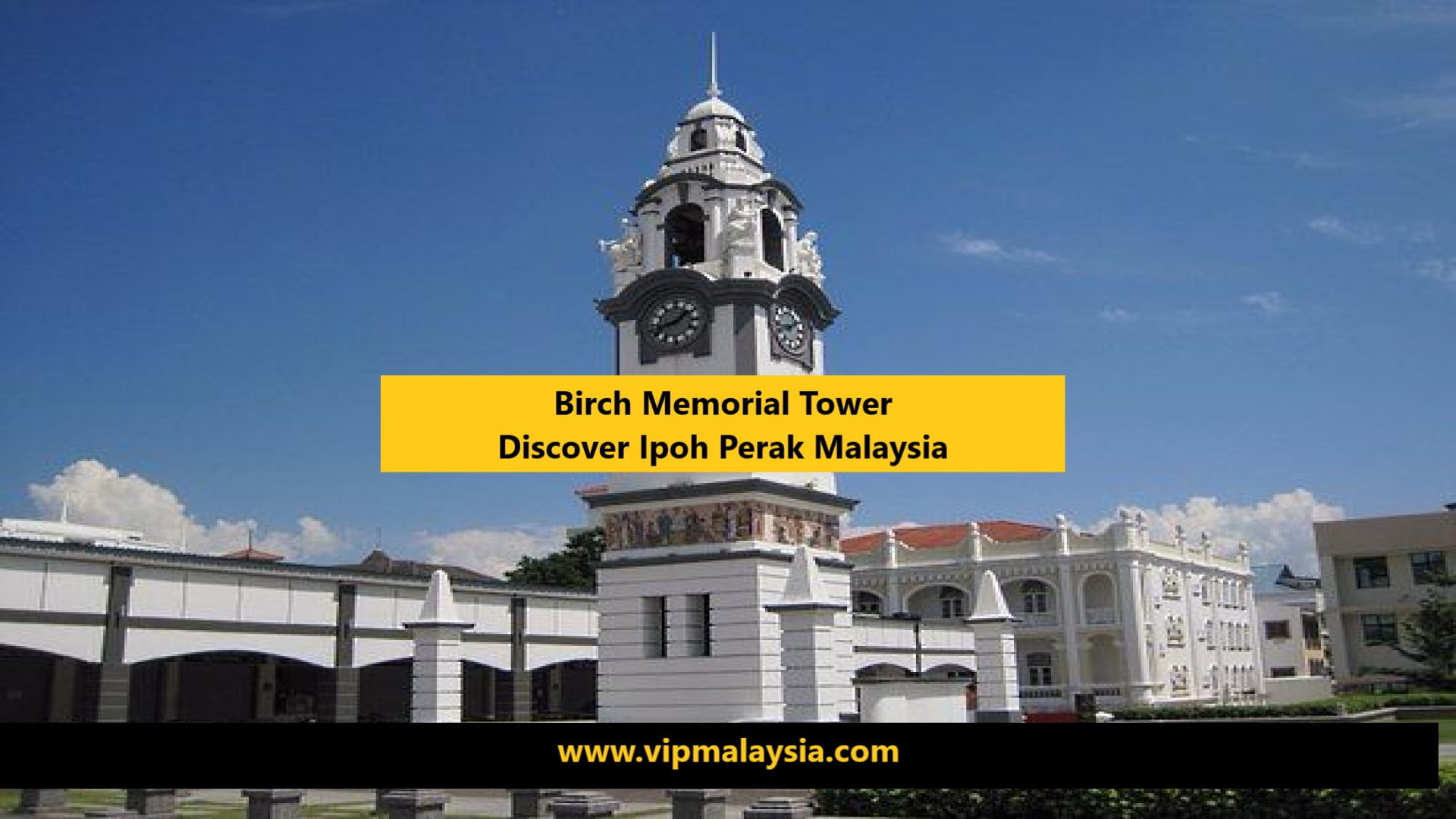
Birch Memorial Clock Tower, Perak
Built in 1909, Birch Memorial Clock Tower stands as a tribute to J.W.W. Birch, Perak’s first British Resident, who was assassinated in 1875. Located in Ipoh’s heritage district, this ornate clock tower features symbolic carvings, historical figures, and striking architecture, making it a must-visit colonial landmark in Malaysia. Explore its rich history, British governance tribute, and cultural significance.
Introduction
The Birch Memorial Clock Tower stands proudly in the heart of Ipoh’s heritage district, a monument that bridges Malaysia’s colonial past with its vibrant present. Built in 1909 to commemorate J.W.W. Birch, the first British Resident of Perak, the tower is more than just a timekeeper—it is a historical narrative carved in stone and adorned with symbolic figures. Visitors are drawn to its ornate design, its cultural significance, and its central location near other heritage gems. Whether you are a history enthusiast, architecture lover, or casual traveler, the Birch Memorial Clock Tower offers a fascinating glimpse into the legacy of British Malaya.
History
The Legacy of J.W.W. Birch
James Wheeler Woodford Birch was appointed as the first British Resident of Perak in 1874 following the Pangkor Treaty. His role was to advise the Sultan and oversee administrative reforms, but his disregard for local customs led to resistance. In 1875, Birch was assassinated in Pasir Salak by Malay chiefs led by Dato’ Maharajalela, sparking the Perak War. The British later consolidated control, and Birch was memorialized through this clock tower, unveiled in 1909 by his son, E.W. Birch.
James Wheeler Woodford Birch (J.W.W. Birch) was a British colonial administrator, born on 3 April 1826 in England. He served briefly in the Royal Navy before joining the Roads Department in Ceylon in 1846. His career advanced, and by 1870 he became Colonial Secretary of the Straits Settlements. Following the Pangkor Treaty of 1874, Birch was appointed the first British Resident of Perak on 4 November 1874. His tenure was marked by conflict with local chiefs due to his enforcement of British policies, taxation reforms, and opposition to slavery. On 2 November 1875, Birch was assassinated in Pasir Salak, Perak, by followers of Dato’ Maharajalela, an event that triggered the Perak War and strengthened British influence in Malaya. He died at age 49.
Pasir Salak is a historical riverside town and mukim located in the Perak Tengah District, Perak, Malaysia. It is situated along the Perak River, about 45 minutes from Ipoh. The town is most famous as the site where J.W.W. Birch, the first British Resident of Perak, was assassinated in 1875 by local Malay chiefs led by Dato’ Maharajalela, an event that sparked the Perak War. This uprising became a symbol of Malay resistance against colonial rule and is considered a precursor to later nationalist movements. Today, Pasir Salak is home to the Pasir Salak Historical Complex, which preserves monuments, dioramas, and memorials dedicated to the struggle, including the Birch assassination site, Kutai traditional houses, and galleries on Perak’s history.
Architectural Symbolism
The tower originally featured a bronze bust of Birch, later removed. Its design includes four statues representing Loyalty, Justice, Patience, and Fortitude, virtues associated with British governance. Four panels illustrate the progress of civilization, depicting figures from Moses and Confucius to Shakespeare and Darwin. The clock mechanism, supplied by Gillet and Johnson of Croydon, strikes chimes reminiscent of Big Ben.
- Name: Lela Pandak Lam, better known as Dato’ Maharajalela
- Birth/Origin: Descendant of Bugis nobility from Luwuk, Sulawesi; settled in Perak during the reign of Sultan Muzaffar Shah III
- Role: Tribal chief and one of the Orang Besar Berlapan (Eight Great Chiefs) of Perak; held authority in Pasir Salak
- Known For: Leading resistance against British colonial rule and orchestrating the assassination of J.W.W. Birch, the first British Resident of Perak, on 2 November 1875 at Pasir Salak
- Historical Context: His opposition stemmed from Birch’s disregard for Malay customs, taxation reforms, and abolition of slavery without compensation, which angered local chiefs
- Death: Executed by hanging on 20 January 1877 in Taiping after being convicted of Birch’s murder
- Legacy: Remembered as a Malay nationalist hero and symbol of resistance against colonialism; memorialized in places such as Jalan Maharajalela in Kuala Lumpur and KD Maharaja Lela naval vessel
Highlights
Striking Architecture
The tower’s square structure is decorated with murals and statues, blending Victorian design with colonial symbolism. Its whitewashed façade and dome make it a standout landmark in Ipoh’s old town.
Civilization Panels
Each of the four panels narrates stages of human progress—from the Stone Age to modern science. Visitors can admire depictions of Galileo, Michelangelo, Florence Nightingale, and Thomas Edison, among others.
The Four Panels (44 Historical Figures)
| Panel | Depictions of Human Progress |
|---|---|
| Panel A (North) | The Stone Age: hunter, fisherman, woman spinning. The Iron Age: man and woman. Early Eastern Peoples: Nubian with gold and ivory, Chaldean astrologer, woman making pottery, Egyptian, Assyrian, Persian. |
| Panel B (West) | Eastern Mediterranean: Moses, David, Phoenician, woman of Aegean civilization. Far East: Confucius, Buddha, Lao Tzu. Greece and Rome: Greek art, Alexander the Great, Plato, Augustus. |
| Panel C (South) | Byzantine Empire: Constantine the Great. Islam: Muhammad (removed in 1958). Age of Chivalry: Crusader. Age of Faith: Saint Clare of Assisi, Saint Thomas Aquinas. Renaissance: Galileo, Michelangelo, Vittoria Colonna, Columbus. Reformation: Martin Luther. Elizabethan Age: Shakespeare. |
| Panel D (East) | Modern Science, Art, and Social Services: Isaac Newton, William Harvey, James Watt, embroiderer, Beethoven, Robert Stephenson, Louis Daguerre, Florence Nightingale, Charles Darwin, Thomas Edison, Joseph Lister. |
Historic Clock Mechanism
The tower houses a mother bell and four smaller bells, once striking melodious chimes. Though time has weathered the mechanism, it remains a fascinating relic of early 20th-century engineering.
Nearby Attractions
Ipoh State Mosque
Adjacent to the tower, the mosque’s grand architecture offers a spiritual and cultural contrast to the colonial memorial.
- Address: Jalan Sultan Idris Shah, 30000 Ipoh, Perak, Malaysia
- Phone: +605-2557964 or +605-2548853
The Ipoh State Mosque, officially called Masjid Sultan Idris Shah II, is the main state mosque of Perak located in central Ipoh. Built between 1967 and 1968 and inaugurated in 1978, it is notable for its modern design featuring 66 domes, spacious prayer halls, and landscaped grounds. The mosque serves as both a religious center and a symbol of Malaysia’s post‑independence identity, making it one of Ipoh’s most prominent landmarks.
Ipoh Railway Station
Nicknamed the “Taj Mahal of Ipoh”, this station is a masterpiece of British colonial architecture and a favorite photography spot.
Ipoh Heritage Trail
The Birch Memorial Clock Tower is indeed one of the key stops along the Ipoh Heritage Trail, which guides visitors through colonial‑era landmarks such as the Ipoh Town Hall, old banks, and other historic buildings in the city’s heritage district. The trail was designed to showcase Ipoh’s architectural and cultural legacy, and the tower is highlighted as a central feature of this walking route.
The Ipoh Heritage Trail is a walking route in Ipoh, Perak, that connects 27 heritage landmarks from the Ipoh Railway Station to the Birch Memorial Clock Tower. Marked with yellow footprints and information boards, it guides visitors through colonial-era architecture, tin mining legacies, cultural streets, and historic institutions, offering a two-hour journey that can extend longer with stops at museums, cafes, and shops.
Ipoh Heritage Trail
Kinta Nature Park
While the tower itself is urban, nearby attractions like Kinta Nature Park offer birdwatching opportunities, with species such as herons, egrets, and kingfishers.
Address & Phone:
- Address: Kinta Nature Park, 31000 Batu Gajah, Perak, Malaysia
- Phone: Managed under Perak State Parks Corporation — +605-5253800
Kinta Nature Park in Batu Gajah, Perak, is a 900-hectare wetland reserve created from former tin-mining land. It offers free entry and is famous for birdwatching, with more than 150 species recorded. Visitors can enjoy observation towers, campsites, and scenic trails, making it a peaceful destination for nature enthusiasts.
Concubine Lane
A bustling street filled with food stalls, boutique shops, and murals, just a short walk from the tower.
Han Chin Pet Soo Museum
A museum dedicated to Ipoh’s tin mining history, offering insights into the Hakka community and colonial trade.
Local Food Scene
Ipoh is famous for dishes like Ipoh white coffee, bean sprout chicken, and curry noodles—perfect after a heritage walk.
Conclusion
Birch Memorial Clock Tower isn’t just a clock—it’s a historical tribute, offering deep insights into Perak’s colonial past, architectural excellence, and significant events in Malaysian history. Whether you’re exploring the tower’s carvings, learning about J.W.W. Birch, or capturing breathtaking photographs, this landmark promises an enriching experience.
Step into Perak’s history—plan your visit to Birch Memorial Clock Tower today!
Summary
- Attraction: Birch Memorial Clock Tower
- Location: #Perak
- Attraction Type: #HistoricalBuilding
- Source: tourismperakmalaysia.com, https://web.archive.org/
- Why Visit:
- Tribute to Perak’s colonial history – Honoring J.W.W. Birch and British administration in Malaya
- Stunning clock tower architecture – Showcasing statues and murals, historical panels, and intricate designs
- Central landmark in Ipoh’s heritage district – Located near Ipoh State Mosque and historical sites
- A symbol of British governance – Depicting four virtues: Loyalty, Justice, Patience, and Fortitude
Quick Info
| Attribute | Details |
|---|---|
| Name | Birch Memorial Clock Tower, Perak |
| Address | Jalan Dato Sagor, 31650 Ipoh, Perak, Malaysia |
| GPS Position | 4.5978° N, 101.0801° E |
| State | Perak |
| Year Built | 1909 |
| Architectural Style | Colonial British Architecture |
| Special Attractions | Clock Tower, Historical Carvings, Civilization Panels with 44 Historical Figures, British Administration Tribute |
| Nearby Attractions | Ipoh State Mosque, Ipoh Railway Station, Ipoh Heritage Trail |
| Accessibility | Located in Ipoh city center |
| Best Time to Visit | Morning or evening for best photography |
| Contact | +605-249 9966 (Tourism Perak) |
Visitor Reviews
Aaron Machler, Zurich, Switzerland – ★★★★★ “I was amazed by the intricate carvings and the historical panels. The tower is a perfect spot to start the Ipoh Heritage Trail. The nearby mosque and railway station make the area even more impressive.”
Bukhari Budin, Penang, Malaysia – ★★★★☆ “The clock tower is beautiful and full of history. I enjoyed learning about Birch and the colonial era. It can get hot during midday, so visiting in the morning is best.”
Theresa Dalot, Melbourne, Australia – ★★★★★ “Walking around the Birch Memorial Clock Tower felt like stepping back in time. The civilization panels are fascinating, and the nearby Concubine Lane adds a lively touch to the visit.”
Siti Rahman, Johor Bahru, Malaysia – ★★★★☆ “The tower is well-preserved and surrounded by heritage buildings. It’s a great place for photography and history lovers. I wish the clock chimes were still functioning.”