Taman Negara Malaysia
Discover Malaysia’s oldest and largest national park, Taman Negara Pahang. This 4,343-square-kilometer rainforest sanctuary offers breathtaking attractions, thrilling trekking trails, and unforgettable wildlife encounters. From canopy walkways to limestone caves, waterfalls, and cultural festivals, Taman Negara is a must-visit destination for nature lovers and adventure seekers.
Introduction
Gazette as a National Park since 1938, Taman Negara is Malaysia’s premier national park and the largest in the country. Spread over 4,343 square kilometers, this wild and virgin region is densely covered with ancient rainforest. Spanning the three states of Kelantan, Terengganu and Pahang, its protrusion into Pahang is the largest. Previously known as King George V National Park, this pristine sanctuary is meticulously conserved, offering visitors a chance to immerse themselves in untouched nature. With its canopy walkways, limestone caves, river rapids, and jungle trekking trails, Taman Negara is not just a park—it is an adventure into Malaysia’s natural heritage.
Kelantan is a state in northeastern Peninsular Malaysia, known for its capital Kota Bharu, its honorific title Darul Naim (“The Blissful Abode”), and its distinct culture shaped by rural traditions and historical influences. Capital city: Kota Bharu; royal seat at Kubang Kerian. Area: Approximately 14,970 sq km (5,780 sq mi). Population: Predominantly Malay (96.6% Bumiputera as of 2020), with small Chinese and other minorities. Languages: Malay (official), Kelantanese Malay (regional), plus minority languages such as Temiar, Jahai, Bateq, and Thai.
Wildlife Observation Hides
Specially constructed hides near salt licks allow visitors to observe nocturnal animals. The Tahan Hide, located just five minutes from the park headquarters, is the most popular. Visitors may spot deer, wild boar, and even elephants during nighttime observation.
Terengganu is one of the states of Malaysia, located on the northeastern coast of Peninsular Malaysia, with Kuala Terengganu as its capital. It is also known by its Arabic honorific Darul Iman (“Abode of Faith”) and is nicknamed the “Turtle State” due to its famous turtle nesting sites. Area: About 13,035 sq km. Population (2020): Approximately 1.2 million, with 97.6% Bumiputera (mostly Malay), plus Orang Asli, Chinese, and Indian minorities. Languages: Malay (official), Terengganu Malay dialect, Kelantan Malay, and minority languages such as Semaq Beri and Bateq.
Conservation Efforts
Strict conservation policies ensure the protection of these species. Educational programs and guided tours emphasize the importance of preserving biodiversity for future generations.
Pahang is the largest state in Peninsular Malaysia, located on the eastern coast, with Kuantan as its capital and Pekan as the royal seat. It is officially known as Darul Makmur (“Abode of Tranquility”). Area: About 36,053 sq km, making it the largest state in Peninsular Malaysia. Population (2020): Approximately 1.6 million, with 81% Bumiputera, 14.7% Chinese, and 3.7% Indian. Languages: Malay (official), with regional dialects such as Pahang Malay and Terengganu Malay, plus minority languages like Semai, Semelai, Temiar, and Jah Hut.
Highlights
Canopy Walkway Experience
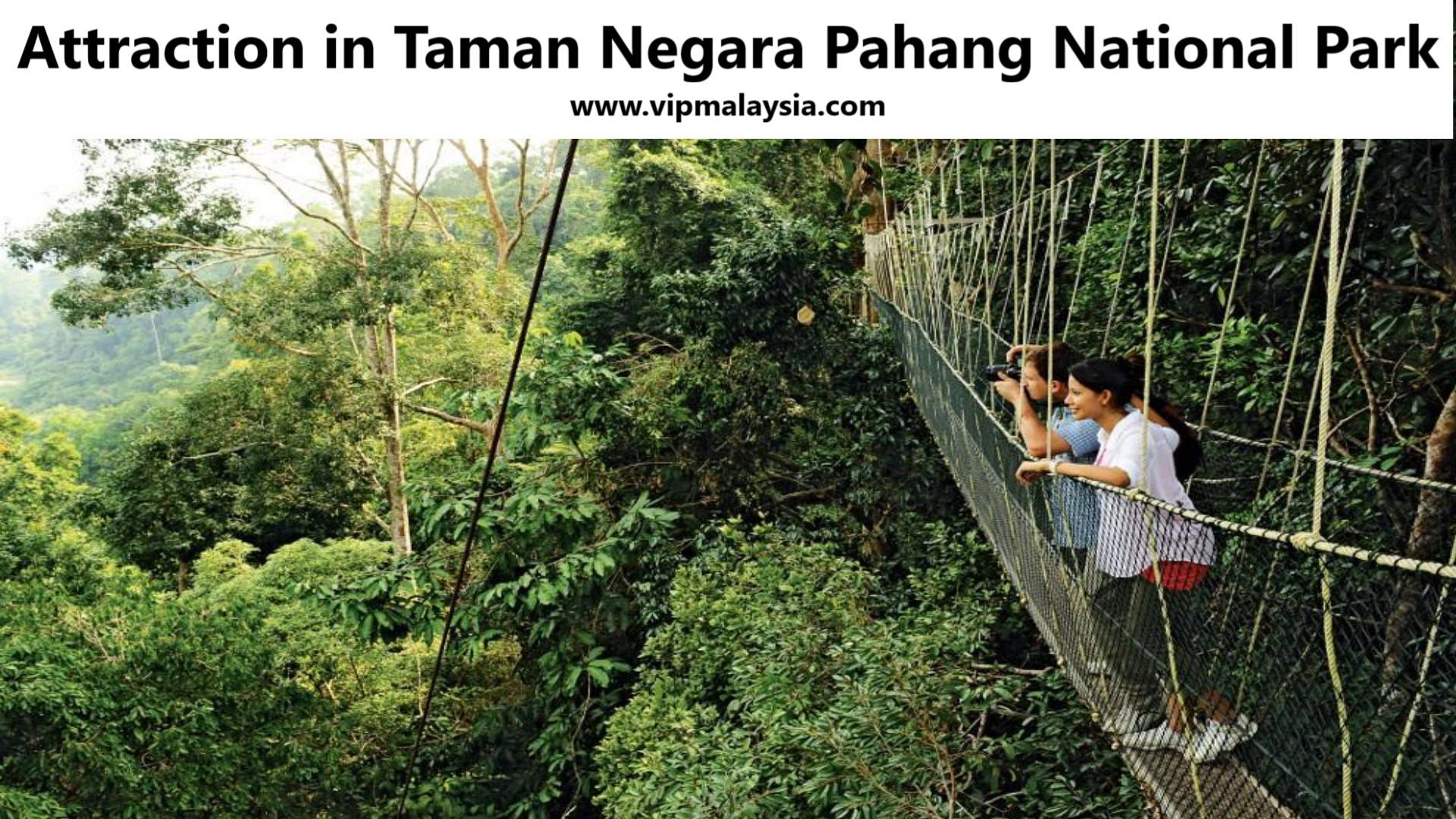
The Canopy Walkway is one of Taman Negara’s most iconic attractions. Suspended 40 meters above the forest floor and stretching 530 meters in length, it offers panoramic views of the rainforest canopy. Visitors can spot hornbills, monkeys, and even the elusive Malayan tapir from above. The walkway is accessible via a short 1.5 km trek from the park headquarters, accessible by a 20–45 minute trek or a short boat ride.
The Malayan tapir (Tapirus indicus) is the largest of all tapir species and the only one found in Asia. It is easily recognized by its distinctive black-and-white coloration and is currently listed as Endangered on the IUCN Red List due to habitat loss and declining populations. Size: Largest tapir species, weighing between 250–320 kg and measuring up to 2.5 meters in length. Coloration: Unique two-tone pattern — black head, shoulders, and legs, with a white midsection and rump. Young tapirs: Born with brown coats patterned with white stripes and spots.
Visitor Facilities
The walkway is well-maintained with safety ropes and nets, and guides are available to provide insights into the flora and fauna. Rest areas and observation points allow visitors to pause and enjoy the scenery. Photography enthusiasts will find this spot ideal for capturing the grandeur of the rainforest.
Key Features
- Supervision: Managed by the Department of Wildlife and National Parks (PERHILITAN) to ensure visitor safety.
- Capacity: Limited to around 4 people per section at a time, with rangers controlling flow.
PERHILITAN refers to the Department of Wildlife and National Parks Peninsular Malaysia (Jabatan Perlindungan Hidupan Liar dan Taman Negara), a government agency under the Ministry of Natural Resources and Environmental Sustainability. It is responsible for managing, conserving, and protecting wildlife and national parks in Peninsular Malaysia. Enforces laws against illegal hunting, trade, and poaching of endangered species such as the Malayan tiger and tapir. Issues permits for hunting, wildlife research, and eco-tourism activities. Runs awareness campaigns and initiatives like Save the Malayan Tiger.
The Malayan tiger (Panthera tigris jacksoni) is a subspecies of tiger native to Peninsular Malaysia, officially recognized as Malaysia’s national animal. It is classified as Critically Endangered (IUCN Red List) with fewer than 150 individuals estimated to remain in the wild. Known locally as harimau or pak belang, it appears on Malaysia’s coat of arms, currency, and sports emblems. Smaller than Bengal or Siberian tigers; males average 120 kg, females about 100 kg.
Limestone Caves Exploration
Taman Negara is home to several limestone caves that date back hundreds of millions of years. Popular caves include Gua Telinga, Gua Kepayang, Gua Daun Menari, and Gua Luas. These caves are rich in geological formations and provide habitats for bats and swiftlets.
Gua Telinga
Gua Telinga is a limestone cave located within Taman Negara National Park in Pahang, Malaysia, known for its narrow passages, unique rock formations, and rich biodiversity. The name Gua Telinga translates to “Ear Cave” in Malay, referring to its ear-shaped entrance.
Key Features
- Location: Situated near Kuala Tahan, inside Taman Negara, one of the world’s oldest rainforests.
- Structure: A limestone cave with narrow tunnels, chambers, and stalactite formations.
- Wildlife: Home to bats, insects, and small cave-dwelling creatures, making it a hotspot for ecological study.
- Adventure activity: Popular for “cave exploration” or spelunking, requiring visitors to crawl, climb, and squeeze through tight spaces.
Visitor Experience
- Guided tours: Entry is usually permitted only with park guides for safety.
- Difficulty: Moderate to challenging, as the cave involves crawling through confined spaces.
- Educational value: Offers insights into limestone geology, cave ecosystems, and rainforest biodiversity.
Gua Kepayang
Gua Kepayang is a limestone cave located within Taman Negara National Park in Pahang, Malaysia. It is known for its large chambers, unique rock formations, and as a popular stopover for jungle trekkers exploring the rainforest.
Key Features
- Location: Inside Taman Negara, one of the world’s oldest rainforests, accessible via jungle trekking routes.
- Structure: A spacious limestone cave with wide chambers, stalactites, and stalagmites.
- Wildlife: Often inhabited by bats, insects, and small cave fauna.
- Adventure activity: Serves as a resting point for trekkers, with some areas used for overnight camping.
Visitor Experience
- Guided tours: Typically visited as part of multi-day jungle trekking expeditions.
- Difficulty: Moderate, requiring trekking through dense rainforest before reaching the cave.
- Educational value: Offers insights into limestone geology and rainforest ecosystems.
Gua Daun Menari
Gua Daun Menari is a limestone cave trail within Taman Negara National Park in Jerantut, Pahang, Malaysia. It is part of a moderately challenging trekking route of about 10.3 km, taking roughly 3 hours to complete, and is popular for hiking, cave exploration, and observing rainforest biodiversity.
Key Features
- Location: Situated in Taman Negara, near Jerantut, Pahang.
- Trail length: Approximately 10.3 km out-and-back.
- Elevation gain: Around 330 meters.
- Duration: Average trekking time is 2 hours 57 minutes to 3.5 hours.
- Difficulty: Rated as moderate, suitable for hikers with some experience.
- Environment: Dense rainforest with rivers, caves, wildflowers, and wildlife along the route.
Visitor Experience
- Activities: Hiking, cave exploration, wildlife spotting, and enjoying panoramic rainforest views.
- Atmosphere: Less crowded compared to other trails, offering a more secluded experience.
- Wildlife: Potential sightings of bats, insects, and rainforest species.
- Safety: Recommended to trek with guides, especially for cave exploration.
Gua Luas
Gua Luas is a limestone cave within Taman Negara National Park in Pahang, Malaysia, recognized for its spacious chambers and striking rock formations. It is often used as a resting point during jungle trekking expeditions.
Lata Berkoh Waterfall
A 40-minute boat ride up the Tahan River leads to Lata Berkoh, a stunning waterfall surrounded by lush greenery. The deep pool beneath the falls is perfect for swimming in cool, refreshing waters.
Lata Berkoh Waterfall is a natural cascade located within Taman Negara National Park in Pahang, Malaysia. It is renowned for its clear waters, lush rainforest surroundings, and accessibility via boat rides along the Tembeling River.
Wildlife Encounters
The river journey itself is an adventure, with opportunities to spot kingfishers, monitor lizards, and macaques along the banks. The pristine environment makes Lata Berkoh a favorite among eco-tourists seeking tranquility.
Tembeling River Rapids
For thrill-seekers, the Tembeling River offers a nine-kilometer ride through seven rapids. The open boat journey is fast-paced and exhilarating, with splashes guaranteed. This activity is popular among adventure travelers looking for a mix of adrenaline and natural beauty.
The Tembeling River Rapids activity, also known as “rapid shooting,” is a popular adventure in Taman Negara, Pahang. Visitors ride longboats through fast-flowing sections of the river, experiencing splashes, thrills, and panoramic rainforest views. It is one of the most sought-after ecotourism activities in the park.
Key Features
- Location: Conducted along the Tembeling River, near Kuala Tahan in Taman Negara.
- Experience: Participants board traditional longboats, guided by skilled boatmen, and navigate through seven sets of rapids.
- Duration: The activity typically lasts 45 minutes to 1 hour, depending on river conditions.
- Thrill factor: Boats bounce and splash through waves, making it an exhilarating ride.
- Scenery: Dense rainforest, wildlife sightings, and riverside villages add cultural and ecological value.
- Life jackets are mandatory, and guides ensure safety throughout the ride. Visitors are advised to bring waterproof bags for belongings, as getting wet is part of the fun.
Attractions
Rare Bird Species
Taman Negara is home to over 300 bird species, including hornbills and pheasants, as well as mammals like the Malayan gaur and sun bear. The park’s biodiversity makes it a paradise for wildlife enthusiasts.
Great Argus (Argusianus argus)
The Great Argus is a magnificent pheasant renowned for its spectacular tail feathers, which can stretch over a meter long. This bird is often sought after by birdwatchers due to its elaborate courtship displays, where males spread their wings and tail to create a mesmerizing fan-like spectacle. Although it is large and striking, the Great Argus is shy and prefers dense forest habitats, making sightings rare and rewarding.
Its presence in Taman Negara highlights the park’s role as a sanctuary for unique avian species. The bird’s reliance on undisturbed rainforest underscores the importance of conservation efforts in Malaysia’s oldest national park. Observing the Great Argus in its natural environment is considered a highlight for serious birders visiting the region.
Malayan Peacock-Pheasant (Polyplectron malacense)
Endemic to Peninsular Malaysia, the Malayan Peacock-Pheasant is one of the most elusive birds in Taman Negara. Its iridescent plumage, adorned with eye-like spots, makes it a jewel of the rainforest. However, its secretive nature and preference for thick undergrowth mean that even experienced birdwatchers may struggle to catch a glimpse.
This species is critically important to Malaysia’s biodiversity, as it is found nowhere else in the world. Conservationists emphasize its vulnerability due to habitat loss, making Taman Negara a crucial refuge. Spotting this pheasant is considered a once-in-a-lifetime experience for ornithologists and eco-tourists alike.
Malayan Crested Fireback (Lophura rufa)
The Malayan Crested Fireback is a rare forest pheasant distinguished by its striking crest and shimmering plumage. It is most often observed in the Merapoh sector of Taman Negara, where dense forest provides the cover it prefers. Its vibrant colors and unique appearance make it a prized sighting among bird enthusiasts.
Despite its beauty, the species is seldom encountered due to its shy behavior and limited distribution. Conservationists monitor its population closely, as it is sensitive to habitat disturbance. Visitors fortunate enough to spot the Malayan Crested Fireback often describe it as one of the most memorable highlights of their trip.
Asian Emerald Dove (Chalcophaps indica)
The Asian Emerald Dove is a small but dazzling bird, known for its jewel-like green plumage that glistens in sunlight. Though widespread across Asia, sightings in Taman Negara are uncommon due to its preference for secluded forest paths and quiet feeding grounds. Its gentle cooing call adds to the serene atmosphere of the rainforest.
This dove plays an important ecological role as a seed disperser, helping maintain the forest’s biodiversity. Birdwatchers often describe the thrill of spotting its shimmering feathers amidst dense foliage as akin to discovering a hidden gem. Its rarity in the park makes every encounter special.
Violet Cuckoo (Chrysococcyx xanthorhynchus)
The Violet Cuckoo is a striking bird with vivid purple plumage that stands out against the green rainforest canopy. It is rarely seen in Taman Negara due to its preference for dense forest interiors, where it feeds on caterpillars and insects. Its melodious calls often reveal its presence before it is spotted.
This species is admired for its beauty and elusive nature, making it a prized addition to any birdwatching checklist. Conservationists note that its rarity highlights the delicate balance of rainforest ecosystems. Observing the Violet Cuckoo is considered a rewarding challenge for patient birders.
Square-tailed Drongo-Cuckoo (Surniculus lugubris)
The Square-tailed Drongo-Cuckoo is a rare parasitic cuckoo species that mimics drongos in appearance. It lays its eggs in the nests of other birds, relying on them to raise its young. This fascinating behavior makes it a subject of interest among ornithologists studying avian ecology.
In Taman Negara, sightings are scarce due to its secretive habits and preference for dense canopy layers. Its presence, however, adds to the park’s rich avian diversity. Birdwatchers who manage to identify this species often appreciate its unique ecological role within the rainforest.
Garnet Pitta (Erythropitta granatina)
The Garnet Pitta is a brilliantly colored bird, with deep red and black plumage that makes it one of the most visually stunning species in Taman Negara. Despite its vibrant appearance, it is extremely secretive and prefers the dim understory of the forest, making it difficult to spot.
Its rarity and beauty have earned it legendary status among birdwatchers. The Garnet Pitta’s presence in the park underscores the importance of preserving undisturbed rainforest habitats. For many visitors, catching even a fleeting glimpse of this elusive bird is the highlight of their birding adventure.
Rhinoceros Hornbill (Buceros rhinoceros)
The Rhinoceros Hornbill is one of Malaysia’s most iconic birds, recognized by its large casque resembling a rhinoceros horn. Though it is a symbol of strength and cultural heritage, sightings in Taman Negara are rare due to its preference for lowland rainforest.
This hornbill plays a vital role in seed dispersal, helping regenerate forest ecosystems. Its rarity in the park makes encounters particularly special, often leaving visitors in awe of its size and majesty. Conservation efforts are crucial to ensure this iconic species continues to thrive in Malaysia’s rainforests.
Helmeted Hornbill (Rhinoplax vigil)
The Helmeted Hornbill is critically endangered and known for its loud, resonant calls that echo through the forest. Its distinctive casque, made of solid keratin, has unfortunately made it a target for poaching. In Taman Negara, sightings are extremely rare but deeply significant.
This species is a flagship for conservation, symbolizing the urgent need to protect Malaysia’s rainforest biodiversity. Birdwatchers who hear its haunting calls often describe the experience as unforgettable. The Helmeted Hornbill’s survival depends on continued protection of pristine habitats like Taman Negara.
Black-and-Red Broadbill (Cymbirhynchus macrorhynchos)
The Black-and-Red Broadbill is a colorful bird found in riverine habitats within Taman Negara. Its striking plumage of crimson and black, combined with its large bill, makes it easily recognizable yet rarely seen. It prefers quiet riverbanks where it builds intricate nests suspended over water.
This species adds vibrancy to the park’s avian diversity, though its rarity makes sightings precious. Birdwatchers often describe the thrill of spotting the Black-and-Red Broadbill as a highlight of their journey. Its dependence on healthy river ecosystems underscores the importance of protecting Taman Negara’s waterways.
Orang Asli Villages
The indigenous Orang Asli communities live within Taman Negara, preserving traditional lifestyles. Visitors can learn about their hunting techniques, blowpipe demonstrations, and cultural practices.
The indigenous people of Taman Negara are the Orang Asli, specifically the Batek (sometimes spelled Bateq) tribe, who belong to the Negrito subgroup. They are traditionally nomadic hunter‑gatherers, living in small forest communities, and are recognized as one of the rarest and most distinct indigenous groups in Peninsular Malaysia.
Cultural Festivals
Occasional cultural events showcase traditional dances, music, and crafts. These experiences provide deeper insight into Malaysia’s indigenous heritage.
Kuala Tahan Gateway
Kuala Tahan is the main entry point to Taman Negara. This small town offers accommodations, restaurants, and visitor facilities. It serves as a hub for organizing guided tours and adventure activities.
Kuala Tahan Gateway is the main entry point into Taman Negara National Park, located in Jerantut District, Pahang, Malaysia. It serves as the hub for visitors, with facilities such as the Kuala Tahan jetty, car park (Medan Kereta), and nearby accommodations, making it the starting point for jungle treks, river activities, and cultural visits. : The jetty offers panoramic views of the Tembeling River and the lush rainforest across the water.
Flora and Fauna Diversity
Taman Negara’s rainforest is home to countless plant species, including giant hardwood trees, medicinal plants, and rare orchids. The park also shelters endangered animals such as the Malayan tiger, Asian elephant, and tapir.
Giant Hardwood Trees: Tualang Tree (Koompassia excelsa)
The Tualang Tree is one of the tallest tropical trees in the world, reaching heights of up to 85 meters (280 feet). Towering above the rainforest canopy, it provides nesting sites for giant honeybees that build massive honeycombs on its branches. Local communities often revere the tree, believing it houses spirits, which is why it is traditionally left untouched. Its sheer size and grandeur make it a symbol of the majesty of Malaysia’s ancient rainforest.
Ecologically, the Tualang Tree plays a vital role in stabilizing soil and supporting wildlife. Its expansive canopy contributes to the rainforest’s layered structure, offering shelter for birds, insects, and mammals. For visitors, standing beneath this towering giant is a humbling experience, and it remains one of the most photographed natural landmarks in Taman Negara.
Medicinal Plants
The Orang Asli, particularly the Batek tribe, rely heavily on rainforest plants for traditional medicine. Roots and leaves are brewed into herbal teas to treat fever and digestive issues, while bark extracts are applied to soothe skin conditions. Forest herbs are also used in poultices to relieve pain and inflammation, showcasing the deep connection between indigenous communities and their environment.
This knowledge is passed down orally through generations, forming an essential part of cultural heritage and survival skills. The use of medicinal plants highlights the rainforest’s role as a living pharmacy, where biodiversity directly supports human health. For visitors, learning about these practices offers insight into the sustainable relationship between people and nature in Taman Negara.
Rare Orchids
Taman Negara is home to a dazzling array of orchid species, many of which are rare and endemic. Among them are Paphiopedilum, or Lady’s Slipper orchids, prized for their unique pouch-like flowers. Other species such as Bulbophyllum display unusual forms adapted to rainforest conditions, while epiphytic orchids thrive on tree trunks and branches in the humid canopy layers.
Conservation is critical, as many orchids face threats from over-collection and habitat loss. Strict protection measures ensure these delicate plants continue to flourish in the park. For nature enthusiasts, spotting a rare orchid in bloom is a highlight of any visit, symbolizing the fragile beauty of Malaysia’s rainforest biodiversity.
Trekking and Adventure
Jungle Trekking Trails
Taman Negara boasts well-marked trails such as the Tahan Trail, Teranggan Trail, Neram Trail, and Bukit Teresek loop. Each trail offers unique experiences, from dense rainforest exploration to panoramic hilltop views.
Tahan Trail
The Tahan Trail refers to the trekking route leading to Gunung Tahan, the highest peak in Peninsular Malaysia (2,187 m), located within Taman Negara National Park. It is considered one of the most challenging treks in Southeast Asia, requiring endurance and several days to complete.
Key Facts
- Location: Runs through Taman Negara, spanning Pahang, Kelantan, and Terengganu.
- Destination: Leads to Gunung Tahan (Mount Tahan), the highest point in Peninsular Malaysia.
- Elevation: 2,187 m (7,175 ft) above sea level.
- Trail length: Approximately 55 km, depending on the chosen route.
- Duration: Typically 7 days for the full trek, though shorter routes exist.
- Difficulty: Rated as challenging, requiring stamina, jungle survival skills, and preparation.
Trail Routes
- Kuala Tahan Route: The longest and most demanding, usually taking 7–9 days.
- Merapoh Route: Shorter, often completed in 5–7 days.
- Combination Route: Some trekkers ascend via one route and descend via the other for a full experience.
Trekking Experience
- Terrain: Dense rainforest, rivers, steep ascents, and rugged mountain paths.
- Wildlife: Potential sightings of Malayan tapirs, birds, and other rainforest species.
- Guides and permits: Required for safety and conservation; managed by PERHILITAN.
- Preparation: Trekkers must be physically fit, carry camping gear, and be ready for unpredictable weather.
Challenges
- Physical endurance: The name “Tahan” means endure, reflecting the trek’s difficulty.
- Weather: Heavy rains can make trails slippery and rivers dangerous to cross.
- Logistics: Food, water purification, and camping equipment must be carried throughout.
Teranggan Trail
The Teranggan Trail (sometimes referred to as Sungai Terenggan Trail) is a jungle trekking route in Taman Negara National Park, Malaysia. It is a medium‑difficulty trail of about 8.5 km one way, taking roughly 4.5 hours to complete, and is popular because it passes the Canopy Walkway, Orang Asli village, and ends at the Teras Mini Waterfall.
Key Features
- Location: Inside Taman Negara, accessible from Kuala Tahan.
- Trail length: About 8.5 km one way.
- Duration: Approximately 4.5 hours to complete.
- Difficulty: Medium, suitable for beginners with moderate fitness.
- Highlights: Canopy Walkway, Orang Asli village, Teras Mini Waterfall, and river rapid shooting return trip.
Visitor Experience
- First 2 km: Easy walk on wooden boardwalks.
- Remaining 6.5 km: Real jungle trekking with uneven terrain, streams, and rainforest paths.
- Activities: Trekking, canopy walk, cultural visit to Orang Asli village, refreshing stop at Teras Mini Waterfall, and boat ride back with rapid shooting.
- Atmosphere: Dense rainforest, wildlife sightings, and cultural immersion.
Neram Trail
The Neram Trail is a jungle trekking route in Taman Negara National Park, Malaysia, leading to the Neram River and its waterfalls. It is considered a moderate trail, offering rainforest immersion, river crossings, and opportunities to observe diverse flora and fauna.
Key Features
- Location: Inside Taman Negara, accessible from Kuala Tahan.
- Trail length: Varies depending on route, typically 6–8 km one way.
- Duration: Around 3–4 hours to complete.
- Difficulty: Moderate, suitable for trekkers with some experience.
- Highlights: Neram River, waterfalls, lush rainforest, and wildlife sightings.
Visitor Experience
- Terrain: Mixture of boardwalks, jungle paths, and river crossings.
- Activities: Trekking, swimming at waterfalls, birdwatching, and photography.
- Atmosphere: Dense rainforest with sounds of wildlife and flowing rivers.
- Guided tours: Recommended for safety and navigation, as the trail can be slippery during rainy season.
Bukit Teresek Trail
Bukit Teresek Trail (also called Teresek Hill Trail) is a popular jungle trekking route in Taman Negara National Park, Pahang, Malaysia. It is a moderate hike of about 5.6 km with 290 m elevation gain, taking 2–2.5 hours, and rewards visitors with panoramic views of Gunung Tahan and the 130‑million‑year‑old rainforest.
This moderate trek leads to a viewpoint overlooking Mount Tahan and the Tahan River. The trail is popular for sunrise hikes, offering breathtaking vistas of mist-covered forests.
Key Features
- Location: Near Kuala Tahan, inside Taman Negara.
- Trail length: Approximately 5.6 km loop.
- Elevation gain: Around 290 m.
- Duration: 2–2.5 hours depending on pace.
- Difficulty: Moderate, suitable for families and beginners with reasonable fitness.
- Highlights: Canopy Walkway, suspension bridge crossing, summit views of Gunung Tahan and Gunung Perlis.
Visitor Experience
- Trail surface: Combination of jungle paths and wooden boardwalks.
- Wildlife sightings: Monkeys, birds, insects, and diverse rainforest flora.
- Atmosphere: Dense tropical rainforest with panoramic vistas at the summit.
- Accessibility: Close to Taman Negara headquarters, making it one of the most accessible treks.
- Popularity: Often included in day‑trip itineraries; considered a “must‑do” hike in Taman Negara.
Mount Tahan Expedition
Mount Tahan, standing at 2,187 meters, is the highest peak in Peninsular Malaysia. The expedition is challenging, requiring 7–9 days of trekking, but rewards climbers with spectacular views and a sense of achievement. Trekkers encounter diverse ecosystems, from lowland rainforest to montane forest. Wildlife sightings include rare species such as the Malayan tiger, clouded leopard, and exotic orchids.
The Tahan River (Malay: Sungai Tahan) is one of the main rivers flowing through Taman Negara National Park in Pahang, Malaysia. It is a tributary of the Tembeling River, originating from the Four Steps Waterfall deep in the rainforest, and is a popular destination for trekking and rapid shooting activities.
Key Features
- Location: Flows through Taman Negara, Jerantut District, Pahang.
- Tributary: One of the main tributaries of the Tembeling River, forming its headwaters together with the Teku River.
- Source: Originates from the Four Steps Waterfall, a remote four‑tiered waterfall about 150 m high, reachable only after 8–9 days of trekking with licensed guides.
- Length: Approximately 135 km, flowing into the Tembeling River.
- Elevation: Source located at 1,840–1,850 m above sea level.
Visitor Experience
- Trekking: Accessed via trails beginning at Kuala Tahan village, often part of expeditions to Gunung Tahan.
- Rapid shooting: The river is known for its strong currents, making it a site for adventurous boat rides.
- Camping: Teku Camp, located at the confluence of the Tahan and Teku Rivers, is a designated campsite for trekkers.
- Cultural significance: The river and its source waterfall are considered sacred among the Orang Asli communities living in Taman Negara.
Teku Camp (Camp Teku) is a designated riverside campsite inside Taman Negara National Park, Pahang, Malaysia. It lies beside the crystal‑clear Teku River and serves as a resting point for trekkers heading towards Gunung Tahan, offering a wilderness camping experience in the rainforest.
The Teku River (Malay: Sungai Teku) is a clear tributary stream flowing through Taman Negara National Park in Pahang, Malaysia. It is known for its pristine waters, nearby waterfalls, and riverside campsite (Teku Camp), making it a popular stop for trekkers heading toward Gunung Tahan. Elevation: Around 211 m above sea level at mapped points. Waterfalls: Teku Waterfalls are a scenic attraction along the river, offering picnic spots and wildlife viewing.
Conclusion
Taman Negara Pahang is more than just a national park—it is a living museum of Malaysia’s natural and cultural heritage. From canopy walkways and limestone caves to river rapids and mountain expeditions, the park offers diverse experiences for every traveler. Its rich biodiversity, indigenous culture, and adventure opportunities make it a must-visit destination. Whether you seek relaxation by waterfalls or adrenaline-pumping treks, Taman Negara promises an unforgettable journey into the heart of Malaysia’s rainforest.
Summary
- Attraction: Attractions in Taman Negara Pahang National Park
- Location: Pahang Malaysia
- Attraction Type: Forest in Malaysia
- Source: pahangtourism.org.my
- Category: #TamanNegara #Pahang #Attraction
Contact Information
Mutiara Taman Negara Kuala Tahan Pahang
Kuala Tahan, 27000, Jerantut, Pahang, Malaysia
Telephone: +609 266 3500
Visitor Reviews
James Tan, Singapore – ★★★★★ “Taman Negara is a paradise for nature lovers. The canopy walkway was breathtaking, and the wildlife sightings were unforgettable. The facilities were well-maintained, and the guides were knowledgeable.”
Nina Ahmad, Malaysia – ★★★★☆ “The jungle trekking trails were challenging but rewarding. I especially enjoyed Bukit Teresek for its panoramic views. The only downside was the humidity, but that’s part of the rainforest experience.”
Kandasamy, India – ★★★★★ “Mount Tahan expedition was the highlight of my trip. It was tough, but the sense of achievement was incredible. The guides ensured safety, and the views from the summit were spectacular.”
Sebastian Gullery, Germany – ★★★★☆ “Lata Berkoh waterfall was stunning. The boat ride was scenic, and swimming in the cool waters was refreshing. I wish there were more food options nearby, but overall, it was a fantastic experience.”
David Johnson, Australia – ★★★★★ “The Orang Asli village visit was eye-opening. Learning about their traditions and blowpipe hunting was fascinating. Taman Negara is truly a blend of adventure and culture.”
Getting to Taman Negara – World’s Oldest Jungle – Feeling MAGIC in National Park! This is our Visual Journey and story about our trip to one of the world’s oldest jungles. It is located in Malaysia, only about 240 km from Kuala Lumpur. This is truly a place full of magic! Visuals by Miz youtube.com
What to do in Malaysia National Park rainforest – Excursion from Mutiara Taman Negara: After a first amazing night in our tiny home in the rainforest of Malaysia National Park, the Mutiara Taman Negara Resort, it was time to explore this beautiful national park. We booked an excursion at the reception of our hotel and did a half day tour. It took us to the largest tree in the rainforest, to a fish sanctuary and we also hiked and swim in a beautiful waterfall. Nature in Malaysia is wonderful. If you want to know what an excursion in National Park Rainforest looks like, this is the video to watch! Eileens Wanderlust youtube.com
Frequently Asked Questions (FAQs)
What are the boat fares in Taman Negara Malaysia?
You need to pay for boat fares:
- Lata Berkoh – RM160.00 (4-seater)
- Kuala Trenggan – RM120.00 (4-seater), RM200.00 (12-seater)
- Kuala Keniyam – RM300.00 (4-seater), RM400.00 (12-seater)
- Telinga Cave – RM60.00 (4-seater), RM80.00 (12-seater)
- Fishing 3D/2N – RM1,500.00 (12-seater)
Boat service between Kuala Tembeling – Kuala Tahan – Kuala Tembeling depart at 9.00 am. & 2.00 pm. daily. The boat fare is RM60.00 per person one way. Advance booking should be made to Mutiara Taman Negara Tel: 609-266 3500.
- Guide Fee: (max.12 pax)
- One (1) Day – RM250.00
- Half a Day – RM150.00
- Gunong Tahan – RM1,200.00 (7 days) , RM150.00 (each additional day)
What are entry fees to Taman Negara Malaysia?
Permits and licenses are mandatory requirements prior to going into Taman Negara. You may apply for one at any Department of Wildlife’s counters located at the Kuala Tembeling jetty or Kuala Tahan:
- Entry permit – RM 1 per person
- Fishing licenses – RM 10 per rod
- Camera license – RM 5 per unit
- Camping fee – RM 2 per person
- Canopy Walk – RM 5 per person
- Hide – RM 5 per person/night
What are the must visit places and activities in Taman Negara?
You must visit Kuala Tahan because it is where the Taman Negara Headquarters is located. Activities such as canopy walkway, Bukit Teresek, Kuala Terenggan, Kuala Keniyam, Telinga Cave.
What else you can do at Taman Negara Malaysia?
These are activities you can do at Taman Negara:
- Camping
- Jungle Trekking
- NIght walk & night safari
- bird watching
- white water rafting
- The batek: native of the jungle)
- Lata Berkoh & Kelah Sanctuary
- Climbing at Gunung Tahan 2,187 meters