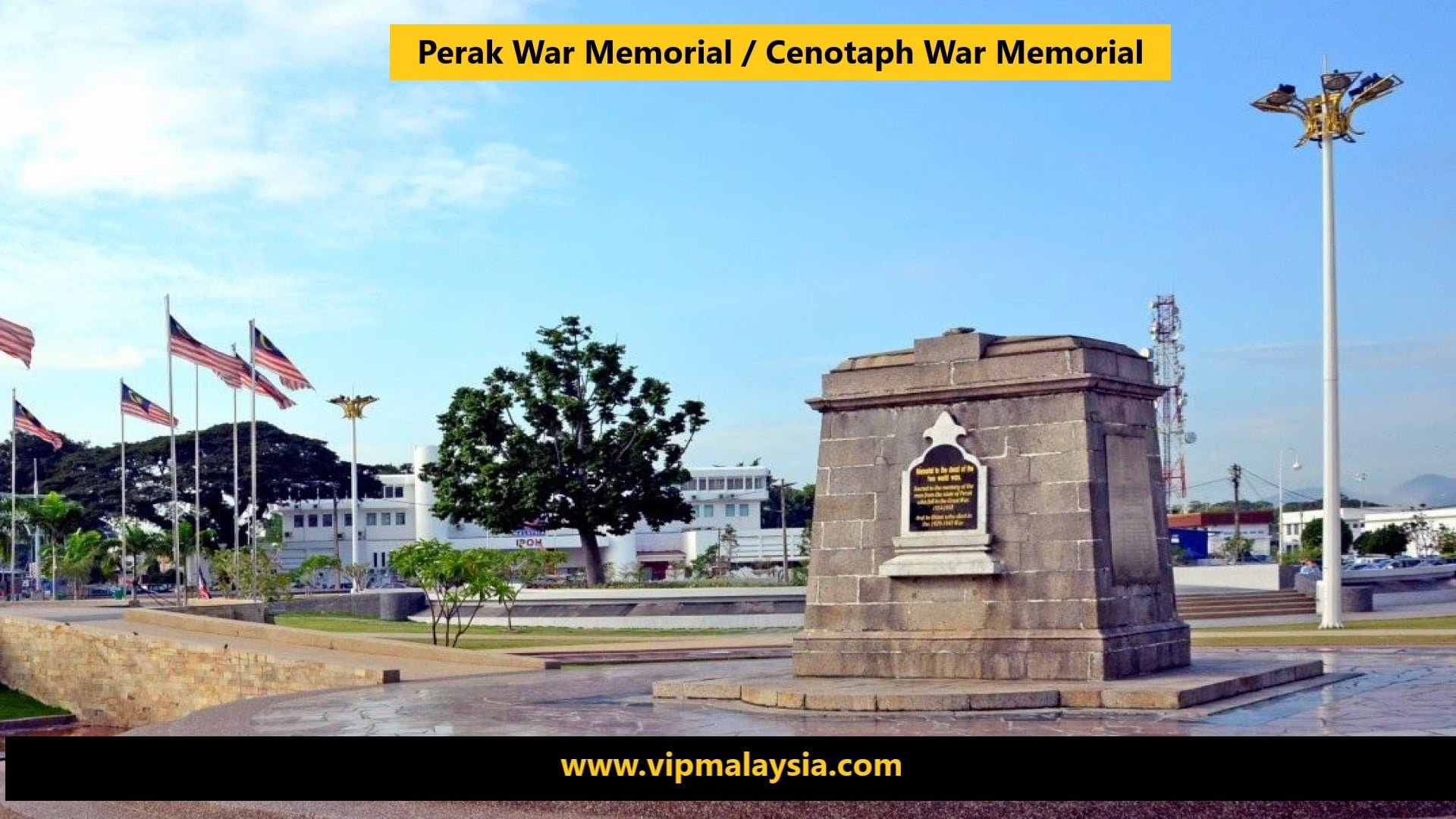
Ipoh War Memorial
The Ipoh War Memorial in Perak stands as a solemn cenotaph commemorating soldiers who gave their lives in World War I and World War II. Located at Ipoh Station Square beside the iconic Ipoh Railway Station, this historic landmark is both a site of remembrance and a cultural attraction for visitors exploring Malaysia’s heritage.
Introduction
The Ipoh War Memorial is one of Malaysia’s most poignant monuments, built to honor the sacrifices of Perak’s servicemen during the global conflicts of the 20th century. Standing proudly outside the Ipoh Railway Station, often called the “Taj Mahal of Ipoh,” the memorial is a place where history, architecture, and collective memory converge. Visitors are drawn not only to its solemn beauty but also to the surrounding colonial landmarks, cultural festivals, and vibrant city life that make Ipoh a fascinating destination.
History
The memorial was unveiled in 1927 as the Perak War Memorial, dedicated initially to those who perished in World War I. After World War II, additional inscriptions were added to commemorate the fallen of that conflict. Over the decades, the cenotaph has become a focal point for remembrance ceremonies, attracting veterans, diplomats, and civilians alike. Its location at Ipoh Station Square was chosen deliberately, symbolizing accessibility and visibility for all who pass through the city.
Comparison Between World War I and World War II
| World War I | World War II |
|---|---|
| Fought from 1914–1918 | Fought from 1939–1945 |
| Triggered by the assassination of Archduke Franz Ferdinand of Austria-Hungary | Triggered by Germany’s invasion of Poland in 1939 |
| Major powers: Allied (UK, France, Russia, later USA) vs. Central (Germany, Austria-Hungary, Ottoman Empire) | Major powers: Allies (UK, USA, USSR, China, France) vs. Axis (Germany, Italy, Japan) |
| Primarily fought in Europe, with battles in Africa and the Middle East | Fought across Europe, Asia, Africa, and the Pacific, truly global |
| Warfare style: trench warfare, chemical weapons, static fronts | Warfare style: blitzkrieg tactics, mechanized armies, aerial bombing, nuclear weapons |
| Casualties: ~20 million deaths (military + civilian) | Casualties: ~70–85 million deaths, including the Holocaust |
| Ended with the Treaty of Versailles (1919) | Ended with the surrender of Germany (May 1945) and Japan (September 1945) |
| Legacy: reshaped Europe, collapse of empires (Austro-Hungarian, Ottoman, German, Russian) | Legacy: creation of the United Nations, Cold War rivalry, decolonization |
Highlights
Architectural Design
The cenotaph is built in classical style, with clean lines and engraved plaques listing the names of fallen servicemen. Its solemn simplicity reflects the dignity of sacrifice. The backdrop of the grand Ipoh Railway Station enhances its visual impact, making it one of the most photographed landmarks in the city.
Annual Ceremonies
Every year, wreath‑laying ceremonies are held at the memorial, attended by Malaysian armed forces, foreign missions, and community groups. These events reinforce the memorial’s role as a living site of remembrance rather than a static monument.
Symbol of Unity
The memorial is more than stone and inscriptions—it is a symbol of unity across generations. Schoolchildren, veterans, and dignitaries gather here, bridging past and present in shared respect for those who served.
Memorial Plaques
The engraved plaques listing names of fallen soldiers are the heart of the memorial. Visitors often pause here to reflect on the personal sacrifices behind the global conflicts.
Remembrance Week
Although not always fixed to June, annual remembrance ceremonies are held, drawing participants from Malaysia, Australia, and the UK. These events highlight the international significance of the memorial.
Colonial Backdrop
The juxtaposition of the cenotaph with the railway station creates a powerful visual narrative of Malaysia’s wartime and colonial history. It is a must‑see for photographers and history enthusiasts.
Nearby Attractions
Ipoh Railway Station
Known as the “Taj Mahal of Ipoh,” this colonial‑era station is a masterpiece of Edwardian architecture. Its white domes and arches provide a stunning backdrop to the memorial, making the area a hub for heritage tourism.
Ipoh Heritage Trail
Visitors can follow the heritage trail to explore colonial buildings, old shophouses, and cultural landmarks. The trail connects the memorial to other sites, offering a deeper understanding of Ipoh’s historical significance.
Birch Memorial Clock Tower
Located nearby, this clock tower commemorates James W.W. Birch, Perak’s first British Resident. It is adorned with panels depicting historical figures and serves as another reminder of Malaysia’s colonial past.
Conclusion
The Ipoh War Memorial is not only a cenotaph but a timeless landmark that embodies Malaysia’s resilience, sacrifice, and unity. Located at Ipoh Station Square beside the iconic Ipoh Railway Station, it continues to serve as a gathering place for remembrance ceremonies, cultural events, and heritage exploration. Visitors are drawn to its solemn plaques, annual tributes, and the powerful colonial backdrop that tells the story of Perak’s wartime contributions.
For travelers, the memorial offers more than history—it connects seamlessly with Ipoh’s vibrant attractions, trekking adventures, and cultural festivals, making it a must‑visit destination in Malaysia. Whether you come to honor fallen heroes, explore the city’s architectural gems, or immerse yourself in local traditions, the Ipoh War Memorial stands as a living testament to courage and unity that continues to inspire generations.
Summary
- Attraction: #IpohWarMemorial
- Location: #Perak
- Attraction Type: #Landmark
- Source: tourismperakmalaysia.com
- Why Visit:
- Tribute to fallen soldiers – Honoring Perak’s heroes from WWI & WWII
- Central Remembrance Week ceremonies – A historical site for annual commemorations
- Historic location – Situated next to Ipoh Railway Station, a colonial-era landmark
- Symbol of unity & sacrifice – A powerful reminder of Malaysia’s wartime contributions
Quick Info
| Attribute | Details |
|---|---|
| Name | Ipoh Cenotaph (also known as Ipoh War Memorial, historically Perak War Memorial) |
| Address | Station Square, in front of Ipoh Railway Station, 30100 Ipoh, Perak, Malaysia |
| GPS Position | 4.5976° N, 101.0743° E (approximate verified coordinates) |
| State | Perak |
| Year Established | 1927 (dedicated to WWI fallen; later extended for WWII and subsequent conflicts) |
| Facility Type | War Memorial & Historical Landmark |
| Special Attractions | Cenotaph monument, engraved plaques with names, annual wreath‑laying ceremonies |
| Nearby Attractions | Ipoh Railway Station, Ipoh Heritage Trail, Birch Memorial Clock Tower |
| Accessibility | Centrally located in Ipoh city, easily accessible by road and public transport |
| Best Time to Visit | During annual remembrance ceremonies (dates vary, often around November for Armistice/Remembrance Day) |
| Contact | Tourism Perak Malaysia: +605‑249 9966 |
Visitor Reviews
Suria Zainuddin, Kuala Lumpur ⭐⭐⭐⭐⭐ “The Ipoh War Memorial moved me deeply. Standing in front of the plaques, I felt a strong connection to the past. The railway station backdrop makes it even more special. A must‑visit for anyone interested in history.”
Jamie Young, Sydney, Australia ⭐⭐⭐⭐⭐ “As an Australian, it was meaningful to see how Malaysia honors its fallen soldiers alongside Commonwealth allies. The ceremony was dignified, and the atmosphere was solemn yet welcoming.”
Nurul Huda, Penang ⭐⭐⭐⭐⭐ “I visited during a school trip, and it was eye‑opening. The memorial is beautifully maintained, and the nearby heritage trail made the experience even richer. Highly recommended for families and students.”
Raj Dam Singh, Mumbai, India ⭐⭐⭐⭐ “The memorial is impressive, though I wish there were more information boards explaining the history. Still, the location next to the railway station makes it easy to access and photograph.”
Sarah Williams, London, UK ⭐⭐⭐⭐⭐ “Attending the wreath‑laying ceremony was unforgettable. The sense of unity among people from different countries was inspiring. Ipoh itself is a charming city with so much to explore.”