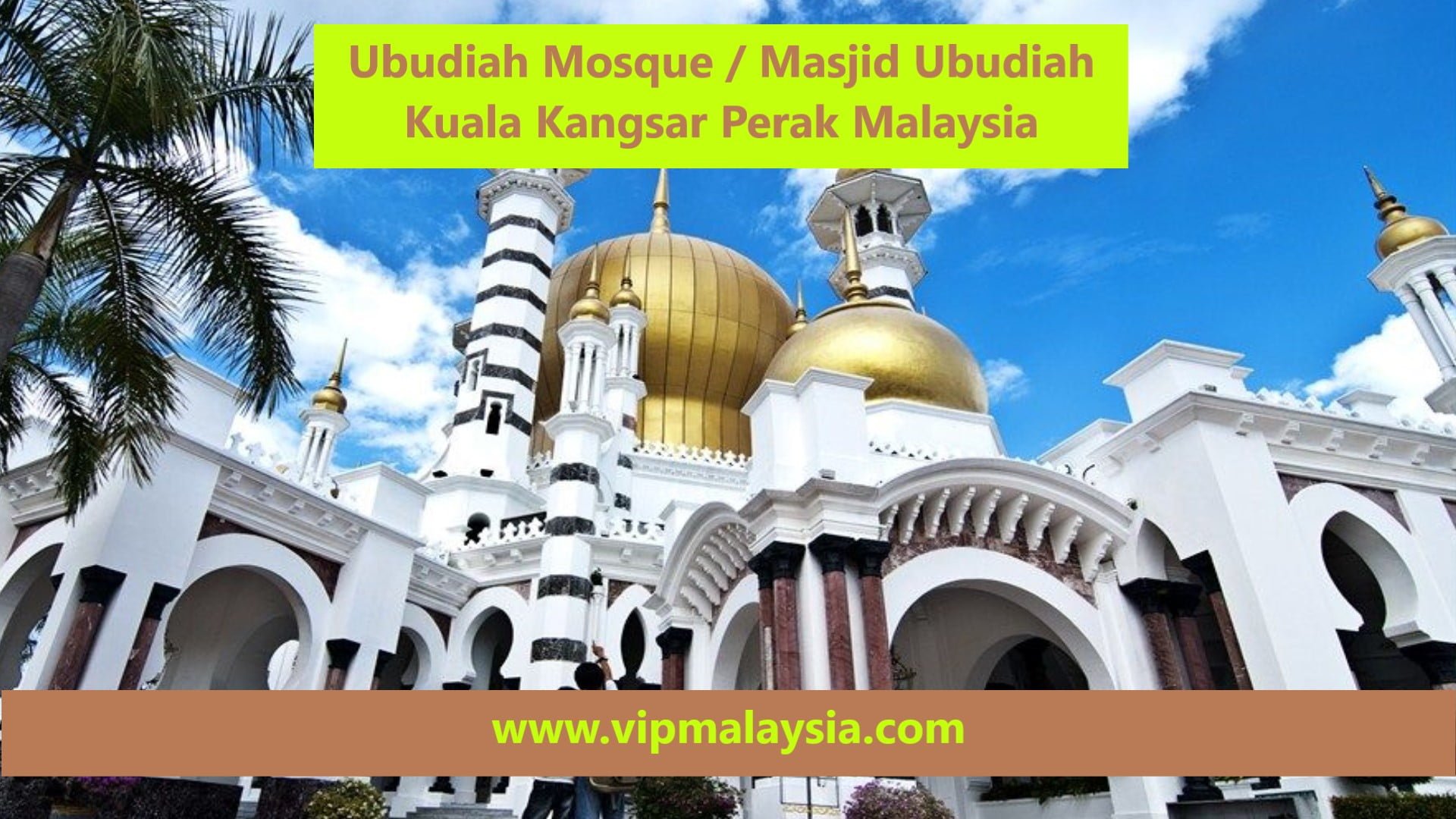
Masjid Ubudiah, Perak
Masjid Ubudiah in Kuala Kangsar, Perak, shines as one of Malaysia’s most stunning mosques, blending royal heritage, Moorish-inspired architecture, and golden domes that captivate visitors worldwide. Discover its history, highlights, nearby attractions, and adventurous experiences in this ultimate travel guide.
Introduction
Masjid Ubudiah, located in the royal town of Kuala Kangsar, Perak, is often hailed as Malaysia’s most beautiful mosque. With its gleaming golden dome, four towering minarets, and Indo-Saracenic Revival design, it stands as a symbol of grandeur and faith. Commissioned in 1913 by Sultan Idris Murshidul Adzam Shah I as an act of gratitude for his recovery from illness, the mosque remains a treasured landmark of Perak’s royal heritage. Visitors are drawn not only to its architectural brilliance but also to its serene atmosphere, cultural significance, and proximity to other royal attractions.
Sultan Idris Murshidul Adzam Shah I (1849–1916) was the 28th Sultan of Perak, reigning from 1887 until his death in 1916. Born on 19 June 1849 in Kuala Keboi, Kampar, Perak, he was the son of Raja Bendahara Alang Iskandar. His reign marked a significant period in Perak’s history, as the state became part of the Federated Malay States under British administration in 1895. Sultan Idris was known for his progressive vision, supporting education, infrastructure, and Malay political development. He inaugurated the Victoria Bridge in Karai in 1900, one of Malaysia’s oldest railway bridges, and played a role in shaping Perak’s modern identity. He passed away on 14 January 1916 at Istana Negara, Bukit Chandan, Kuala Kangsar, and was buried at the Al-Ghufran Royal Mausoleum nearby.
History
The mosque’s construction began in 1913 under the design of Arthur Benison Hubback, the British architect behind Kuala Lumpur and Ipoh railway stations. Its completion in 1917 was delayed by two unusual events: the outbreak of World War I and a famous incident where elephants belonging to the Sultan and Raja Chulan damaged imported Italian marble. Despite these setbacks, the mosque was officially opened in 1917 by Sultan Abdul Jalil Nasaruddin Shah, successor to Sultan Idris. Costing RM200,000—a significant sum at the time—the mosque quickly became a symbol of pride for Perak.
Arthur Benison Hubback (1871–1948) was a British architect and army officer best known for his contributions to colonial architecture in Malaya. Born on 13 April 1871 in Liverpool, England, he trained in architecture before arriving in Malaya in 1895. By 1900, he was appointed Chief Government Architect of the Federated Malay States, designing over 25 landmark buildings. His works include the Kuala Lumpur Railway Station, Masjid Jamek, Masjid Ubudiah in Kuala Kangsar, Ipoh Railway Station, and the National Textile Museum. Hubback’s style combined Indo-Saracenic Revival and European “Wrenaissance” influences, leaving a lasting impact on Malaysia’s architectural heritage.
Arthur Benison Hubback’s major works in Malaysia
| Year | Work / Building | Location & Style |
|---|---|---|
| 1907 | Masjid Jamek | Kuala Lumpur — Indo-Saracenic Revival style with Mughal domes and arches |
| 1910 | Kuala Lumpur Railway Station | Kuala Lumpur — Indo-Saracenic Revival with Moorish and Mughal influences |
| 1913–1917 | Masjid Ubudiah | Kuala Kangsar, Perak — Royal mosque with golden dome, Indo-Saracenic Revival |
| 1914 | Ipoh Railway Station | Ipoh, Perak — Neo-classical with Indo-Saracenic elements |
| 1914 | Panggung Bandaraya DBKL | Kuala Lumpur — Neo-Moorish style |
| 1915 | National Textile Museum (formerly FMS Railway Headquarters) | Kuala Lumpur — Indo-Saracenic Revival |
| 1915 | Carcosa Seri Negara (extension works) | Kuala Lumpur — Colonial European with Saracenic touches |
| 1916 | Old Kuala Lumpur High Court Building | Kuala Lumpur — Indo-Saracenic Revival |
| 1917 | Masjid Ubudiah completion | Kuala Kangsar, Perak — Symbol of Perak’s royal heritage |
| 1910s | Kowloon-Canton Railway Terminus | Hong Kong — Indo-Saracenic Revival |
Malaysia’s Most Beautiful Mosques
| Mosque | Attraction | Address & Phone |
|---|---|---|
| Sultan Salahuddin Abdul Aziz Shah Mosque (Blue Mosque) | Largest mosque in Malaysia, iconic blue dome | Persiaran Masjid, Seksyen 14, 40000 Shah Alam, Selangor — +60 3-5519 9988 |
| Putra Mosque (Pink Mosque) | Stunning pink granite mosque by Putrajaya Lake | Persiaran Persekutuan, Presint 1, 62502 Putrajaya — +60 3-8888 5678 |
| Masjid Negara (National Mosque) | National symbol with modern Islamic design | Jalan Perdana, Tasik Perdana, 50480 Kuala Lumpur — +60 3-2693 7905 |
| Crystal Mosque | Unique glass and steel mosque in Terengganu | Pulau Wan Man, Islamic Heritage Park, 21000 Kuala Terengganu, Terengganu — +60 9-622 1600 |
| Masjid Zahir | Historic mosque, one of the oldest in Malaysia | Jalan Tunku Ibrahim, Bandar Alor Setar, 05000 Kedah — +60 4-733 5678 |
| Masjid Ubudiah | Royal mosque with golden dome in Kuala Kangsar | Bukit Chandan, 33000 Kuala Kangsar, Perak — +60 5-776 4256 |
| Tuanku Mizan Zainal Abidin Mosque (Iron Mosque) | Modern mosque built with steel, overlooking Putrajaya Lake | Jalan Tuanku Abdul Rahman, Presint 3, 62502 Putrajaya — +60 3-8881 6800 |
| Federal Territory Mosque | Ottoman-inspired mosque in Kuala Lumpur | Jalan Tuanku Abdul Halim, Kompleks Kerajaan, 50480 Kuala Lumpur — +60 3-6201 8798 |
| Kota Kinabalu City Mosque | Floating mosque on Likas Bay | Jalan Pasir, Kampung Likas, 88400 Kota Kinabalu, Sabah — +60 88-246 000 |
| Masjid Jamek Sultan Abdul Samad | Historic mosque at the confluence of rivers | Jalan Tun Perak, City Centre, 50050 Kuala Lumpur — +60 3-2691 2829 |
Cultural Festivals
Visitors during Islamic festivals such as Eid al-Fitr or Eid al-Adha witness the mosque at its most vibrant, with thousands gathering for prayers. The atmosphere is deeply spiritual and culturally enriching.
Photography Opportunities
The mosque’s golden dome glows spectacularly at sunrise and sunset. Morning light offers the best angles, while evening captures highlight its silhouette against the sky.
Visitor Facilities
Masjid Ubudiah welcomes non-Muslim visitors outside prayer times, provided modest dress codes are observed. Scarves are available for women, and donations are encouraged. Facilities include prayer halls, ablution areas, and landscaped gardens.
Highlights
Architectural Grandeur
The mosque’s Indo-Saracenic Revival style blends Moorish, Mughal, and Islamic influences. Its central golden dome, flanked by four minarets and smaller domed turrets, creates a striking skyline visible from afar. Italian marble adds elegance to the white façade, with darker bands enhancing its symmetry.
Moorish Influence
Moorish architecture developed in the western Islamic world, particularly in Spain (Al-Andalus) and North Africa. It is characterized by horseshoe arches, intricate geometric tilework, courtyards, and ornate arabesque decoration. Famous examples include the Alhambra in Granada and the Great Mosque of Córdoba. These features contributed to the decorative richness and spatial harmony seen in Indo-Saracenic Revival buildings.
Mughal Influence
Mughal architecture flourished in India between the 16th and 18th centuries under emperors like Akbar and Shah Jahan. It is known for grand domes, slender minarets, symmetrical layouts, and elaborate ornamentation. Iconic monuments such as the Taj Mahal and Agra Fort showcase its blend of Persian, Islamic, and Indian traditions. This influence brought monumental scale and refined detailing into Indo-Saracenic Revival works.
Islamic Influence
Islamic architecture, spanning from the 7th century onward, emphasizes mosques, domes, minarets, courtyards, and decorative calligraphy. It integrates geometric patterns and arabesques while avoiding figurative imagery, focusing instead on spiritual symbolism. Structures like the Dome of the Rock in Jerusalem and the Great Mosque of Damascus exemplify its core principles. This broad tradition provided the foundational elements of faith and design that Indo-Saracenic Revival architects adapted.
Dome and Minarets
The golden dome is the mosque’s crown jewel, glowing brilliantly under sunlight. The four minarets rise majestically, symbolizing strength and faith. Visitors often capture photographs from the palace grounds or the public square, where the symmetry of the mosque is most apparent.
Nearby Attractions
Iskandariah Palace
Located nearby, this palace serves as the official residence of the Sultan of Perak. While entry is restricted, its regal architecture is admired from outside, offering a glimpse into Perak’s royal grandeur.
- Address: Bukit Chandan, 33000 Kuala Kangsar, Perak, Malaysia
- Phone: +60 5-776 4256
Iskandariah Palace (Istana Iskandariah) is the official royal residence of the Sultan of Perak, located in the royal town of Kuala Kangsar, Perak. Completed in 1933, it was commissioned by Sultan Iskandar Shah and has since served as the abode for successive Sultans of Perak. The palace sits majestically on Bukit Chandan, overlooking the Perak River, and is renowned for its Indo-Saracenic architectural style, blending colonial European elements with Islamic features such as onion-shaped domes and pointed arches. It remains a symbol of Perak’s royal heritage and cultural grandeur.
Sultan Azlan Shah Gallery
A museum dedicated to the late Sultan Azlan Shah, showcasing royal artifacts, photographs, and Perak’s rich royal lineage. It provides cultural depth to a visit to Masjid Ubudiah.
- Address: Jalan Istana, Bukit Chandan, 33000 Kuala Kangsar, Perak, Malaysia
- Phone: +60 5-776 0546
Sultan Azlan Shah Gallery (Galeri Sultan Azlan Shah) is a heritage museum located in Bukit Chandan, Kuala Kangsar, Perak. Officially opened on 9 December 2003 by Sultan Azlan Muhibbuddin Shah, the gallery was established in the restored Istana Ulu, a palace originally built in 1898 and completed in 1903. The gallery showcases the life, achievements, and royal legacy of Sultan Azlan Shah, the 34th Sultan of Perak and Malaysia’s 9th Yang di-Pertuan Agong. Exhibits include personal memorabilia, historical artifacts, royal dioramas, and cultural displays, offering visitors a deeper understanding of Perak’s royal heritage and the constitutional monarchy system. The building itself reflects a blend of colonial and local architectural styles, with Acehnese roof influences and domes inspired by Indian design.
Royal Mausoleum (Makam Diraja)
Situated beside the mosque, this serene site houses the tombs of Perak’s past rulers. Visitors often combine mosque tours with a respectful walk through the mausoleum grounds.
- Address: Bukit Chandan, 33000 Kuala Kangsar, Perak, Malaysia
- Phone: +60 5-776 5500
Royal Mausoleum (Makam Diraja Perak) is the burial ground for the Sultans of Perak and members of the royal family, located in Bukit Chandan, Kuala Kangsar. This sacred site lies adjacent to Masjid Ubudiah, one of Malaysia’s most beautiful mosques. The mausoleum is distinguished by its serene atmosphere and traditional Islamic architecture, with domes and arches reflecting Perak’s royal heritage. It serves as a place of reverence and remembrance, symbolizing the continuity of Perak’s monarchy and its cultural legacy.
Istana Kenangan (Memory Palace)
A stunning wooden palace once used as a royal residence, now converted into a museum displaying Perak’s cultural heritage. Its traditional Malay architecture contrasts beautifully with Masjid Ubudiah’s grandeur.
- Phone: +60 5-776 4757
- Address: Bukit Chandan, 33000 Kuala Kangsar, Perak, Malaysia
Istana Kenangan (Memory Palace), also known as Istana Tepas or Istana Lembah, is a historic royal residence in Bukit Chandan, Kuala Kangsar, Perak. Built in 1926 by master carpenter Haji Suffian and his sons, it was commissioned by Sultan Iskandar Shah as a temporary palace while Istana Iskandariah was under construction. The palace is a masterpiece of traditional Malay architecture, constructed entirely of hardwood without nails, with woven bamboo walls and a distinctive roof design. Its aerial view resembles a sword in its sheath, symbolizing royal power. From 1931 to 1933, Sultan Iskandar Shah resided here, and later it served as a royal guest palace during ceremonial occasions. In 1986, it was converted into the Royal Museum of Kuala Kangsar (Muzium Diraja Kuala Kangsar), preserving Perak’s royal heritage and declared a historical heritage site in 2009.
Trekking and Adventure
Bukit Chandan Exploration
Masjid Ubudiah sits atop Bukit Chandan, a hill offering scenic views of Kuala Kangsar. Visitors can trek around the area, enjoying lush greenery and glimpses of royal landmarks.
- Address: Bukit Chandan, 33000 Kuala Kangsar, Perak, Malaysia
- Phone: +60 5-776 5500
Bukit Chandan is a historic royal hill area in Kuala Kangsar, Perak, Malaysia. It is home to several of Perak’s most important royal landmarks, including Masjid Ubudiah, Iskandariah Palace, the Royal Mausoleum (Makam Diraja), and the Sultan Azlan Shah Gallery. Bukit Chandan has long been associated with Perak’s monarchy, serving as the seat of royal residences and ceremonial sites. The area is also known for its lush greenery and elevated views of the Perak River, making it both a cultural and scenic destination.
Riverside Walks
The Kuala Kangsar Riverside along the Perak River provides opportunities for leisurely walks, photography, and boat rides. The riverbanks are lined with colonial-era buildings and local markets, adding charm to the experience.
- Address: Kuala Kangsar Riverside Esplanade, Jalan Daeng Selili, 33000 Kuala Kangsar, Perak, Malaysia
- Phone: +60 5-777 2020
Kuala Kangsar Riverside (Esplanade), also known as the Kuala Kangsar Waterfront, is a scenic promenade along the Perak River in the royal town of Kuala Kangsar, Perak. Historically, the riverside has been a gathering place for locals and travelers, reflecting the town’s royal heritage and traditional Malay charm. Today, it offers a relaxing ambiance with tree-lined walkways, gazebos, playgrounds, and riverside dining. Visitors can enjoy morning jogs, sunset strolls, or night views with reflections on the river. The esplanade also features viewing decks and a small marina, making it a favorite spot for families, photographers, and couples. Nearby attractions include Masjid Ubudiah, Istana Kenangan, Victoria Bridge, and the Sultan Azlan Shah Gallery.
Wildlife Encounters
The surrounding Perak region is home to tropical rainforest species such as hornbills, macaques, and monitor lizards. Nature enthusiasts often combine mosque visits with eco-tours in nearby forest reserves.
Conclusion
Masjid Ubudiah is more than a mosque—it is a royal symbol, an architectural masterpiece, and a cultural beacon of Perak. From its golden dome and marble floors to its proximity to royal landmarks, the mosque offers a rich blend of history, spirituality, and beauty. Whether you are a pilgrim, a heritage traveler, or an adventurer exploring Perak’s landscapes, Masjid Ubudiah promises an unforgettable experience.
Summary
- Attraction: #MasjidUbudiah
- Location: #Perak
- Attraction Type: #Food
- Source: tourismperakmalaysia.com, https://itc.gov.my/, http://www.mpkkpk.gov.my/
- Why Visit:
- Stunning Islamic architecture – Designed by Arthur Benison Hubback, the mind behind Ipoh & KL railway stations
- Royal heritage significance – Commissioned by Sultan Idris as a mark of gratitude for recovery from illness
- Marble imported from Italy – Showcasing world-class craftsmanship and artistic excellence
- Sacred Islamic landmark – An important spiritual destination for Muslims in Perak and beyond
Quick Info
| Attribute | Details |
|---|---|
| Name | Masjid Ubudiah, Perak |
| Address | Ubudiah Royal Mosque, Jalan Istana, Bukit Chandan, 33000 Kuala Kangsar, Perak, Malaysia |
| GPS Position | 4.7731° N, 100.9294° E |
| State | Perak |
| Date Built | Foundation laid in 1913, completed in 1917 |
| Facility Type | Mosque & Historical Landmark |
| Architect | Arthur Benison Hubback |
| Special Attractions | Golden Dome, Marble Floors, Royal Heritage |
| Nearby Attractions | Iskandariah Palace, Royal Mausoleum (Makam Diraja), Sultan Azlan Shah Gallery, Istana Kenangan |
| Accessibility | Located in Kuala Kangsar, accessible via PLUS Highway exit (Kuala Kangsar Interchange) |
| Best Time to Visit | Morning or sunset for best photography |
| Contact | +60 5-776 4256 |
Visitor Reviews
Lukman Tumiran, Penang ⭐⭐⭐⭐⭐ “I was amazed by the golden dome shining in the morning sun. The mosque is breathtaking, and the nearby Sultan Azlan Shah Gallery added depth to my visit. Truly worth the trip.”
Jonathan Augustine, Singapore ⭐⭐⭐⭐⭐ “The architecture is stunning, and the history behind the elephant incident made the tour fascinating. I appreciated the respectful visitor guidelines and the serene atmosphere.”
Seri Mawar, Kuala Lumpur ⭐⭐⭐⭐⭐ “Masjid Ubudiah is a jewel of Perak. The marble floors and Moorish design are exquisite. I combined my visit with a walk along the Perak River, which made the day perfect.”
Engku Hassan Nasrullah, Johor Bahru ⭐⭐⭐⭐ “The mosque is beautiful, though entry times for visitors are limited. Still, the photography opportunities are unmatched, especially at sunset.”