Category: recreational parks

The best Recreational Parks in Malaysia

  • Gunung Lang Recreational Park: Nature’s Hidden Gem Near Ipoh

    Gunung Lang Recreational Park: Nature’s Hidden Gem Near Ipoh


    Gunung Lang Recreational Park, Perak

    Located just 5 km from Ipoh town, Gunung Lang Recreational Park is one of Perak’s best nature destinations, featuring stunning limestone formations, scenic lakes, and family-friendly activities. Whether you’re hiking through lush landscapes, taking a tranquil boat ride, or enjoying a picnic surrounded by nature, this park offers a peaceful escape from the city.

    Experience Serenity & Adventure at Gunung Lang Recreational Park

    Why Visit Gunung Lang Recreational Park, Perak?

    • ✔ Limestone mountains & scenic lake views – A perfect blend of nature and tranquility
    • ✔ Family-friendly activities – Including boat rides, cycling paths, and nature trails
    • ✔ Stunning flora & fauna – See rare plants like heliconia, bougainvillea, and musa trees
    • ✔ Eco-tourism destination – Officially protected as an environmentally sensitive area

    Escape the city and immerse yourself in nature—plan your visit to Gunung Lang today!

    The Beauty & History of Gunung Lang

    Geological & Historical Background

    • ✔ Explored since the 1880s – Originally a tin-mining site transformed into a nature retreat
    • ✔ Features artificial lakes – Created from old mining lands, now teeming with freshwater fish
    • ✔ Conservation priorityProtected by local authorities for eco-tourism, research, and education

    Landscapes & Recreational Spaces

    • ✔ Majestic limestone hills – Providing stunning panoramic views of the park
    • ✔ Floating heritage structures – Showcasing classic Perak architecture
    • ✔ Hiking trails & viewing towers – Offering spectacular views of the lush greenery

    Activities & Outdoor Fun

    Adventure & Leisure for All Ages

    • ✔ Boat rides across the lake – Experience a tranquil journey through limestone surroundings
    • ✔ Picnic spots & open-air relaxation – Ideal for family outings, group gatherings, and nature lovers
    • ✔ Camping grounds for outdoor enthusiastsAccommodates up to 600 visitors for camping events

    Nearby Attractions

    • ✔ Perak Cave Temple – A historic Buddhist temple within limestone formations
    • ✔ Kek Lok Tong Cave Temple – Featuring enormous caverns and stunning statues
    • ✔ Ipoh’s Heritage Trail – Explore colonial-era buildings and cultural hotspots

    User Reviews & Testimonials

    “A peaceful getaway near Ipoh! The limestone scenery and boat ride made it a memorable trip.” – Amin R., Malaysia

    “Perfect for a weekend picnic! The park is clean, beautiful, and great for families.” – Jasmine L., Singapore

    “Loved the natural beauty! The floating houses and lakes made the park feel magical.” – Carlos M., Spain

    “A must-visit nature retreat! The viewing tower offers breathtaking sights over Ipoh.” – Nadia W., UK

    “Fantastic spot for nature photography! The limestone backdrop makes every shot stunning.” – Hassan R., Indonesia

    Quick Info About Gunung Lang Recreational Park, Perak

    Attribute Details
    Name Gunung Lang Recreational Park, Perak
    Address Jalan Damai, 30100 Ipoh, Perak, Malaysia
    GPS Position 4.6097° N, 101.0893° E
    State Perak
    Established 1999
    Facility Type Nature Park & Recreational Area
    Special Attractions Limestone Hills, Lake Views, Floating Heritage Structures
    Nearby Attractions Perak Cave Temple, Kek Lok Tong Cave Temple, Ipoh Heritage Trail
    Accessibility Located near Ipoh, accessible via Jalan Kuala Kangsar
    Best Time to Visit Morning or evening for ideal weather
    Contact N/A

    Why You Should Visit Gunung Lang Recreational Park

    Gunung Lang Recreational Park isn’t just a nature retreat—it’s an adventure into Malaysia’s limestone beauty, offering scenic lakes, outdoor activities, and peaceful surroundings. Whether you’re boating across tranquil waters, enjoying a picnic, or capturing breathtaking photos, this park promises an unforgettable experience.

    📍 Reconnect with nature—plan your visit to Gunung Lang today!


    Gunung Lang Recreational Park, Perak


    Gunung Lang Recreational Park Ipoh Perak Malaysia

    Gunung Lang Recreational Park: Summary

    • Attraction: #GunungLangRecreationalPark 
    • Location: #Perak 
    • Attraction Type: #RecreationalPark 

    Perak: Explore the Best Destinations

    Discover the ultimate destinations and hidden gems waiting for you! Click now for expert travel guides, insider tips, and must-visit spots that will make your journey unforgettable. Start exploring today!


    Perak

    Web Directories

    Looking for travel inspiration, delicious recipes, or the best places to eat? Want to stay updated on smart financial tips, personal loan promotions, or the latest car models? Whether you’re searching for hobby ideas, product reviews, or something new, we’ve got you covered! Click on the links, explore exciting insights, and let your next discovery begin—it’s just one click away!

    1. https://asiaworldtour.com: “Asia World Tour: Your Gateway to Asian and World Adventures”
    2. https://personalfinancingloan.com: “Personal Financing Loan: Your Path to Financial Freedom”
    3. https://hobbyforte.com: “HobbyForte: Discover Your Car Passion, Explore Your Interests”
    4. https://reviewsanything.com: “ReviewsAnything: Your Trusted Source for Honest Gadget Reviews”
    5. https://rumahmampumilik.com: “Rumah Mampu Milik: Your Affordable Homeownership Journey Begins Here”
    6. https://malaysiadigit.com: “MalaysiaDigit: Your Digital Destination for News and Insights”
    7. https://vipmalaysia.com: “VIP Malaysia: Elevate Your Experience in Malaysia”
    8. https://vipmalaysia.com: “Indulge in Elegance at Nordiyana: Latest Recipe and Culinary Inspirations”
    9. https://e-penyatagaji.com: “E-Penyata Gaji: Simplifying Payroll Management for You”
    10. https://googleasia.org: “Google Asia: Explore the World and Asia’s Wonders with Google Asia”
    11. https://malaysiafit.com: “Malaysia Fit: Your Partner in Health and Wellness”
    12. https://koperasi.info: “Koperasi: Building Communities, Empowering Lives”
    13. https://recipeinside.com: “RecipeInside: Unveiling Culinary Creations, Your Guide to Delicious Dishes”
    14. https://asiahealthcenter.com: “Asia Health Center: Your Source for Holistic Wellness Solutions”
    15. https://nationalhealthcenters.com: “National Health Centers: Your Source for Vital Health Information and Community Care”
    16. https://malaysiabit.com: “MalaysiaBit: Stay Informed, Stay Connected”
    17. https://epenyatagaji.com: “E-Penyata Gaji: Your Digital Payslip Solution”
    18. https://koperasi.work: “Koperasi Work: Collaborate, Innovate, Succeed”
    19. https://koperasi.business: “Koperasi Business: Driving Entrepreneurship, Fostering Growth”
  • Taman Negara Malaysia: Wildlife Wonders

    Taman Negara Malaysia: Wildlife Wonders

    Taman Negara Malaysia

    Discover Malaysia’s oldest and largest national park, Taman Negara Pahang. This 4,343-square-kilometer rainforest sanctuary offers breathtaking attractions, thrilling trekking trails, and unforgettable wildlife encounters. From canopy walkways to limestone caves, waterfalls, and cultural festivals, Taman Negara is a must-visit destination for nature lovers and adventure seekers.

    Introduction

    Gazette as a National Park since 1938, Taman Negara is Malaysia’s premier national park and the largest in the country. Spread over 4,343 square kilometers, this wild and virgin region is densely covered with ancient rainforest. Spanning the three states of Kelantan, Terengganu and Pahang, its protrusion into Pahang is the largest. Previously known as King George V National Park, this pristine sanctuary is meticulously conserved, offering visitors a chance to immerse themselves in untouched nature. With its canopy walkways, limestone caves, river rapids, and jungle trekking trails, Taman Negara is not just a park—it is an adventure into Malaysia’s natural heritage.

    Kelantan is a state in northeastern Peninsular Malaysia, known for its capital Kota Bharu, its honorific title Darul Naim (“The Blissful Abode”), and its distinct culture shaped by rural traditions and historical influences. Capital city: Kota Bharu; royal seat at Kubang Kerian. Area: Approximately 14,970 sq km (5,780 sq mi). Population: Predominantly Malay (96.6% Bumiputera as of 2020), with small Chinese and other minorities. Languages: Malay (official), Kelantanese Malay (regional), plus minority languages such as Temiar, Jahai, Bateq, and Thai.

    Wildlife Observation Hides

    Specially constructed hides near salt licks allow visitors to observe nocturnal animals. The Tahan Hide, located just five minutes from the park headquarters, is the most popular. Visitors may spot deer, wild boar, and even elephants during nighttime observation.

    Terengganu is one of the states of Malaysia, located on the northeastern coast of Peninsular Malaysia, with Kuala Terengganu as its capital. It is also known by its Arabic honorific Darul Iman (“Abode of Faith”) and is nicknamed the “Turtle State” due to its famous turtle nesting sites. Area: About 13,035 sq km. Population (2020): Approximately 1.2 million, with 97.6% Bumiputera (mostly Malay), plus Orang Asli, Chinese, and Indian minorities. Languages: Malay (official), Terengganu Malay dialect, Kelantan Malay, and minority languages such as Semaq Beri and Bateq.

    Conservation Efforts

    Strict conservation policies ensure the protection of these species. Educational programs and guided tours emphasize the importance of preserving biodiversity for future generations.

    Pahang is the largest state in Peninsular Malaysia, located on the eastern coast, with Kuantan as its capital and Pekan as the royal seat. It is officially known as Darul Makmur (“Abode of Tranquility”). Area: About 36,053 sq km, making it the largest state in Peninsular Malaysia. Population (2020): Approximately 1.6 million, with 81% Bumiputera, 14.7% Chinese, and 3.7% Indian. Languages: Malay (official), with regional dialects such as Pahang Malay and Terengganu Malay, plus minority languages like Semai, Semelai, Temiar, and Jah Hut.

    Highlights

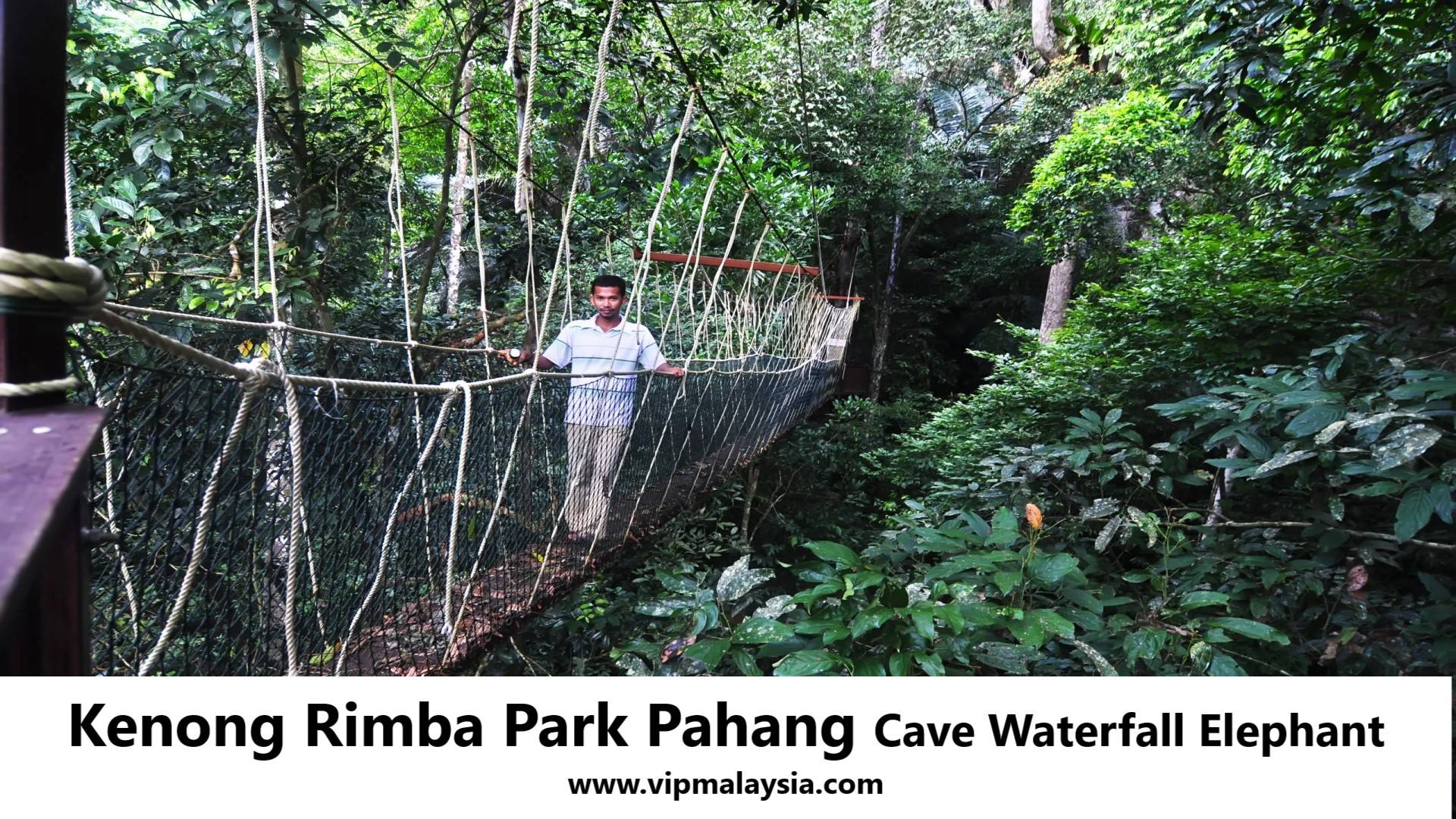
    Canopy Walkway Experience

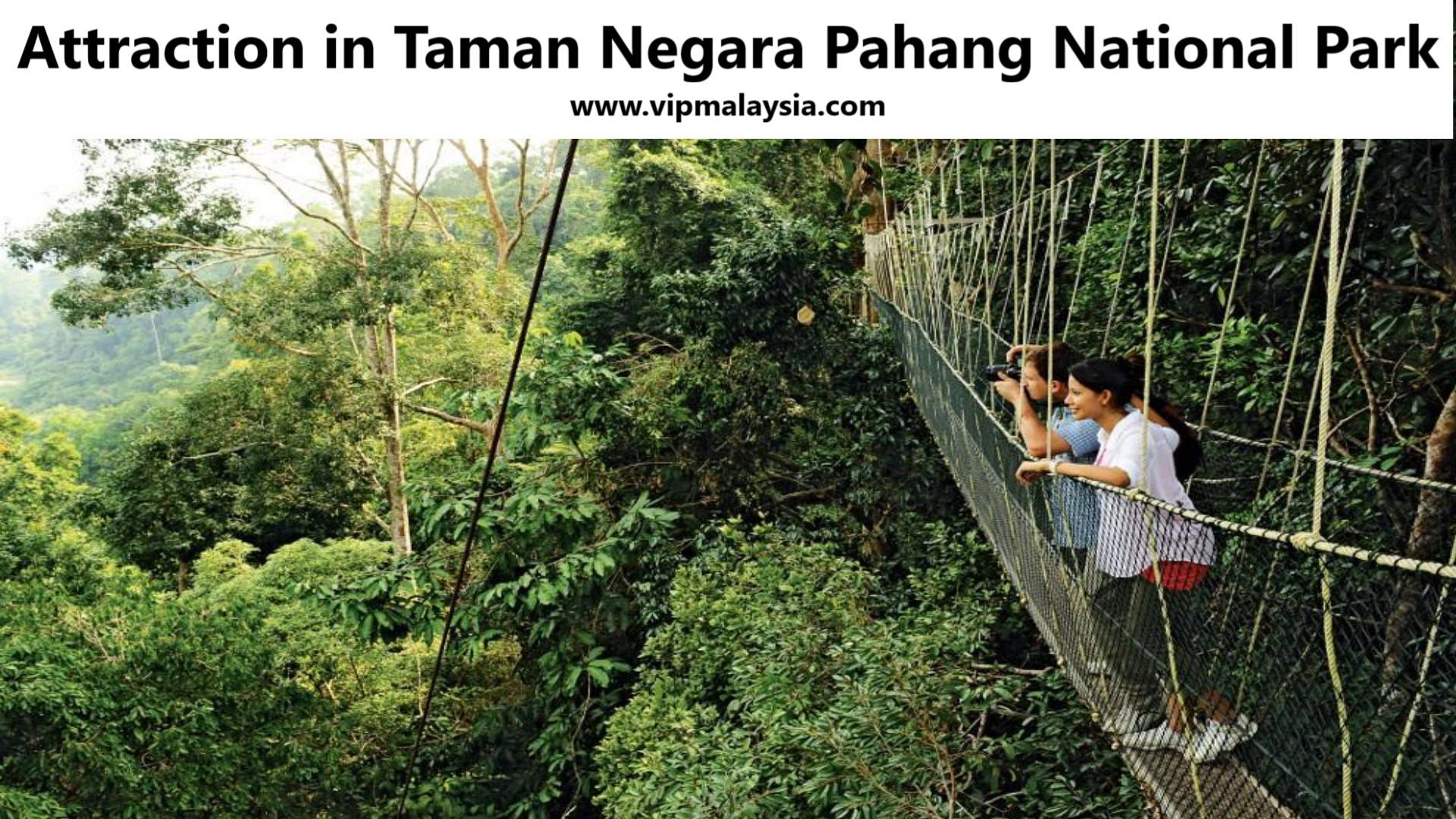
    The Canopy Walkway is one of Taman Negara’s most iconic attractions. Suspended 40 meters above the forest floor and stretching 530 meters in length, it offers panoramic views of the rainforest canopy. Visitors can spot hornbills, monkeys, and even the elusive Malayan tapir from above. The walkway is accessible via a short 1.5 km trek from the park headquarters, accessible by a 20–45 minute trek or a short boat ride.

    The Malayan tapir (Tapirus indicus) is the largest of all tapir species and the only one found in Asia. It is easily recognized by its distinctive black-and-white coloration and is currently listed as Endangered on the IUCN Red List due to habitat loss and declining populations. Size: Largest tapir species, weighing between 250–320 kg and measuring up to 2.5 meters in length. Coloration: Unique two-tone pattern — black head, shoulders, and legs, with a white midsection and rump. Young tapirs: Born with brown coats patterned with white stripes and spots.

    Visitor Facilities

    The walkway is well-maintained with safety ropes and nets, and guides are available to provide insights into the flora and fauna. Rest areas and observation points allow visitors to pause and enjoy the scenery. Photography enthusiasts will find this spot ideal for capturing the grandeur of the rainforest.

    Key Features

    • Supervision: Managed by the Department of Wildlife and National Parks (PERHILITAN) to ensure visitor safety.
    • Capacity: Limited to around 4 people per section at a time, with rangers controlling flow.

    PERHILITAN refers to the Department of Wildlife and National Parks Peninsular Malaysia (Jabatan Perlindungan Hidupan Liar dan Taman Negara), a government agency under the Ministry of Natural Resources and Environmental Sustainability. It is responsible for managing, conserving, and protecting wildlife and national parks in Peninsular Malaysia. Enforces laws against illegal hunting, trade, and poaching of endangered species such as the Malayan tiger and tapir. Issues permits for hunting, wildlife research, and eco-tourism activities. Runs awareness campaigns and initiatives like Save the Malayan Tiger.

    The Malayan tiger (Panthera tigris jacksoni) is a subspecies of tiger native to Peninsular Malaysia, officially recognized as Malaysia’s national animal. It is classified as Critically Endangered (IUCN Red List) with fewer than 150 individuals estimated to remain in the wild. Known locally as harimau or pak belang, it appears on Malaysia’s coat of arms, currency, and sports emblems. Smaller than Bengal or Siberian tigers; males average 120 kg, females about 100 kg.

    Limestone Caves Exploration

    Taman Negara is home to several limestone caves that date back hundreds of millions of years. Popular caves include Gua Telinga, Gua Kepayang, Gua Daun Menari, and Gua Luas. These caves are rich in geological formations and provide habitats for bats and swiftlets.

    Gua Telinga

    Gua Telinga is a limestone cave located within Taman Negara National Park in Pahang, Malaysia, known for its narrow passages, unique rock formations, and rich biodiversity. The name Gua Telinga translates to “Ear Cave” in Malay, referring to its ear-shaped entrance.

    Key Features

    • Location: Situated near Kuala Tahan, inside Taman Negara, one of the world’s oldest rainforests.
    • Structure: A limestone cave with narrow tunnels, chambers, and stalactite formations.
    • Wildlife: Home to bats, insects, and small cave-dwelling creatures, making it a hotspot for ecological study.
    • Adventure activity: Popular for “cave exploration” or spelunking, requiring visitors to crawl, climb, and squeeze through tight spaces.

    Visitor Experience

    • Guided tours: Entry is usually permitted only with park guides for safety.
    • Difficulty: Moderate to challenging, as the cave involves crawling through confined spaces.
    • Educational value: Offers insights into limestone geology, cave ecosystems, and rainforest biodiversity.

    Gua Kepayang

    Gua Kepayang is a limestone cave located within Taman Negara National Park in Pahang, Malaysia. It is known for its large chambers, unique rock formations, and as a popular stopover for jungle trekkers exploring the rainforest.

    Key Features

    • Location: Inside Taman Negara, one of the world’s oldest rainforests, accessible via jungle trekking routes.
    • Structure: A spacious limestone cave with wide chambers, stalactites, and stalagmites.
    • Wildlife: Often inhabited by bats, insects, and small cave fauna.
    • Adventure activity: Serves as a resting point for trekkers, with some areas used for overnight camping.

    Visitor Experience

    • Guided tours: Typically visited as part of multi-day jungle trekking expeditions.
    • Difficulty: Moderate, requiring trekking through dense rainforest before reaching the cave.
    • Educational value: Offers insights into limestone geology and rainforest ecosystems.

    Gua Daun Menari

    Gua Daun Menari is a limestone cave trail within Taman Negara National Park in Jerantut, Pahang, Malaysia. It is part of a moderately challenging trekking route of about 10.3 km, taking roughly 3 hours to complete, and is popular for hiking, cave exploration, and observing rainforest biodiversity.

    Key Features

    • Location: Situated in Taman Negara, near Jerantut, Pahang.
    • Trail length: Approximately 10.3 km out-and-back.
    • Elevation gain: Around 330 meters.
    • Duration: Average trekking time is 2 hours 57 minutes to 3.5 hours.
    • Difficulty: Rated as moderate, suitable for hikers with some experience.
    • Environment: Dense rainforest with rivers, caves, wildflowers, and wildlife along the route.

    Visitor Experience

    • Activities: Hiking, cave exploration, wildlife spotting, and enjoying panoramic rainforest views.
    • Atmosphere: Less crowded compared to other trails, offering a more secluded experience.
    • Wildlife: Potential sightings of bats, insects, and rainforest species.
    • Safety: Recommended to trek with guides, especially for cave exploration.

    Gua Luas

    Gua Luas is a limestone cave within Taman Negara National Park in Pahang, Malaysia, recognized for its spacious chambers and striking rock formations. It is often used as a resting point during jungle trekking expeditions.

    Lata Berkoh Waterfall

    A 40-minute boat ride up the Tahan River leads to Lata Berkoh, a stunning waterfall surrounded by lush greenery. The deep pool beneath the falls is perfect for swimming in cool, refreshing waters.

    Lata Berkoh Waterfall is a natural cascade located within Taman Negara National Park in Pahang, Malaysia. It is renowned for its clear waters, lush rainforest surroundings, and accessibility via boat rides along the Tembeling River.

    Wildlife Encounters

    The river journey itself is an adventure, with opportunities to spot kingfishers, monitor lizards, and macaques along the banks. The pristine environment makes Lata Berkoh a favorite among eco-tourists seeking tranquility.

    Tembeling River Rapids

    For thrill-seekers, the Tembeling River offers a nine-kilometer ride through seven rapids. The open boat journey is fast-paced and exhilarating, with splashes guaranteed. This activity is popular among adventure travelers looking for a mix of adrenaline and natural beauty.

    The Tembeling River Rapids activity, also known as “rapid shooting,” is a popular adventure in Taman Negara, Pahang. Visitors ride longboats through fast-flowing sections of the river, experiencing splashes, thrills, and panoramic rainforest views. It is one of the most sought-after ecotourism activities in the park.

    Key Features

    • Location: Conducted along the Tembeling River, near Kuala Tahan in Taman Negara.
    • Experience: Participants board traditional longboats, guided by skilled boatmen, and navigate through seven sets of rapids.
    • Duration: The activity typically lasts 45 minutes to 1 hour, depending on river conditions.
    • Thrill factor: Boats bounce and splash through waves, making it an exhilarating ride.
    • Scenery: Dense rainforest, wildlife sightings, and riverside villages add cultural and ecological value.
    • Life jackets are mandatory, and guides ensure safety throughout the ride. Visitors are advised to bring waterproof bags for belongings, as getting wet is part of the fun.

    Attractions

    Rare Bird Species

    Taman Negara is home to over 300 bird species, including hornbills and pheasants, as well as mammals like the Malayan gaur and sun bear. The park’s biodiversity makes it a paradise for wildlife enthusiasts.

    Great Argus (Argusianus argus)

    The Great Argus is a magnificent pheasant renowned for its spectacular tail feathers, which can stretch over a meter long. This bird is often sought after by birdwatchers due to its elaborate courtship displays, where males spread their wings and tail to create a mesmerizing fan-like spectacle. Although it is large and striking, the Great Argus is shy and prefers dense forest habitats, making sightings rare and rewarding.

    Its presence in Taman Negara highlights the park’s role as a sanctuary for unique avian species. The bird’s reliance on undisturbed rainforest underscores the importance of conservation efforts in Malaysia’s oldest national park. Observing the Great Argus in its natural environment is considered a highlight for serious birders visiting the region.

    Malayan Peacock-Pheasant (Polyplectron malacense)

    Endemic to Peninsular Malaysia, the Malayan Peacock-Pheasant is one of the most elusive birds in Taman Negara. Its iridescent plumage, adorned with eye-like spots, makes it a jewel of the rainforest. However, its secretive nature and preference for thick undergrowth mean that even experienced birdwatchers may struggle to catch a glimpse.

    This species is critically important to Malaysia’s biodiversity, as it is found nowhere else in the world. Conservationists emphasize its vulnerability due to habitat loss, making Taman Negara a crucial refuge. Spotting this pheasant is considered a once-in-a-lifetime experience for ornithologists and eco-tourists alike.

    Malayan Crested Fireback (Lophura rufa)

    The Malayan Crested Fireback is a rare forest pheasant distinguished by its striking crest and shimmering plumage. It is most often observed in the Merapoh sector of Taman Negara, where dense forest provides the cover it prefers. Its vibrant colors and unique appearance make it a prized sighting among bird enthusiasts.

    Despite its beauty, the species is seldom encountered due to its shy behavior and limited distribution. Conservationists monitor its population closely, as it is sensitive to habitat disturbance. Visitors fortunate enough to spot the Malayan Crested Fireback often describe it as one of the most memorable highlights of their trip.

    Asian Emerald Dove (Chalcophaps indica)

    The Asian Emerald Dove is a small but dazzling bird, known for its jewel-like green plumage that glistens in sunlight. Though widespread across Asia, sightings in Taman Negara are uncommon due to its preference for secluded forest paths and quiet feeding grounds. Its gentle cooing call adds to the serene atmosphere of the rainforest.

    This dove plays an important ecological role as a seed disperser, helping maintain the forest’s biodiversity. Birdwatchers often describe the thrill of spotting its shimmering feathers amidst dense foliage as akin to discovering a hidden gem. Its rarity in the park makes every encounter special.

    Violet Cuckoo (Chrysococcyx xanthorhynchus)

    The Violet Cuckoo is a striking bird with vivid purple plumage that stands out against the green rainforest canopy. It is rarely seen in Taman Negara due to its preference for dense forest interiors, where it feeds on caterpillars and insects. Its melodious calls often reveal its presence before it is spotted.

    This species is admired for its beauty and elusive nature, making it a prized addition to any birdwatching checklist. Conservationists note that its rarity highlights the delicate balance of rainforest ecosystems. Observing the Violet Cuckoo is considered a rewarding challenge for patient birders.

    Square-tailed Drongo-Cuckoo (Surniculus lugubris)

    The Square-tailed Drongo-Cuckoo is a rare parasitic cuckoo species that mimics drongos in appearance. It lays its eggs in the nests of other birds, relying on them to raise its young. This fascinating behavior makes it a subject of interest among ornithologists studying avian ecology.

    In Taman Negara, sightings are scarce due to its secretive habits and preference for dense canopy layers. Its presence, however, adds to the park’s rich avian diversity. Birdwatchers who manage to identify this species often appreciate its unique ecological role within the rainforest.

    Garnet Pitta (Erythropitta granatina)

    The Garnet Pitta is a brilliantly colored bird, with deep red and black plumage that makes it one of the most visually stunning species in Taman Negara. Despite its vibrant appearance, it is extremely secretive and prefers the dim understory of the forest, making it difficult to spot.

    Its rarity and beauty have earned it legendary status among birdwatchers. The Garnet Pitta’s presence in the park underscores the importance of preserving undisturbed rainforest habitats. For many visitors, catching even a fleeting glimpse of this elusive bird is the highlight of their birding adventure.

    Rhinoceros Hornbill (Buceros rhinoceros)

    The Rhinoceros Hornbill is one of Malaysia’s most iconic birds, recognized by its large casque resembling a rhinoceros horn. Though it is a symbol of strength and cultural heritage, sightings in Taman Negara are rare due to its preference for lowland rainforest.

    This hornbill plays a vital role in seed dispersal, helping regenerate forest ecosystems. Its rarity in the park makes encounters particularly special, often leaving visitors in awe of its size and majesty. Conservation efforts are crucial to ensure this iconic species continues to thrive in Malaysia’s rainforests.

    Helmeted Hornbill (Rhinoplax vigil)

    The Helmeted Hornbill is critically endangered and known for its loud, resonant calls that echo through the forest. Its distinctive casque, made of solid keratin, has unfortunately made it a target for poaching. In Taman Negara, sightings are extremely rare but deeply significant.

    This species is a flagship for conservation, symbolizing the urgent need to protect Malaysia’s rainforest biodiversity. Birdwatchers who hear its haunting calls often describe the experience as unforgettable. The Helmeted Hornbill’s survival depends on continued protection of pristine habitats like Taman Negara.

    Black-and-Red Broadbill (Cymbirhynchus macrorhynchos)

    The Black-and-Red Broadbill is a colorful bird found in riverine habitats within Taman Negara. Its striking plumage of crimson and black, combined with its large bill, makes it easily recognizable yet rarely seen. It prefers quiet riverbanks where it builds intricate nests suspended over water.

    This species adds vibrancy to the park’s avian diversity, though its rarity makes sightings precious. Birdwatchers often describe the thrill of spotting the Black-and-Red Broadbill as a highlight of their journey. Its dependence on healthy river ecosystems underscores the importance of protecting Taman Negara’s waterways.

    Orang Asli Villages

    The indigenous Orang Asli communities live within Taman Negara, preserving traditional lifestyles. Visitors can learn about their hunting techniques, blowpipe demonstrations, and cultural practices.

    The indigenous people of Taman Negara are the Orang Asli, specifically the Batek (sometimes spelled Bateq) tribe, who belong to the Negrito subgroup. They are traditionally nomadic hunter‑gatherers, living in small forest communities, and are recognized as one of the rarest and most distinct indigenous groups in Peninsular Malaysia.

    Cultural Festivals

    Occasional cultural events showcase traditional dances, music, and crafts. These experiences provide deeper insight into Malaysia’s indigenous heritage.

    Kuala Tahan Gateway

    Kuala Tahan is the main entry point to Taman Negara. This small town offers accommodations, restaurants, and visitor facilities. It serves as a hub for organizing guided tours and adventure activities.

    Kuala Tahan Gateway is the main entry point into Taman Negara National Park, located in Jerantut District, Pahang, Malaysia. It serves as the hub for visitors, with facilities such as the Kuala Tahan jetty, car park (Medan Kereta), and nearby accommodations, making it the starting point for jungle treks, river activities, and cultural visits. : The jetty offers panoramic views of the Tembeling River and the lush rainforest across the water.

    Flora and Fauna Diversity

    Taman Negara’s rainforest is home to countless plant species, including giant hardwood trees, medicinal plants, and rare orchids. The park also shelters endangered animals such as the Malayan tiger, Asian elephant, and tapir.

    Giant Hardwood Trees: Tualang Tree (Koompassia excelsa)

    The Tualang Tree is one of the tallest tropical trees in the world, reaching heights of up to 85 meters (280 feet). Towering above the rainforest canopy, it provides nesting sites for giant honeybees that build massive honeycombs on its branches. Local communities often revere the tree, believing it houses spirits, which is why it is traditionally left untouched. Its sheer size and grandeur make it a symbol of the majesty of Malaysia’s ancient rainforest.

    Ecologically, the Tualang Tree plays a vital role in stabilizing soil and supporting wildlife. Its expansive canopy contributes to the rainforest’s layered structure, offering shelter for birds, insects, and mammals. For visitors, standing beneath this towering giant is a humbling experience, and it remains one of the most photographed natural landmarks in Taman Negara.

    Medicinal Plants

    The Orang Asli, particularly the Batek tribe, rely heavily on rainforest plants for traditional medicine. Roots and leaves are brewed into herbal teas to treat fever and digestive issues, while bark extracts are applied to soothe skin conditions. Forest herbs are also used in poultices to relieve pain and inflammation, showcasing the deep connection between indigenous communities and their environment.

    This knowledge is passed down orally through generations, forming an essential part of cultural heritage and survival skills. The use of medicinal plants highlights the rainforest’s role as a living pharmacy, where biodiversity directly supports human health. For visitors, learning about these practices offers insight into the sustainable relationship between people and nature in Taman Negara.

    Rare Orchids

    Taman Negara is home to a dazzling array of orchid species, many of which are rare and endemic. Among them are Paphiopedilum, or Lady’s Slipper orchids, prized for their unique pouch-like flowers. Other species such as Bulbophyllum display unusual forms adapted to rainforest conditions, while epiphytic orchids thrive on tree trunks and branches in the humid canopy layers.

    Conservation is critical, as many orchids face threats from over-collection and habitat loss. Strict protection measures ensure these delicate plants continue to flourish in the park. For nature enthusiasts, spotting a rare orchid in bloom is a highlight of any visit, symbolizing the fragile beauty of Malaysia’s rainforest biodiversity.

    Trekking and Adventure

    Jungle Trekking Trails

    Taman Negara boasts well-marked trails such as the Tahan Trail, Teranggan Trail, Neram Trail, and Bukit Teresek loop. Each trail offers unique experiences, from dense rainforest exploration to panoramic hilltop views.

    Tahan Trail

    The Tahan Trail refers to the trekking route leading to Gunung Tahan, the highest peak in Peninsular Malaysia (2,187 m), located within Taman Negara National Park. It is considered one of the most challenging treks in Southeast Asia, requiring endurance and several days to complete.

    Key Facts

    • Location: Runs through Taman Negara, spanning Pahang, Kelantan, and Terengganu.
    • Destination: Leads to Gunung Tahan (Mount Tahan), the highest point in Peninsular Malaysia.
    • Elevation: 2,187 m (7,175 ft) above sea level.
    • Trail length: Approximately 55 km, depending on the chosen route.
    • Duration: Typically 7 days for the full trek, though shorter routes exist.
    • Difficulty: Rated as challenging, requiring stamina, jungle survival skills, and preparation.

    Trail Routes

    • Kuala Tahan Route: The longest and most demanding, usually taking 7–9 days.
    • Merapoh Route: Shorter, often completed in 5–7 days.
    • Combination Route: Some trekkers ascend via one route and descend via the other for a full experience.

    Trekking Experience

    • Terrain: Dense rainforest, rivers, steep ascents, and rugged mountain paths.
    • Wildlife: Potential sightings of Malayan tapirs, birds, and other rainforest species.
    • Guides and permits: Required for safety and conservation; managed by PERHILITAN.
    • Preparation: Trekkers must be physically fit, carry camping gear, and be ready for unpredictable weather.

    Challenges

    • Physical endurance: The name “Tahan” means endure, reflecting the trek’s difficulty.
    • Weather: Heavy rains can make trails slippery and rivers dangerous to cross.
    • Logistics: Food, water purification, and camping equipment must be carried throughout.

    Teranggan Trail

    The Teranggan Trail (sometimes referred to as Sungai Terenggan Trail) is a jungle trekking route in Taman Negara National Park, Malaysia. It is a medium‑difficulty trail of about 8.5 km one way, taking roughly 4.5 hours to complete, and is popular because it passes the Canopy Walkway, Orang Asli village, and ends at the Teras Mini Waterfall.

    Key Features

    • Location: Inside Taman Negara, accessible from Kuala Tahan.
    • Trail length: About 8.5 km one way.
    • Duration: Approximately 4.5 hours to complete.
    • Difficulty: Medium, suitable for beginners with moderate fitness.
    • Highlights: Canopy Walkway, Orang Asli village, Teras Mini Waterfall, and river rapid shooting return trip.

    Visitor Experience

    • First 2 km: Easy walk on wooden boardwalks.
    • Remaining 6.5 km: Real jungle trekking with uneven terrain, streams, and rainforest paths.
    • Activities: Trekking, canopy walk, cultural visit to Orang Asli village, refreshing stop at Teras Mini Waterfall, and boat ride back with rapid shooting.
    • Atmosphere: Dense rainforest, wildlife sightings, and cultural immersion.

    Neram Trail

    The Neram Trail is a jungle trekking route in Taman Negara National Park, Malaysia, leading to the Neram River and its waterfalls. It is considered a moderate trail, offering rainforest immersion, river crossings, and opportunities to observe diverse flora and fauna.

    Key Features

    • Location: Inside Taman Negara, accessible from Kuala Tahan.
    • Trail length: Varies depending on route, typically 6–8 km one way.
    • Duration: Around 3–4 hours to complete.
    • Difficulty: Moderate, suitable for trekkers with some experience.
    • Highlights: Neram River, waterfalls, lush rainforest, and wildlife sightings.

    Visitor Experience

    • Terrain: Mixture of boardwalks, jungle paths, and river crossings.
    • Activities: Trekking, swimming at waterfalls, birdwatching, and photography.
    • Atmosphere: Dense rainforest with sounds of wildlife and flowing rivers.
    • Guided tours: Recommended for safety and navigation, as the trail can be slippery during rainy season.

    Bukit Teresek Trail

    Bukit Teresek Trail (also called Teresek Hill Trail) is a popular jungle trekking route in Taman Negara National Park, Pahang, Malaysia. It is a moderate hike of about 5.6 km with 290 m elevation gain, taking 2–2.5 hours, and rewards visitors with panoramic views of Gunung Tahan and the 130‑million‑year‑old rainforest.

    This moderate trek leads to a viewpoint overlooking Mount Tahan and the Tahan River. The trail is popular for sunrise hikes, offering breathtaking vistas of mist-covered forests.

    Key Features

    • Location: Near Kuala Tahan, inside Taman Negara.
    • Trail length: Approximately 5.6 km loop.
    • Elevation gain: Around 290 m.
    • Duration: 2–2.5 hours depending on pace.
    • Difficulty: Moderate, suitable for families and beginners with reasonable fitness.
    • Highlights: Canopy Walkway, suspension bridge crossing, summit views of Gunung Tahan and Gunung Perlis.

    Visitor Experience

    • Trail surface: Combination of jungle paths and wooden boardwalks.
    • Wildlife sightings: Monkeys, birds, insects, and diverse rainforest flora.
    • Atmosphere: Dense tropical rainforest with panoramic vistas at the summit.
    • Accessibility: Close to Taman Negara headquarters, making it one of the most accessible treks.
    • Popularity: Often included in day‑trip itineraries; considered a “must‑do” hike in Taman Negara.

    Mount Tahan Expedition

    Mount Tahan, standing at 2,187 meters, is the highest peak in Peninsular Malaysia. The expedition is challenging, requiring 7–9 days of trekking, but rewards climbers with spectacular views and a sense of achievement. Trekkers encounter diverse ecosystems, from lowland rainforest to montane forest. Wildlife sightings include rare species such as the Malayan tiger, clouded leopard, and exotic orchids.

    The Tahan River (Malay: Sungai Tahan) is one of the main rivers flowing through Taman Negara National Park in Pahang, Malaysia. It is a tributary of the Tembeling River, originating from the Four Steps Waterfall deep in the rainforest, and is a popular destination for trekking and rapid shooting activities.

    Key Features

    • Location: Flows through Taman Negara, Jerantut District, Pahang.
    • Tributary: One of the main tributaries of the Tembeling River, forming its headwaters together with the Teku River.
    • Source: Originates from the Four Steps Waterfall, a remote four‑tiered waterfall about 150 m high, reachable only after 8–9 days of trekking with licensed guides.
    • Length: Approximately 135 km, flowing into the Tembeling River.
    • Elevation: Source located at 1,840–1,850 m above sea level.

    Visitor Experience

    • Trekking: Accessed via trails beginning at Kuala Tahan village, often part of expeditions to Gunung Tahan.
    • Rapid shooting: The river is known for its strong currents, making it a site for adventurous boat rides.
    • Camping: Teku Camp, located at the confluence of the Tahan and Teku Rivers, is a designated campsite for trekkers.
    • Cultural significance: The river and its source waterfall are considered sacred among the Orang Asli communities living in Taman Negara.

    Teku Camp (Camp Teku) is a designated riverside campsite inside Taman Negara National Park, Pahang, Malaysia. It lies beside the crystal‑clear Teku River and serves as a resting point for trekkers heading towards Gunung Tahan, offering a wilderness camping experience in the rainforest.

    The Teku River (Malay: Sungai Teku) is a clear tributary stream flowing through Taman Negara National Park in Pahang, Malaysia. It is known for its pristine waters, nearby waterfalls, and riverside campsite (Teku Camp), making it a popular stop for trekkers heading toward Gunung Tahan. Elevation: Around 211 m above sea level at mapped points. Waterfalls: Teku Waterfalls are a scenic attraction along the river, offering picnic spots and wildlife viewing.

    Conclusion

    Taman Negara Pahang is more than just a national park—it is a living museum of Malaysia’s natural and cultural heritage. From canopy walkways and limestone caves to river rapids and mountain expeditions, the park offers diverse experiences for every traveler. Its rich biodiversity, indigenous culture, and adventure opportunities make it a must-visit destination. Whether you seek relaxation by waterfalls or adrenaline-pumping treks, Taman Negara promises an unforgettable journey into the heart of Malaysia’s rainforest.

    Summary

    • Attraction: Attractions in Taman Negara Pahang National Park
    • Location: Pahang Malaysia
    • Attraction Type: Forest in Malaysia
    • Source: pahangtourism.org.my
    • Category: #TamanNegara #Pahang #Attraction 

    Contact Information

    Mutiara Taman Negara Kuala Tahan Pahang
    Kuala Tahan, 27000, Jerantut, Pahang, Malaysia
    Telephone: +609 266 3500

    Visitor Reviews

    James Tan, Singapore – ★★★★★ “Taman Negara is a paradise for nature lovers. The canopy walkway was breathtaking, and the wildlife sightings were unforgettable. The facilities were well-maintained, and the guides were knowledgeable.”

    Nina Ahmad, Malaysia – ★★★★☆ “The jungle trekking trails were challenging but rewarding. I especially enjoyed Bukit Teresek for its panoramic views. The only downside was the humidity, but that’s part of the rainforest experience.”

    Kandasamy, India – ★★★★★ “Mount Tahan expedition was the highlight of my trip. It was tough, but the sense of achievement was incredible. The guides ensured safety, and the views from the summit were spectacular.”

    Sebastian Gullery, Germany – ★★★★☆ “Lata Berkoh waterfall was stunning. The boat ride was scenic, and swimming in the cool waters was refreshing. I wish there were more food options nearby, but overall, it was a fantastic experience.”

    David Johnson, Australia – ★★★★★ “The Orang Asli village visit was eye-opening. Learning about their traditions and blowpipe hunting was fascinating. Taman Negara is truly a blend of adventure and culture.”

    Getting to Taman Negara – World’s Oldest Jungle – Feeling MAGIC in National Park! This is our Visual Journey and story about our trip to one of the world’s oldest jungles. It is located in Malaysia, only about 240 km from Kuala Lumpur. This is truly a place full of magic! Visuals by Miz youtube.com

    What to do in Malaysia National Park rainforest – Excursion from Mutiara Taman Negara: After a first amazing night in our tiny home in the rainforest of Malaysia National Park, the Mutiara Taman Negara Resort, it was time to explore this beautiful national park. We booked an excursion at the reception of our hotel and did a half day tour. It took us to the largest tree in the rainforest, to a fish sanctuary and we also hiked and swim in a beautiful waterfall. Nature in Malaysia is wonderful. If you want to know what an excursion in National Park Rainforest looks like, this is the video to watch! Eileens Wanderlust youtube.com

    Frequently Asked Questions (FAQs)

    What are the boat fares in Taman Negara Malaysia?

    You need to pay for boat fares:

    • Lata Berkoh – RM160.00 (4-seater)
    • Kuala Trenggan – RM120.00 (4-seater), RM200.00 (12-seater)
    • Kuala Keniyam – RM300.00 (4-seater), RM400.00 (12-seater)
    • Telinga Cave – RM60.00 (4-seater), RM80.00 (12-seater)
    • Fishing 3D/2N – RM1,500.00 (12-seater)

    Boat service between Kuala Tembeling – Kuala Tahan – Kuala Tembeling depart at 9.00 am. & 2.00 pm. daily. The boat fare is RM60.00 per person one way. Advance booking should be made to Mutiara Taman Negara Tel: 609-266 3500.

    • Guide Fee: (max.12 pax)
    • One (1) Day – RM250.00
    • Half a Day – RM150.00
    • Gunong Tahan – RM1,200.00 (7 days) , RM150.00 (each additional day)

    What are entry fees to Taman Negara Malaysia?

    Permits and licenses are mandatory requirements prior to going into Taman Negara. You may apply for one at any Department of Wildlife’s counters located at the Kuala Tembeling jetty or Kuala Tahan:

    • Entry permit – RM 1 per person
    • Fishing licenses – RM 10 per rod
    • Camera license – RM 5 per unit
    • Camping fee – RM 2 per person
    • Canopy Walk – RM 5 per person
    • Hide – RM 5 per person/night

    What are the must visit places and activities in Taman Negara?

    You must visit Kuala Tahan because it is where the Taman Negara Headquarters is located. Activities such as canopy walkway, Bukit Teresek, Kuala Terenggan, Kuala Keniyam, Telinga Cave.

    What else you can do at Taman Negara Malaysia?

    These are activities you can do at Taman Negara:

    • Camping
    • Jungle Trekking
    • NIght walk & night safari
    • bird watching
    • white water rafting
    • The batek: native of the jungle)
    • Lata Berkoh & Kelah Sanctuary
    • Climbing at Gunung Tahan 2,187 meters
  • Pekan Sehari Temerloh: Pahang’s Sunday Market Gem

    Pekan Sehari Temerloh: Pahang’s Sunday Market Gem

    Pekan Sehari Temerloh, Pahang

    Pekan Sehari Temerloh is the longest and largest weekly market in Pahang, drawing visitors and locals alike for its lively atmosphere, fresh produce, traditional delicacies, and artisanal goods. Located along Lurah Semantan, this Sunday-only bazaar offers everything from fresh river fish to handcrafted items—an unmissable stop for travelers looking to experience authentic Malaysian street markets.

    Pekan Sehari Temerloh is Pahang’s largest and longest weekly market, held every Sunday along Sungai Pahang. With over 400 stalls, it offers fresh produce, river fish, traditional delicaci> es, and artisanal crafts, making it a must-visit cultural and culinary experience in Malaysia.

    Explore Malaysia’s liveliest Sunday market in Temerloh, where fresh river fish, authentic delicacies, and handcrafted goods meet scenic views of Sungai Pahang.

    Introduction

    Located in the heart of Temerloh, Pekan Sehari Temerloh is the biggest weekly market in Pahang and one of the most vibrant in Malaysia. Established decades ago, it has become a cultural landmark, attracting locals and tourists alike. Every Sunday from 7 AM to 12 PM, the market transforms Jalan Lurah Semantan into a bustling bazaar filled with fresh produce, traditional foods, and artisanal crafts. Its riverside setting along Sungai Pahang adds scenic charm, making shopping here a uniquely Malaysian experience.

    Lurah Semantan refers to a central community area in Temerloh, Pahang, Malaysia, best known for Alun Alun Lurah Semantan (Lurah Semantan Square), a public space used for local events, markets, and gatherings. It also hosts facilities such as the PETRONAS Lurah Semantan station, making it both a social and economic hub for the town.

    Sungai Pahang (Pahang River) is the longest river on the Malay Peninsula, stretching about 459 km across the state of Pahang, Malaysia, before flowing into the South China Sea at Kuala Pahang in Pekan. It plays a vital role in the region’s ecology, history, and economy. Drainage basin: Covers about 29,300 km², extending into Pahang and parts of Negeri Sembilan.

    Highlights

    Fresh River Fish Market

    Temerloh is famously known as the “Patin Capital of Malaysia”, and the market reflects this heritage. Visitors can find ikan patin, temoleh, baung, and other freshwater species sourced directly from Sungai Pahang. The fish are prized for their freshness and quality, often sold at competitive prices.

    Patin is a freshwater catfish species (Pangasianodon hypophthalmus) from the Pangasiidae family, widely found in Malaysian rivers such as Sungai Pahang and Sungai Perak. It is highly prized for its tender, fatty flesh and is the star ingredient in the famous Pahang dish patin masak tempoyak (patin cooked with fermented durian). Size: Can grow up to 1 meter long and weigh several kilograms. Taste: Rich, fatty, and tender flesh, considered one of Malaysia’s most flavorful freshwater fish. Nutritional Value: Omega-3 fatty acids: High levels beneficial for heart health, protein-rich: Provides essential amino acids and micronutrients: Contains calcium, iron, potassium, phosphorus, and vitamins.

    Signature Seafood Experience

    The highlight is ikan patin masak tempoyak, catfish cooked in fermented durian paste, a delicacy unique to Pahang. Vendors often share cooking tips, making the market both a shopping and cultural learning experience.

    Ikan patin masak tempoyak is a traditional Pahang dish made from patin fish (freshwater catfish) cooked in a sauce of tempoyak (fermented durian), chili, turmeric, and other local spices. It is considered one of Malaysia’s most iconic river fish dishes, especially associated with Temerloh along the Sungai Pahang. Premium river-caught patin used in this dish can fetch high prices, reflecting its prestige.

    Traditional Delicacies

    Food lovers will delight in the variety of authentic Pahang cuisine available. From rebong masak lemak (bamboo shoots in coconut milk) to kuih-muih like tapai, bahulu, and apam balik, the market is a feast for the senses.

    Rebong Masak Lemak

    Rebung masak lemak is a traditional Malay dish made from rebung (bamboo shoots) cooked in a rich, creamy masak lemak (coconut milk curry) with turmeric, chili, and aromatic herbs. It is a popular delicacy in Malaysia, especially in Negeri Sembilan and Pahang, where masak lemak cili api is a signature style.

    Characteristics

    • Main ingredient: Rebung, tender bamboo shoots harvested young.
    • Cooking style: Masak lemak, a coconut milk-based curry flavored with turmeric and chili.
    • Taste profile: Creamy, slightly spicy, with a mild sweetness from coconut milk and earthy notes from bamboo shoots.
    • Variations: Sometimes cooked with added proteins like ikan patin, chicken, or beef.

    Tapai

    Tapai is a traditional fermented food in Southeast Asia, especially popular in Malaysia and Indonesia. It is made from glutinous rice or cassava that is inoculated with a starter culture (usually ragi, a mix of yeast and fungi) and left to ferment, producing a sweet, slightly alcoholic taste.

    Characteristics

    • Main ingredients: Glutinous rice or cassava.
    • Fermentation agent: Ragi, a starter containing yeast and molds.
    • Taste profile: Sweet, mildly sour, with a subtle alcoholic note.
    • Texture: Soft, moist, and sticky.

    Bahulu

    Bahulu is a traditional Malay sponge cake, often described as Malaysia’s version of madeleines. It is small, fluffy, and lightly sweet, usually baked in brass or cast-iron molds with floral or oval shapes. Bahulu is a popular festive treat, especially during Hari Raya Aidilfitri and other celebrations.

    Characteristics

    • Main ingredients: Eggs, flour, sugar, and sometimes vanilla.
    • Texture: Soft and airy inside, with a slightly crisp golden-brown crust.
    • Shapes: Traditionally baked in molds shaped like flowers, fish, or ovals.
    • Taste profile: Mildly sweet, eggy, and light — perfect for tea-time snacks.

    Apam Balik

    Apam balik is a traditional Malaysian street snack, also known as “turnover pancake” or “folded pancake.” It is made from a batter of flour, eggs, sugar, and baking powder, cooked on a griddle, then filled with ingredients such as crushed peanuts, sugar, and sweet corn before being folded in half.

    Characteristics

    • Main ingredients: Flour, eggs, sugar, baking powder.
    • Fillings: Traditionally crushed peanuts, sugar, and sweet corn. Modern versions may include chocolate, cheese, or kaya.
    • Texture: Crispy edges with a soft, fluffy center.
    • Taste profile: Sweet, nutty, and slightly buttery.

    Local Handcrafted Products

    Beyond food, Pekan Sehari is a treasure trove of artisanal goods. Handwoven baskets, batik fabrics, and traditional crafts are sold alongside homemade herbal remedies and natural skincare products.

    Artisans and Cultural Crafts

    Local artisans showcase their skills, ensuring that traditional crafts remain alive. Visitors can purchase souvenirs that embody Pahang’s cultural richness, from batik textiles to handmade coffee beans roasted at Kopi Wong’s specialty stall.

    Over 400 Vendors

    With hundreds of stalls, the market offers everything from fresh produce to clothing. The sheer scale makes it one of the largest traditional markets in Peninsular Malaysia.

    Trekking & Adventure

    Visitor Facilities and Nearby Towns

    Temerloh town provides accommodations, eateries, and cultural attractions. Visitors often combine a trip to Pekan Sehari with nearby destinations like Kuala Gandah Elephant Sanctuary or Krau Wildlife Reserve, creating a full eco-cultural itinerary.

    Cultural Festivals and Local Heritage

    Visiting during festivals such as Hari Raya or local harvest celebrations enhances the experience. The market becomes even livelier, with performances, traditional music, and festive foods adding to the atmosphere.

    Scenic Sungai Pahang Views

    Shopping along the riverbank offers picturesque views, especially in the morning when the market is at its busiest. The river is central to Temerloh’s identity, and its presence enriches the market’s charm.

    Conclusion

    Pekan Sehari Temerloh is a vibrant marketplace overflowing with local charm, making it a must-visit destination for food lovers, cultural explorers, and souvenir hunters. Whether you’re sampling fresh seafood, indulging in traditional dishes, or browsing handcrafted items, this Sunday market promises an authentic Malaysian experience.

    Ready to explore Pahang’s longest weekly market? Visit Pekan Sehari Temerloh today!

    Summary

    • Attraction: Pekan Sehari Temerloh
    • Location: #Pahang 
    • Attraction Type: #Market 
    • Source: pahangtourism.org.my, pdttemerloh.pahang.gov.my
    • Why Visit:
      • The biggest & longest weekly market in Pahang
      • Bustling marketplace with fresh fruits, vegetables & handcrafted goods
      • Famous for local delicacies like ikan patin masak tempoyak
      • Enjoy scenic views of Sungai Pahang while shopping

    Quick Info

    AttributeDetails
    NamePekan Sehari Temerloh
    LocationJalan Ibrahim, Lurah Semantan, Temerloh, Pahang, Malaysia
    GPS Position3.4502° N, 102.4206° E
    StatePahang
    Main AttractionsFresh Produce, Traditional Delicacies, Artisanal Goods
    Nearby LandmarksSungai Pahang, Temerloh Old Town
    AccessibilityEasy access via East Coast Expressway
    Best Time to VisitSundays, 7:00 AM – 1:00 PM
    Entry FeesFree admission
    Recommended ActivitiesShopping, Food Tasting, Photography
    Opening HoursEvery Sunday, 7:00 AM – 1:00 PM
    ContactTemerloh Tourism Office (+609-2797249)

    Visitor Reviews

    • Aziz Pelesit Kota, Malaysia – ★★★★★ “The ikan patin masak tempoyak was unforgettable. The market is lively, and the riverside setting makes it special.”
    • Donald Lee Thorn, USA – ★★★★☆ “Loved the variety of crafts and local foods. It’s crowded, but that’s part of the charm. A must-see in Temerloh.”
    • Priyamana, India – ★★★★★ “The fresh fish market was amazing. Vendors were friendly and explained cooking methods. Truly authentic.”
    • Moriti, Malawi– ★★★★☆ “Great cultural experience. The handcrafted batik fabrics were beautiful. Wish the market stayed open longer.”

    Frequently Asked Questions (FAQs)

    Apakah keistimewaan Pekan Sehari di Temerloh, Pahang?

    Jika anda berpeluang untuk ke sini, jangan lepaskan peluang untuk membeli kopi yang dikisar sendiri oleh seorang otai. Dikenali sebagai Kopi Wong, serbuk kopi yang beliau hasilkan mendapat tempat dihati penduduk setempat dan jika anda penggemar kopi, datanglah membeli Serbuk Kopi Wong yang sangat original ini.

  • Deerland Park: A Hidden Wildlife Sanctuary in Pahang

    Deerland Park: A Hidden Wildlife Sanctuary in Pahang

    Deerland Park, Pahang

    Deerland Park in Lanchang, Pahang, is a privately managed wildlife sanctuary offering intimate encounters with rescued deer, sun bears, exotic birds, and reptiles. Located just 2 km from Kuala Gandah Elephant Sanctuary, it combines eco-tourism with conservation education, making it one of Malaysia’s hidden gems for families and nature enthusiasts.

    Deer are hoofed ruminant mammals belonging to the family Cervidae, characterized by antlers (in males of most species), cloven hooves, and a herbivorous diet. They are widely distributed across Eurasia, the Americas, and parts of Africa, with species ranging from small roe deer to large moose and elk. In Malay, the word for “deer” is most commonly translated as rusa. Other regional or specific terms include menjangan and kijang, depending on the type of deer being referred to.

    Introduction

    Established in 1996 by En Abdullah Ahmad B. Mahmud, Deerland Park spans 10 acres in Lanchang, Pahang. Built with private funds, the park was designed to support Malaysia’s dwindling wildlife populations while offering the public a chance to appreciate nature. Its proximity to the Kuala Gandah Elephant Sanctuary and Krau Wildlife Reserve makes it part of a larger conservation corridor. Visitors can expect hands-on experiences like feeding deer, observing sun bears, and learning about Malaysia’s diverse ecosystems.

    The sun bear (Helarctos malayanus) is the smallest species of bear in the world, native to the tropical forests of Southeast Asia (including Malaysia, Thailand, Myanmar, Laos, Cambodia, Vietnam, and the islands of Sumatra and Borneo). It is easily recognized by the golden crescent-shaped patch on its chest and is currently listed as Vulnerable due to habitat loss and poaching. Size: Adults weigh 30–70 kg and stand 120–150 cm long, making them the smallest bear species. Distinctive feature: Orange-yellow crescent marking on the chest, unique to each individual. Diet: Omnivorous — eats fruits, insects, honey, and small vertebrates. Known for its exceptionally long tongue (20–25 cm) used to extract honey.

    Conservation and Educational Programs

    Deerland Park promotes wildlife protection through interactive exhibits and guided tours. Its mission aligns with Malaysia’s conservation goals, offering a platform for public education. By supporting Deerland, visitors contribute to sustaining endangered species and preserving ecosystems.

    Highlights

    Wildlife Encounters & Attractions

    Deerland Park houses around 30 Indonesian deer, alongside exotic wildlife such as Bengal cats, ostriches, Nilgai deer from India, and colorful birds like peafowl and pheasants. Reptile exhibits include Burmese and reticulated pythons, offering a glimpse into Malaysia’s reptilian diversity.

    Indonesian deer

    The “Indonesian deer” often refers to the Babirusa (Babyrousa), a rare wild pig species native to Indonesia that is commonly called the “deer-pig” because of its slender body and tusk-like canine teeth resembling antlers. Found only on islands such as Sulawesi, Togian, Sula, and Buru, it is a unique mammal that has puzzled scientists for decades. Behavior: Shy, forest-dwelling, often near rivers and swamps.

    Bengal Cats

    The Bengal cat (Felis catus × Prionailurus bengalensis) is a hybrid domestic cat breed developed by crossing the Asian leopard cat with domestic cats, prized for its exotic spotted or marbled coat and energetic personality. Originating in the United States in the 1970s, it is now one of the most recognized pedigree cat breeds worldwide. Appearance: Medium-to-large cats with muscular build, short coat featuring rosettes, marbling, or arrowhead markings. Size: Adult males weigh 9–15 pounds, females 6–12 pounds. Height ranges 13–16 inches. Life span: Typically 12–20 years, depending on environment and care.

    Ostrich

    The ostrich (Struthio camelus) is the world’s largest living bird, native to Africa. It is a flightless species known for its long legs, powerful running ability (up to 70 km/h), and distinctive long neck, making it a unique member of the bird family.

    Nilgai Deer

    The nilgai (Boselaphus tragocamelus), also called the “blue bull,” is the largest antelope in Asia. Despite sometimes being referred to as a “deer,” it belongs to the Bovidae family (related to cattle and antelopes) rather than Cervidae (true deer). Males are bluish-grey, females are tawny-orange, and the species is abundant across India and Nepal.

    Peafowl

    Peafowl are large terrestrial birds in the pheasant family (Phasianidae), best known for the male’s extravagant tail feathers. The term covers three species: the Indian peafowl (Pavo cristatus), the green peafowl (Pavo muticus), and the Congo peafowl (Afropavo congensis). Males are called peacocks, females are peahens. Size: Large birds, males can reach 2.3 m in length including tail feathers.

    Pheasants

    Pheasants are medium-to-large birds belonging to the family Phasianidae, known for their bright plumage, long tails, and ground-dwelling habits. They are native to Asia but have been widely introduced elsewhere for hunting and ornamental purposes. In Malay, pheasants are generally referred to as burung pegar.

    Burmese Pythons

    The Burmese python (Python bivittatus) is one of the largest non‑venomous snake species in the world, native to Southeast Asia, and currently listed as Vulnerable on the IUCN Red List. It is also notorious as an invasive species in Florida, USA, due to escapes and releases from the pet trade.

    Characteristics

    • Size: Typically 3–5 meters (10–16 feet), but can exceed 6 meters.
    • Weight: Up to 90 kg (200 lbs).
    • Appearance: Dark brown blotches bordered with black along the body; muscular build.
    • Lifespan: 20–25 years in the wild or captivity.
    • Hunting style: Ambush predator; kills prey by constriction. Known to consume prey as large as deer, alligators, and domestic animals in Florida.
    • Excellent swimmers, often near water but also adept at climbing trees.

    Reticulated Pythons

    The reticulated python (Malayopython reticulatus) is the world’s longest snake species, native to South and Southeast Asia, and classified as Least Concern by the IUCN. It is non‑venomous, a powerful constrictor, and can reach lengths of over 10 meters (32 feet).

    Characteristics

    • Size: Average 3–6 meters, but exceptional individuals exceed 10 meters (32.8 feet).
    • Weight: Typically 75–160 kg depending on size.
    • Appearance: Distinctive “reticulated” (net‑like) geometric pattern of black, gold, and brown across the body.
    • Lifespan: 20–25 years in captivity, slightly less in the wild.
    • Excellent swimmers; often near water but also capable climbers.
    • Hunting style: Ambush predator; kills prey by constriction. Known to take large prey such as pigs, deer, and occasionally primates.

    Wildlife Attractions

    Deer Sanctuary

    Visitors can hand-feed and interact with friendly deer in semi-natural enclosures. This sanctuary emphasizes conservation, teaching guests about the importance of protecting deer species in Malaysia. Families particularly enjoy the gentle nature of the deer, making it a highlight for children.

    Exotic Wildlife and Nature Trails

    Beyond deer, the park features sun bears, ostriches, and rare bird species. Guided tours lead visitors through scenic rainforest trails, where native flora and fauna thrive. The trails provide opportunities for photography and birdwatching, immersing guests in Malaysia’s natural beauty.

    Trekking & Adventure

    Visitor Facilities and Nearby Towns

    Facilities include shaded rest areas, feeding stations, and small exhibits. The nearby town of Temerloh, about 50 km away, offers accommodations, food stalls, and cultural experiences. Visitors often combine trips to Deerland Park with Kuala Gandah Elephant Sanctuary for a full day of eco-tourism.

    Cultural Festivals and Local Heritage

    Timing a visit during Pahang’s cultural festivals enhances the experience. Traditional Malay performances, food fairs, and handicraft markets in Temerloh allow visitors to connect with local heritage while exploring wildlife attractions.

    Must-Visit Highlights

    Sun Bear Enclosure

    The park’s rescued sun bears are a major attraction. Guests can observe their behavior and learn about conservation efforts to protect this vulnerable species.

    Kuala Gandah Elephant Sanctuary Nearby

    Just 2 km away, this sanctuary rehabilitates elephants and educates visitors about human-elephant conflict. Pairing a visit here with Deerland Park creates a comprehensive wildlife experience.

    Educational Programs

    Interactive exhibits and nature guides provide insights into animal behavior, ecosystems, and conservation strategies. Students and researchers benefit from hands-on learning opportunities.

    Conclusion

    Deerland Park offers a unique blend of wildlife interactions, eco-tourism, and conservation education, making it a top destination for animal lovers, families, and adventure seekers. Whether you’re feeding gentle deer, spotting exotic wildlife, or immersing yourself in nature’s beauty, this hidden gem promises an extraordinary experience.

    Plan your nature getaway today—explore Deerland Park in Pahang!

    Summary

    • Attraction: Deerland Park
    • Location: #Pahang 
    • Attraction Type: #Park #Zoo #Wildlife  
    • Source: pahangtourism.org.my, mpt.gov.my
    • Why Visit:
      • Meet rescued deer, sun bears, exotic birds & other wildlife
      • Explore a pristine rainforest teeming with natural beauty
      • Enjoy hands-on experiences like feeding animals & learning about conservation
      • Perfect for eco-tourism, photography & outdoor adventures

    Quick Info

    AttributeDetails
    NameDeerland Park
    LocationBukit Rengit, Lanchang, Pahang, Malaysia
    GPS Position3.6841° N, 102.2227° E
    StatePahang
    Main AttractionsDeer Sanctuary, Wildlife Encounters, Nature Trails
    Nearby LandmarksKuala Gandah Elephant Sanctuary, Krau Wildlife Reserve
    Accessibility2-hour drive from Kuala Lumpur via East Coast Expressway
    Best Time to VisitYear-round for wildlife experiences
    Entry FeesStandard wildlife park admission applies
    Recommended ActivitiesAnimal Feeding, Guided Nature Tours, Photography
    Opening HoursOpen daily
    ContactDeerland Park (+6019-3020012 / +609-2797249)

    Visitor Reviews

    • Sam Lim, Malaysia – ★★★★★ “Feeding the deer was magical. My kids loved the hands-on experience, and the sun bear enclosure was fascinating.”
    • Markus Schneider, Germany – ★★★★☆ “The park is small but packed with wildlife. I enjoyed the guided trail and seeing rare birds. Facilities are basic but sufficient.”
    • Tumiran Bakhtiar, Indonesia – ★★★★★ “Deerland Park is perfect for families. The educational programs taught us so much about conservation. Highly recommended.”
    • David Sean, UK– ★★★★☆ “Loved the close encounters with deer and exotic animals. Combining this with Kuala Gandah made for an amazing day trip.”

    Frequently Asked Questions (FAQs)

    Dimanakah lokasi Deerland Park dan berapakah keluasan taman ini?

    Ia terletak di Lanchang dan mengambil masa sejauh 50.5km dari Temerloh. Taman ini mempunyai keluasan 10 ekar.

    Bilakah waktu operasi Deerland Park, Pahang?

    Waktu Operasi : 11.00 pagi – 6.00 petang (Setiap hari kecuali Jumaat)

  • Krau Wildlife Reserve: Largest Biodiversity Sanctuary

    Krau Wildlife Reserve: Largest Biodiversity Sanctuary

    Krau Wildlife Reserve, Pahang

    Krau Wildlife Reserve is Malaysia’s largest wildlife reserve, spanning 62,395 hectares, offering an extraordinary glimpse into the country’s rich biodiversity and conservation efforts. Home to the seladang (gaur), primates, rare birds, and unique ecosystems, this protected area is a must-visit for nature lovers and researchers alike.

    The seladang, also known as the gaur (Bos gaurus), is one of the largest wild cattle species in the world, native to South and Southeast Asia, and in Malaysia it is specifically referred to as the seladang. It is a powerful, stocky animal with distinctive dark brown to black coloration, massive horns, and a muscular build, often found in forested hills and montane regions. Scientific name: Bos gaurus (Malayan subspecies: Bos gaurus hubbacki). Size: Shoulder height up to 1.9 meters, males can weigh up to 1,000 kg. Habitat: Prefers hilly or montane forests, often near forest edges and salt licks

    Introduction

    Nestled in the Temerloh District of Pahang, Krau Wildlife Reserve is a sanctuary of extraordinary biodiversity. Established in 1923 and later expanded to 62,395 hectares, it is Malaysia’s largest wildlife reserve. The reserve is drained by the Krau, Lompat, and Teris rivers, and its altitude ranges from 43 meters at Kuala Lompat to 2,107 meters at Mount Benom. This diverse terrain supports lush rainforests, salt licks, and river valleys, creating habitats for countless species. For visitors, Krau offers not only breathtaking scenery but also a chance to witness conservation in action.

    The Teris River (Sungai Teris) is a stream located in Pahang, Malaysia, within the Krau Wildlife Reserve. It is a small but ecologically important waterway, supporting diverse flora and fauna in one of Malaysia’s oldest protected forest reserves. Elevation: Around 100 meters above sea level. Flora diversity: Surveys recorded species from gymnosperms, monocotyledons, and dicotyledons, including rare plants like Gnetum tenuifolium.

    Gymnosperms are a group of seed-producing plants known as “naked seed” plants because their seeds are not enclosed within fruits, unlike flowering plants (angiosperms). They include conifers, cycads, ginkgo, and gnetophytes, and are among the oldest plant lineages, dating back to the Carboniferous period.

    Monocotyledons (often called monocots) are one of the two major groups of flowering plants (angiosperms), characterized by having a single seed leaf or cotyledon in their embryos. They include grasses, lilies, orchids, palms, and many staple crops such as rice, wheat, and maize.

    Dicotyledons (often called dicots) are one of the two major groups of flowering plants (angiosperms), characterized by having two seed leaves or cotyledons in their embryos. They represent a vast diversity of species, including most broad-leaved trees, shrubs, and many herbaceous plants.

    Gnetum tenuifolium is a slender, evergreen climbing plant belonging to the gymnosperm group Gnetaceae, native to Southeast Asia, including the Malay Peninsula. It is used locally for food and medicine, though its habitats are increasingly threatened by deforestation.

    The Teris River (Sungai Teris) is a stream located in Pahang, Malaysia, within the Krau Wildlife Reserve. It is ecologically important, supporting diverse flora and fauna, and has been the subject of biodiversity research.

    Highlights

    Wildlife & Conservation

    The reserve is renowned for its seladang (gaur), Malaysia’s second-largest land mammal, which thrives in the Krau River valley. Salt licks in the eastern and southern areas attract herds of these majestic creatures. Visitors may also encounter long-tailed macaques, gibbons, hornbills, and rare bat species. Research stations, such as the one at Kuala Lompat, focus on primate and bat studies, contributing to global knowledge of tropical ecosystems.

    Kuala Lompat is a forest research station located within the Krau Wildlife Reserve in Pahang, Malaysia. It is managed by the Forest Research Institute of Malaysia (FRIM) and serves as a base for ecological, botanical, and wildlife studies in one of the country’s oldest protected areas. Kuala Lompat is remote, requiring permits and coordination with FRIM for entry. Unlike tourist waterfalls or parks, Kuala Lompat is primarily for researchers, not casual visitors.

    Seladang and Other Endangered Species

    The seladang is a symbol of Malaysia’s wilderness, often seen grazing in open valleys. Alongside them, endangered hornbills and raptors soar above the canopy. The reserve’s biodiversity also includes clouded leopards, sun bears, and tapirs, making it a critical refuge for Malaysia’s fauna.

    Trekking & Adventure

    For adventure seekers, Krau offers trekking routes that lead to Mount Benom, rising to 2,107 meters. Trails wind through dense rainforest, river crossings, and salt licks, providing opportunities to spot wildlife. Guided treks emphasize safety and conservation, ensuring minimal disturbance to habitats.

    Visitor Facilities and Nearby Towns

    Facilities are limited to maintain ecological integrity, but basic accommodations and guided tours are available. The nearby town of Temerloh serves as a gateway, offering lodging, food, and cultural experiences. Visitors can also explore local markets and traditional Malay villages.

    Temerloh’s most famous signature food is Ikan Patin Tempoyak, a freshwater catfish dish cooked in fermented durian paste. This dish has earned Temerloh the nickname Bandar Ikan Patin (Patin Town) and is widely regarded as the culinary identity of Pahang. Other notable foods include pekasam (fermented fish), cendol, and Puding DiRaja.

    Cendol is a traditional Southeast Asian dessert made of green rice flour jelly strands flavored with pandan, coconut milk, palm sugar syrup (gula Melaka), and shaved ice. It is one of Malaysia’s most iconic sweet treats, especially popular during hot tropical days. Optional toppings: Red beans, sweet corn, glutinous rice, or durian for richer versions. Popularity in Malaysia: A staple at roadside stalls, kopitiams, and food courts, especially in Penang, Melaka, and Kuala Lumpur. It represents Malaysia’s multicultural food identity and is often enjoyed during festive seasons or as a cooling street snack.

    Must-Visit Highlights

    Kuala Lompat Research Station

    This station is internationally recognized for its studies on primates and bats. Visitors can learn about ongoing research and the importance of biodiversity conservation.

    The Kuala Lompat Research Station is a forest research institute located inside the Krau Wildlife Reserve in Pahang, Malaysia. It is managed primarily for ecological and biodiversity studies, and access is restricted to researchers with prior approval. Strictly limited to researchers; the general public is not allowed without permits.

    National Elephant Conservation Centre

    Located near the reserve, this center rehabilitates rescued elephants and educates the public about human-elephant conflict. It is a vital part of Malaysia’s conservation strategy.

    The National Elephant Conservation Centre (NECC), also known as the Kuala Gandah Elephant Sanctuary, is Malaysia’s only dedicated elephant conservation facility. Established in 1989 in Lanchang, Pahang, it focuses on rescuing, relocating, and rehabilitating wild elephants whose habitats are threatened by development. Location: About 2 hours from Kuala Lumpur via East Coast Expressway.

    Cultural Festivals and Local Heritage

    Visitors can time their trips to coincide with Pahang’s cultural festivals, such as traditional dance performances and food fairs, enriching the wildlife experience with local heritage.

    Eco-Tourism and Sustainability

    Eco-tourism in Krau is carefully managed to minimize human impact. Access is restricted, and guided tours emphasize conservation awareness. Programs for wildlife rescue and rehabilitation actively monitor populations, ensuring the reserve remains a safe haven for endangered species. The Institute of Biodiversity supports scientific research, making Krau a hub for conservation studies.

    Conclusion

    Krau Wildlife Reserve is a testament to Malaysia’s commitment to wildlife conservation, making it an essential destination for researchers, conservationists, and nature lovers. Whether you’re observing rare species, studying biodiversity, or learning about conservation efforts, this sanctuary promises a profound appreciation for Malaysia’s natural heritage.

    Discover the wonders of Malaysia’s wildlife—explore Krau Wildlife Reserve in Pahang today!

    Summary

    • Attraction: Krau Wildlife Reserve
    • Location: #Pahang 
    • Attraction Type: #Wildlife 
    • Source: wildlife.gov.my
    • Why Visit:
      • One of Malaysia’s most significant wildlife conservation areas
      • Home to endangered species, including the seladang
      • Breathtaking rainforests & diverse habitats
      • Research stations studying primates, bats, and rare birds

    Quick Info

    AttributeDetails
    NameKrau Wildlife Reserve
    LocationTemerloh, Pahang, Malaysia
    GPS Position4.1851° N, 102.0347° E
    StatePahang
    Main AttractionsSeladang Conservation, Rainforest Exploration, Biodiversity Studies
    Nearby LandmarksBenom Mountain, Kuala Lompat Research Station
    AccessibilityLocated near Lanchang, Pahang
    Best Time to VisitYear-round, especially for wildlife observation
    Entry FeesRegulated access for conservation purposes
    Recommended ActivitiesWildlife Observation, Research, Nature Exploration
    Opening HoursRestricted access with permits required
    ContactKrau Wildlife Reserve (+609-3121253)

    Visitor Reviews

    • Tan Swee Goh, Singapore – ★★★★★ “I was amazed by the seladang herds near the salt licks. The guided trek to Mount Benom was challenging but rewarding. Truly a hidden gem of Malaysia.”
    • Haji Daud, Malaysia – ★★★★☆ “The biodiversity here is incredible. I especially enjoyed visiting the Kuala Lompat Research Station. Facilities are basic, but that’s part of the authentic experience.”
    • Usha Patel, India – ★★★★★ “The National Elephant Conservation Centre was inspiring. Seeing rescued elephants rehabilitated gave me hope for conservation efforts in Asia.”
    • Kenji Sawadi, Japan – ★★★★☆ “The rainforest trekking was unforgettable. I spotted hornbills and macaques. Wish there were more visitor amenities, but the pristine environment is worth it.”

    Frequently Asked Questions (FAQs)

    Boleh senaraikan kawasan perlindungan dibawah pengurusan Jabatan Perhilitan?

    Berikut adalah senarai kawasan perlindungan dibawah pengurusan Jabatan Perhilitan

    • Rezab Hidupan Liar Krau, Pahang
    • Rezab Hidupan Liar Pahang Tua, Pahang
    • Rezab Hidupan Liar Bukit Fraser, Pahang
    • Rezab Hidupan Liar Sungkai, Perak
    • Rezab Hidupan Liar Chior, Perak
    • Rezab Hidupan Liar Batu Gajah, Perak
    • Rezab Hidupan Liar Sungai Dusun, Selangor
    • Rezab Hidupan Liar Bukit Kutu, Selangor
    • Rezab Hidupan Liar Bukit Sungai Puteh, Kuala Lumpur/ Selangor
    • Rezab Hidupan Liar Bukit Nanas, Kuala Lumpur
    • Rezab Hidupan Liar Kelab Golf Di Raja Selangor, Kuala Lumpur
    • Rezab Hidupan Liar Klang Gate, Selangor
    • Rezab Hidupan Liar Tanjung Tuan, Melaka
    • Four Bird Island, Port Dickson, Negeri Sembilan
    • Rezab Hidupan Liar Pulau Tioman
    • GoM, GEF –UNDP PROJECT

    Enhancing Effectiveness and Financial Sustainability of Protected Areas in Malaysia (PA Financing Project)

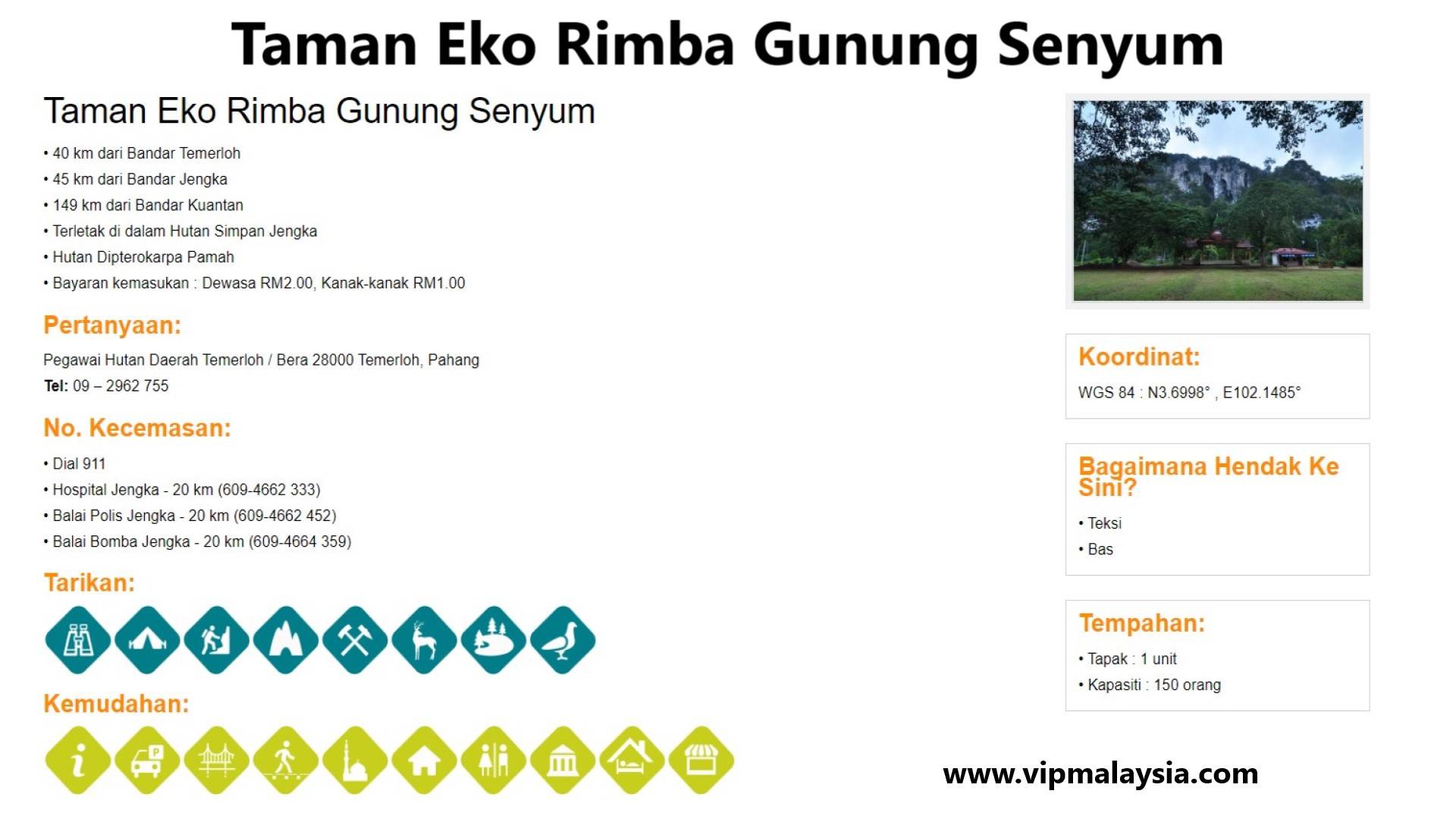
  • Taman Eko Rimba Gunung Senyum: Cave Adventure Awaits

    Taman Eko Rimba Gunung Senyum: Cave Adventure Awaits

    Taman Eko Rimba Gunung Senyum, Pahang

    Taman Eko Rimba Gunung Senyum in Pahang is a spectacular eco-park featuring 19 limestone caves, lush rainforest, and archaeological treasures dating back thousands of years. Visitors can trek scenic trails, camp under the stars, and explore caves like Gua Terang Bulan and Gua Gelap. Sitting at 1,549 meters above sea level, this natural wonder is a paradise for spelunkers, researchers, and adventure seekers.

    Gunung Senyum (literally “Smiling Mountain”) is a limestone hill and recreational forest in Jengka, Temerloh District, Pahang, Malaysia, famous for its caves, archaeological sites, and eco-tourism activities. It is part of the Jengka Forest Reserve and covers about 794 hectares, making it a key natural and cultural attraction in central Pahang. Height: Approximately 486–550 meters above sea level.

    Introduction

    Located in Temerloh District, Pahang, Taman Eko Rimba Gunung Senyum is one of Malaysia’s most fascinating eco-tourism destinations. Known for its limestone caves formed over 3,000 years ago, the park offers a blend of geological wonders, biodiversity, and cultural heritage. With 19 caves to explore, ranging from mystical caverns to archaeological sites, Gunung Senyum is ideal for adventurers, researchers, and nature lovers. Visitors can enjoy trekking, camping, and photography while immersing themselves in Malaysia’s natural and historical legacy.

    Highlights

    Gunung Senyum’s caves are the centerpiece of the park, each with unique formations and stories. The caves are accessible via trekking trails, offering both casual exploration and challenging spelunking opportunities.

    Gua Terang Bulan (Moonlight Cave)

    This cave is famous for its moonlit glow, creating a mystical atmosphere. The formations inside resemble natural sculptures, inspiring legends among locals. Visitors often describe it as one of the most enchanting caves in Malaysia.

    Gua Gelap

    True to its name, Gua Gelap is pitch-dark and requires torches for exploration. The cave challenges adventurers with narrow passages and hidden chambers. Its silence and darkness create an unforgettable spelunking experience.

    Gua Jebak Puyoh

    Rich in geological history, Gua Jebak Puyoh showcases ancient formations that fascinate researchers and explorers alike. The cave’s layered rocks tell stories of environmental changes over millennia.

    Gua Angin (Wind Cave)

    Gua Angin is known for its constant cool breeze that flows through its chambers. The natural ventilation makes it a refreshing stop for explorers. Visitors often rest here to enjoy the calming atmosphere before continuing their journey.

    Gua Tiga Ber adik (Three Brothers Cave)

    This cave features three interconnected chambers symbolizing unity. The layout resembles siblings standing side by side. It is often highlighted as a representation of family bonds in local folklore.

    Gua Kelawar (Bat Cave)

    Home to bat colonies, Gua Kelawar plays an important ecological role. The bats help control insect populations in the forest. Visitors can observe them at dusk when they leave the cave in large numbers.

    Gua Gajah (Elephant Cave)

    The limestone formations here resemble elephants in shape. Its massive structures give the cave a majestic feel. Many visitors are drawn to its striking resemblance to the animal.

    Gua Makam Tok Long

    This cave contains a burial site considered sacred by locals. It is often visited with respect and reverence. The site reflects the cultural and spiritual heritage of the community.

    Gua Merlap

    Known for sparkling mineral deposits, Gua Merlap shines under torchlight. The glittering walls create a magical effect. Explorers often describe it as walking through a cave of stars.

    Gua Taman

    At its entrance, lush greenery thrives, resembling a natural garden. The vegetation adds beauty and freshness to the cave. It is a peaceful spot that blends forest and limestone scenery.

    Gua Tiga Tingkat (Three Levels Cave)

    This cave has multiple levels, offering adventurous exploration. Each tier presents different formations and pathways. It is popular among thrill-seekers who enjoy climbing and discovery.

    Gua Batu Sanding

    The walls of this cave appear smooth and polished. The limestone looks as though it has been sanded down. This unique texture sets it apart from other caves in the area.

    Gua Kolam Tujuh (Seven Pools Cave)

    Natural pools formed by water seepage can be found here. These pools add charm and uniqueness to the cave. They are often admired for their tranquil beauty.

    Gua Silat

    Traditionally linked to martial arts, Gua Silat carries cultural significance. It is said to have been used for training in the past. The cave’s spacious interior makes it suitable for such practices.

    Gua Malim

    This cave is associated with spiritual rituals and meditation. Its quiet environment provides a sense of peace. It remains a place of reflection for those seeking tranquility.

    Gua Puteri (Princess Cave)

    Local legends tie this cave to a mystical princess. Stories of enchantment surround its chambers. Visitors are often intrigued by its folklore and beauty.

    Gua Penyu (Turtle Cave)

    Rock formations here resemble turtles resting. The shapes are a natural wonder admired by explorers. It is one of the more visually distinctive caves in Gunung Senyum.

    Gua Jeram

    Small waterfalls and streams flow inside this cave. The sound of running water adds to its charm. It is a refreshing spot for visitors seeking natural beauty.

    Gua Dangdang

    This cave is famous for its echoes. Sounds made inside reverberate loudly, creating a dramatic effect. It is often enjoyed by visitors experimenting with its acoustics.

    Trekking and Adventure

    Archaeological and Geological Discoveries

    Gunung Senyum is not only a natural wonder but also a scientific landmark. Archaeologists and geologists have studied its caves for decades, uncovering evidence of ancient human activity and unique rock formations.

    A Landmark for Scientific Exploration

    The limestone formations date back over 3,000 years, while mudstone and shale landscapes are estimated at 2,100 years old. These geological features provide valuable insights into Malaysia’s environmental history. Researchers continue to explore the caves, making Gunung Senyum a hub for scientific discovery.

    Trekking Trails

    The eco-park offers trails of varying difficulty, suitable for both casual hikers and seasoned adventurers. Trails wind through dense forest, limestone ridges, and cave entrances, offering diverse experiences.

    Camping and Visitor Facilities

    Camping is popular among visitors, with designated sites offering basic facilities. The park provides rest areas, picnic spots, and guided tours. Nearby villages offer homestays, allowing travelers to experience local hospitality and cuisine.

    Nearby Towns

    Temerloh, known as the “Patin Fish Capital,” is a nearby town offering culinary delights such as ikan patin tempoyak. Local festivals celebrate Pahang’s culture, featuring traditional music, dance, and crafts. These events enrich the eco-tourism experience by connecting visitors to the region’s heritage.

    Artifacts found in some caves suggest human presence dating back centuries. These discoveries highlight Gunung Senyum’s role as both a natural and cultural heritage site.

    Conclusion

    Taman Eko Rimba Gunung Senyum offers a magical blend of geological wonders, untouched rainforests, and thrilling cave explorations, making it a must-visit destination for adventurers, researchers, and outdoor enthusiasts. Whether you’re trekking through limestone formations, studying ancient caves, or embracing the beauty of Pahang’s wilderness, this park promises an unforgettable escape.

    Ready for adventure? Explore the fascinating caves of Gunung Senyum today!

    Summary

    • Attraction: Taman Eko Rimba Gunung Senyum
    • Location: #Pahang 
    • Attraction Type: #Mount 
    • Source: pahangtourism.org.my, forestry.gov.my, Bharian
    • Why Visit:
      • Discover 19 remarkable caves, including Gua Terang Bulan & Gua Gelap
      • Explore limestone formations over 3,000 years old
      • Surrounded by lush rainforest, ideal for eco-tourism & nature photography
      • Great for trekking, camping, and archaeological research

    Quick Info

    AttributeDetails
    NameTaman Eko Rimba Gunung Senyum
    LocationNear Jengka, Pahang, Malaysia
    GPS Position3.8851° N, 102.3847° E
    StatePahang
    Main AttractionsCave Exploration, Trekking, Geological Research
    Nearby LandmarksTemerloh, Jengka, Pahang River
    AccessibilityLocated 40 km from Temerloh, 45 km from Jengka
    Best Time to VisitYear-round for cave adventures & trekking
    Entry FeesStandard recreational fees apply
    Recommended ActivitiesCave Exploration, Trekking, Photography, Camping
    Emergency ContactsPolice: +609-4662452 | Fire Station: +609-4664359
    ContactForest Officer, Temerloh (+609-2962755)

    Visitor Reviews

    Hannah Noir, Germany – ★★★★★ “Exploring Gua Terang Bulan was magical. The formations looked like natural sculptures, and the guided tour was very informative.”

    Mohd Farid, Malaysia – ★★★★☆ “The trekking trails were challenging but rewarding. Facilities are basic, so come prepared. The caves are worth every effort.”

    Hashimi Yusoff, Malaysia – ★★★★★ “I loved the biodiversity. Spotting hornbills and orchids made the trek unforgettable. Camping under the stars was a highlight.”

    Maizatul Azra, Malaysia – ★★★★★ “Gua Gelap was thrilling. The darkness and silence made it a true adventure. The staff were helpful and ensured safety throughout.”

    Frequently Asked Questions (FAQs)

    How many small caves in Taman Eko Rimba Gunung Senyum, Pahang?

    There are 19 caves found within the park, and among the caves that arouse greater interest to scientific researchers and archaeologists:

    • Gua Terang Bulan
    • Gua Hidang
    • Gua Taman Satu
    • Gua Taman Dua
    • Gua Angin
    • Gua Merlap
    • Gua Kolam Tuju
    • Gua Gajah
    • Gua Gelap

    What is the famous legendary story in Taman Eko Rimba Gunung Senyum?

    Among the most famous legend in Taman Eko Rimba Gunung Senyum is the story of Tok Long, is a noble person, Tok Long who is said to have married an elf in this mountain region. The consequences of breaking a promise, Tok Long failed to find his wife back in causing elves decided meditating on it until his death. Grave in Gua Makam Tok Long is said to be evidence of a long story handed down from generation to generation.

    Bagaimana Gunung Senyum yang terletak di Pahang mendapat nama?

    Menurut sejarah, Gunung Senyum mendapat namanya apabila Almarhum Sultan Ahmad yang memerintah Pahang pada tahun 1863 hingga 1892, ketika itu dalam perjalanan berangkat ke Kuala Krau, Temerloh, terpandang kepada sebuah gunung di tebing kanan Sungai Pahang dan bertanya kepada pengiring baginda, nama gunung berkenaan. Pengiring baginda hanya berpandangan antara satu sama lain sambil tersenyum. Bagi mengelakkan pengiring dan pembesar Pahang berasa malu, baginda bertitah menamakan gunung berkenaan sebagai Gunung Senyum, gara-gara gelagat pegawai istananya yang asyik tersenyum.

    Apakah kemudahan yang disediakan oleh Taman Eko Rimba Gunung Senyum, Pahang?

    Perkhemahan adalah salah satu aktiviti yang popular disini. Diantara kemudahan yang ada adalah informasi, parking, bridge, pelantar, masjid, chalet, toilet, dewan, pondok dan gerai.

    Apakah tarikan yang boleh didapati di Taman Eko Rimba Gunung Senyum, Pahang?

    Menurut sumber rasmi, antara tarikan yang boleh anda lakukan adalah kajian, khemah, trekking, cave geology artasik dan melihat spesis burung yang banyak dan jarang ditemui.

    Berapakah kadar bayaran di Taman Eko Rimba Gunung Senyum?

    Kadar bayaran yang dikenakan apabila saya ingin meneroka Taman ini adalah seperti berikut:

    • Bayaran kemasukan : Dewasa RM2.00
    • Bayaran kemasukan : Kanak-kanak RM1.00
  • Kuala Gandah Elephant Sanctuary: Ethical Wildlife Haven

    Kuala Gandah Elephant Sanctuary: Ethical Wildlife Haven

    Kuala Gandah Elephant Sanctuary, Pahang

    Kuala Gandah Elephant Sanctuary is Malaysia’s premier elephant conservation center, playing a crucial role in rescuing, rehabilitating, and protecting Malaysia’s endangered elephants. Nestled within the Krau Wildlife Reserve in Lanchang, Pahang, this sanctuary offers visitors a rare opportunity to interact with rescued elephants while learning about conservation efforts.

    Kuala Gandah is a village in Lanchang, Temerloh District, Pahang, Malaysia, best known for the Kuala Gandah Elephant Conservation Centre (KGEC). This center is one of Malaysia’s most important wildlife facilities, dedicated to rescuing, rehabilitating, and relocating wild Asian elephants displaced by deforestation and development.

    Krau Wildlife Reserve is the largest wildlife reserve in Peninsular Malaysia, covering about 62,395 hectares in Pahang. Established in 1923, it protects diverse ecosystems from lowland rainforest to montane forest and is especially important for conserving species like the gaur (Indian bison), primates, bats, and birds. Altitude range: From 43 meters at Kuala Lompat to 2,107 meters at Mount Benom’s summit. Rivers: Drained by the Krau, Lompat, and Teris Rivers, which sustain its ecosystems.

    Lanchang is a small town in Temerloh District, Pahang, Malaysia, known for its agricultural activities, eco-tourism, and proximity to major conservation areas like the Krau Wildlife Reserve.

    Introduction

    Nestled in the lush forests of Pahang, the Kuala Gandah Elephant Sanctuary—officially known as the National Elephant Conservation Centre—has become a cornerstone of Malaysia’s wildlife preservation efforts. Managed by the Department of Wildlife and National Parks (PERHILITAN), the sanctuary provides a safe haven for elephants displaced by deforestation and human-wildlife conflict. Visitors are welcomed into an environment where conservation meets education, offering both hands-on experiences and deep insights into the challenges of protecting Malaysia’s majestic giants. Kuala Gandah Elephant Sanctuary is established in 1989, managed by PERHILITAN (Department of Wildlife and National Parks).

    The gaur (Bos gaurus), also known as the Indian bison, is the largest species of wild cattle in the world. Native to South and Southeast Asia, it is a powerful, muscular animal recognized for its massive build, distinctive dark brown coat, and striking white “stockings” on its legs. Size: Males can weigh up to 1,500 kg, standing 1.7–2.2 meters tall at the shoulder.

    PERHILITAN is Malaysia’s Department of Wildlife and National Parks (Jabatan Perlindungan Hidupan Liar dan Taman Negara), a government agency under the Ministry of Natural Resources and Environmental Sustainability. It is responsible for conserving wildlife, managing national parks, and enforcing laws against poaching and illegal trade. Established in 1972, evolving from the earlier Jabatan Mergastua.

    Highlights

    Conservation and Rehabilitation

    The sanctuary has successfully relocated and rehabilitated over 400 wild elephants in the past 25 years. Many of these elephants were rescued from areas where their habitats were destroyed by logging or agricultural expansion. The center’s mission is to ensure that elephants can live safely while raising awareness about the importance of protecting their ecosystems.

    Rescuing and Relocating Endangered Elephants

    Elephants brought to Kuala Gandah undergo medical care, rehabilitation, and gradual reintegration into protected reserves. The process is carefully managed to reduce stress on the animals and ensure their long-term survival. Visitors gain a rare glimpse into the dedication of conservationists working tirelessly to safeguard Malaysia’s wildlife.

    Educational and Interactive Visitor Programs

    The sanctuary emphasizes ethical tourism, allowing guests to interact with elephants responsibly. Activities include feeding, bathing, and observing elephants in their natural environment. Guided tours provide context about elephant behavior, conservation challenges, and the sanctuary’s role in wildlife protection.

    Creating Awareness and Support for Conservation

    Educational programs are designed to inspire visitors to become advocates for conservation. By learning about the elephants’ struggles and triumphs, guests leave with a deeper appreciation of Malaysia’s biodiversity and the importance of sustainable practices.

    Sustainable Eco-Tourism

    Unlike exploitative attractions, Kuala Gandah ensures that elephants are treated with respect. There are no performances or forced activities; instead, the focus is on rehabilitation and education. Visitor contributions directly support ongoing rescue missions, veterinary care, and research initiatives.

    National Elephant Conservation Centre

    The sanctuary doubles as a research hub, where scientists study elephant behavior, genetics, and habitat needs. This knowledge informs national policies on wildlife management and strengthens Malaysia’s commitment to protecting endangered species.

    Elephant Feeding and Bathing Sessions

    One of the most memorable experiences is feeding elephants with fruits and vegetables provided by the sanctuary. Bathing sessions allow visitors to help cool the elephants in the river, fostering a sense of connection and responsibility.

    Souvenir and Craft Shops

    Local artisans sell handicrafts and eco-friendly souvenirs near the sanctuary. Purchasing these items supports community livelihoods and promotes sustainable tourism.

    Trekking and Adventure

    Exploring Pahang’s Natural Beauty

    Beyond the sanctuary, Pahang offers trekking opportunities through tropical rainforests and river valleys. Visitors can combine their trip with eco-adventures such as jungle trekking, birdwatching, and river exploration.

    Wildlife Encounters

    Trekkers may spot hornbills, macaques, and even tapirs in the surrounding forests. The biodiversity of Pahang enhances the experience, making it a holistic journey that blends conservation with adventure.

    Adventure Activities Near Kuala Gandah

    Nearby attractions include Lanchang town, known for its local markets and cultural festivals. Visitors can also explore waterfalls and forest reserves, adding variety to their itinerary.

    Visitor Facilities

    The sanctuary provides visitor amenities such as rest areas, guided tours, and educational exhibits. Local homestays and eco-lodges offer accommodations for those wishing to extend their stay and immerse themselves in rural Malaysian culture.

    Cultural Festivals and Events

    Visitors can time their trip to coincide with local festivals in nearby towns. These events showcase traditional music, dance, and cuisine, offering a vibrant cultural immersion alongside the sanctuary visit.

    Nearby Towns and Attractions

    Lanchang and Temerloh are popular stopovers, offering authentic Malaysian food such as ikan patin tempoyak (catfish in fermented durian sauce). These towns enrich the travel experience with their blend of culture and hospitality.

    Conclusion

    Kuala Gandah Elephant Sanctuary is a beacon of hope for Malaysia’s endangered elephants, making it an essential stop for eco-tourists, conservationists, and wildlife lovers. Whether you’re interacting with rescued elephants, supporting conservation efforts, or learning about Malaysia’s wildlife, this sanctuary offers a meaningful and unforgettable experience.

    Get closer to Malaysia’s majestic giants—plan your visit to Kuala Gandah Elephant Sanctuary today!

    Summary

    • Attraction: Kuala Gandah Elephant Sanctuary
    • Location: #Pahang 
    • Attraction Type: #Wildlife 
    • Source: pahangtourism.org.my, wildlife.gov.my
    • Why Visit:
      • Meet orphaned and rescued elephants in a protected environment
      • Learn about Malaysia’s elephant conservation efforts
      • Experience hands-on activities, including feeding & bathing elephants
      • Support ethical wildlife rehabilitation & sustainable eco-tourism

    Quick Info

    AttributeDetails
    NameKuala Gandah Elephant Sanctuary
    LocationLanchang, Pahang, Malaysia
    GPS Position3.6841° N, 102.2227° E
    StatePahang
    Main AttractionsElephant Rehabilitation, Feeding & Bathing Activities, Conservation Education
    Nearby LandmarksKrau Wildlife Reserve, Benom Mountain
    Accessibility2-hour drive from Kuala Lumpur via East Coast Expressway
    Best Time to VisitYear-round for wildlife experiences
    Entry FeesStandard conservation support fees apply
    Recommended ActivitiesElephant Feeding, Bathing, Guided Conservation Tours
    Opening HoursOpen daily
    ContactKuala Gandah Elephant Sanctuary (+6013-9319650)

    Visitor Reviews

    Maria Claudia, Spain – ★★★★★ “Bathing the elephants was a heartwarming experience. The guides explained everything clearly, and I felt my visit truly supported conservation.”

    Ravi Kumar, India – ★★★★☆ “The sanctuary is well-managed and ethical. Facilities are basic but sufficient. Watching elephants roam freely was unforgettable.”

    Mustapha Kamal, Malaysia – ★★★★★ “I appreciated the educational programs. Learning about the relocation efforts gave me a new perspective on wildlife conservation.”

    James O’Connor, Ireland – ★★★★★ “Feeding the elephants was magical. The staff were passionate and knowledgeable, making the visit both fun and meaningful.”

    Frequently Asked Questions (FAQs)

    What are the kid’s fun activities at Kuala Gandah Elephant Sanctuary, Pahang?

    Families that are traveling with kids should not miss a visit to Kuala Gandah. Kids will forever fall in love with elephants after they experience the close interaction at Kuala Gandah. Visitors can witness feeding and bathing of the elephants, a great experience especially for children. To minimize stress for the elephants’ visitors can only see the elephants 2 times a day. Bathing of the elephants is only possible if water levels are high enough.

    Important to watch is the National Geographic Video documentary that is shown a few times daily; weekdays at 1pm, 1.30pm & 2pm (on Fridays only), weekends at 12.30pm, 1pm & 1.30pm.

    How to get to Kuala Gandah Elephant Sanctuary in Pahang?

    It is roughly a two-hour drive from Kuala Lumpur (around 200km). There are organized tours from Kuala Lumpur, though you can also get a taxi or rent a car to drive there yourself. The elephant sanctuary is located along the East Coast Expressway between Kuala Lumpur and the city of Kuantan in eastern peninsular. From the main highway you get off at exit 816 Lanchang Interchange (Lanchang/Raub/Kuala Lipis). From there you can follow the signs to Kuala Gandah (or keep heading towards Lanchang). The sanctuary is opened daily between 10.30 and about 4pm.

    What are the visitor’s timetables to Kuala Gandah Elephant Sanctuary in Pahang?

    The visitor’s timetables are:

     TIMELOCATIONACTIVITIES 
     1030 – 1100River (Wooden bridge) Adult elephants bathe in the river
     1030 – 1600 Exercise yardAdult elephants in the grazing area
     10.30 – 1645 Activities area Observation and hand feeding young elephants
     1100 – 1130 River (Activities area) Young elephants’ bath in the river
     1130 – 1200 (Except Friday – Sunday and Public Holiday) River (Wooden bridge) Adult elephants bathe in the river
     1415 – 1445 /

    1500 – 1530 (Friday)

     River (Activities area) Adult elephants bathe in the river

    *Call Kuala Gandah Elephant Sanctuary Pahang for latest schedule.
    *Subject to change

    When is the visiting time to Kuala Gandah Elephant Sanctuary, Pahang?

    DayTime
    Monday – Sunday 10.30 am – 4.15 pm
  • Tekam Plantation Resort: Agro-Tourism Escape

    Tekam Plantation Resort: Agro-Tourism Escape

    Tekam Plantation Resort

    Tekam Plantation Resort offers visitors an immersive agro-tourism experience, allowing them to explore plantations, witness harvesting activities, and enjoy exotic tropical fruits. Nestled amidst 2,000 hectares of lush greenery, this resort is a must-visit destination for nature lovers and agricultural enthusiasts.

    Discover Tekam Plantation Resort, where oil palm, rubber, cocoa, and coffee plantations meet eco-friendly adventures. Enjoy fruit-picking, trekking, and cozy accommodations in the heart of Pahang.

    Introduction

    Located in Jerantut, Pahang, Tekam Plantation Resort is Malaysia’s model agro-tourism project. Established in the late 1990s, it offers visitors a chance to experience agriculture firsthand while enjoying eco-friendly leisure activities. The resort is surrounded by lush plantations and forests, providing a serene environment for relaxation and exploration. With facilities such as chalets, seminar rooms, swimming pools, and golf courses, Tekam Plantation Resort blends education, adventure, and comfort.

    Highlights

    Plantation Tours and Crop Harvesting

    Visitors can witness the harvesting of oil palm bunches, rubber tapping, and cocoa and coffee processing. Guided tours explain how crops are cultivated and transformed into everyday products like soap, tyres, and chocolate. These experiences provide insight into Malaysia’s agricultural heritage.

    Educational Value Of Tours

    Tours highlight the importance of agriculture in Malaysia’s economy. Guests learn about sustainable farming practices and the role of plantations in global trade. This makes the resort popular among students and researchers.

    Durian and Exotic Fruit Experience

    Tekam Plantation Resort is famous for its durian orchards, offering visitors the chance to taste freshly picked durians. Seasonal fruits such as mangosteen, rambutan, and jackfruit are also available. Fruit-picking activities are organized during peak seasons, typically July to August.

    Mangosteen is a tropical fruit from the tree Garcinia mangostana, native to Southeast Asia, often called the “queen of fruits.” It is prized for its sweet-tart flavor, juicy white flesh, and thick purple rind. Size: Small, round fruit about 5–8 cm in diameter. In Bahasa Melayu, mangosteen is called manggis.

    Rambutan is a tropical fruit from the tree Nephelium lappaceum, native to Southeast Asia. It is closely related to lychee and longan, and is easily recognized by its hairy red or yellow skin and translucent, juicy flesh. Size: Small, round fruit about 3–6 cm in diameter.

    Jackfruit is a large tropical fruit from the tree Artocarpus heterophyllus, native to South and Southeast Asia. It is the world’s largest tree-borne fruit, known for its spiky green rind, fibrous yellow flesh, and versatility in both sweet and savory dishes. Can grow up to 80 cm long and weigh 10–25 kg (sometimes more).

    Cultural Significance Of Durian

    Durian, known as the “King of Fruits,” holds cultural importance in Malaysia. Festivals and community gatherings often feature durian feasts, making the experience both culinary and cultural.

    Durian is a large tropical fruit from the genus Durio, native to Southeast Asia, is famous for its thorn-covered husk, creamy flesh, and strong odor, which some find fragrant and others offensive. Size: Up to 30 cm long and 15 cm diameter, weight: Typically 1–3 kg, husk: Green to brown, covered in sharp spines and flesh: Pale yellow to deep orange, depending on variety. Banned in many hotels and public transport in Malaysia due to its smell.

    Trekking and Adventure

    Eco-Trekking and Mountain Biking

    Scenic trails allow visitors to explore plantations and surrounding forests on foot or by mountain bike. Guided tours provide safety and insights into local flora and fauna. These activities promote eco-tourism while offering adventure.

    Wildlife Encounters On Trails

    The resort’s forests are home to macaques, hornbills, and butterflies. Birdwatchers often visit during early mornings to spot rare species. Trekking routes are designed to minimize environmental impact while maximizing wildlife observation.

    Relaxing Getaway and Comfortable Accommodations

    The resort offers cozy chalets, hotel-style rooms, and dormitories for students. Facilities include swimming pools, golf courses, tennis courts, and seminar halls. These amenities make Tekam Plantation Resort suitable for family vacations, corporate retreats, and educational trips.

    Nearby Attractions

    The resort is located near Kota Gelanggi Caves, offering opportunities for cave exploration. Visitors can combine agro-tourism with adventure tourism, making their stay more diverse and enriching.

    The Kota Gelanggi Caves are a limestone cave complex located about 25 km from Jerantut town in Pahang, Malaysia. Estimated to be nearly 150 million years old, the site is gazetted as a National Heritage Site and is renowned for its biodiversity, geological formations, archaeological significance, and rich local myths. Size: Covers approximately 147.3 hectares. Number of Caves: Over 100 limestone caves, though only a few are accessible to the public. Notable Caves in the Complex: Gua Kepala Gajah, Gua Terang Bulan, Gua Kepayang, Gua Angin.

    Gua Kepala Gajah is one of the limestone caves within the Kota Gelanggi Cave Complex in Jerantut, Pahang, Malaysia. Its name, which means “Elephant Head Cave,” comes from rock formations inside that resemble the head of an elephant.

    Gua Angin (Wind Cave) is one of the limestone caves in the Kota Gelanggi Cave Complex, located in Jerantut, Pahang, Malaysia. The cave is known for its natural wind currents, which can be felt as visitors walk through its chambers.

    Must-Visit Highlights

    Jerantut Town And Cultural Festivals

    Jerantut serves as the gateway to Taman Negara and Tekam Plantation Resort. Visitors can explore local markets, taste traditional dishes like ikan patin tempoyak, and participate in cultural festivals. These experiences add depth to the agro-tourism adventure.

    Local Handicrafts And Cuisine

    Markets in Jerantut sell handicrafts such as woven mats and batik textiles. Culinary highlights include durian feasts and traditional Malay desserts, enriching the visitor experience.

    Conclusion

    Tekam Plantation Resort combines agricultural exploration, eco-tourism, and tropical retreats, making it a top destination for travelers seeking an authentic nature escape. Whether you’re discovering plantation life, tasting exotic fruits, or enjoying outdoor adventures, this resort guarantees an enriching travel experience.

    Plan your agro-tourism retreat today—experience Tekam Plantation Resort in Pahang! 

    Summary

    • Attraction: Tekam Plantation Resort
    • Location: #Pahang 
    • Attraction Type: #Heritage 
    • Source: pahangtourism.org.my, tamannegara.my, batuembun.pjk.com.my
    • Why Visit:
      • Experience firsthand the harvesting of oil palm, rubber, cocoa & coffee
      • Discover Malaysia’s exotic fruits, including the famous durian
      • Enjoy eco-friendly adventures and plantation tours
      • Stay in comfortable resort accommodations amidst natural surroundings

    Quick Info

    AttributeDetails
    NameTekam Plantation Resort
    LocationJerantut, Pahang, Malaysia
    GPS Position4.3871° N, 102.3751° E
    Main AttractionsPlantation Tours, Agro-Tourism, Tropical Fruit Orchards
    Nearby LandmarksTaman Negara, Gunung Senyum, Kota Gelanggi
    AccessibilityLocated near Jerantut, reachable via major highways
    Best Time to VisitJuly – August for peak fruit season
    Entry FeesStandard resort accommodation pricing applies
    Recommended ActivitiesHarvesting Tours, Fruit Picking, Mountain Biking
    Opening HoursOpen daily
    ContactTekam Plantation Resort (+609-4718300)

    Visitor Reviews

    Mohd Faizal, Malaysia – ★★★★★ “The plantation tour was eye-opening. Watching rubber tapping and cocoa harvesting gave me a new appreciation for agriculture. The resort facilities were excellent.”

    Laura Jensen, Denmark – ★★★★☆ “I loved the durian orchard. Tasting freshly picked durians was unforgettable. The chalets were cozy, though the Wi-Fi was limited.”

    Nagoya Shimuto, Japan – ★★★★★ “The eco-trekking trails were beautiful. I spotted hornbills and butterflies along the way. The guides were knowledgeable and friendly.”

    Sebastian Lopez, Spain – ★★★★☆ “The swimming pool and golf course made the stay relaxing. The fruit-picking activity was fun, especially with rambutan and mangosteen. A great family vacation spot.”

    Frequently Asked Questions (FAQs)

    What are facilities offered at Tekam Plantation Resort, Pahang?

    Facilities that available in the resort includes coffee house, swimming pool, soccer field, cafeteria, tennis court, board games, mini market, volleyball court, flower nursery, library, Sepak Takraw court, Children’s playground, conference room/hall, and table tennis.

    What is the itinerary when you intended to visit Tekam Plantation Resort, Pahang?

    According to Taman Negara Malaysia (National Park), there are three (3) days programs as stated below:

    Day 1
    08:00amDepart from Kuala Lumpur.
    11:30amArrive at Jerantut.
    12:00pmDeparture to Tekam Plantation Resort.
    Day 2
    08:00amBreakfast.
     After Breakfast, Free and Easy time (choose optional activities, refer optional activities below).
    Day 3
    08:30amBreakfast.
    12:00pmPick up from Tekam Plantation Resort.
    01:00pmArrival at Jerantut
    01:30pmDepart to Kuala Lumpur OR to other destination.

    What are activities in Tekam Plantation Resort, Pahang?

    Plantation Resort provides a variety of optional activities which guests may choose to participate depending upon personal preference or interest. The program schedule is listed below:

    Optional Resort Activities
    Minimum 3 PersonsRM per Person
    Plantation Tour45.00
    Palm Oil Mill Tour35.00
    Rubber Factory Tour35.00
    Kota Gelanggi Historical Cave Exploration (5hrs)55.00
    Kota Gelanggi Historical Cave Adventure (3hrs)55.00
    Terang Bulan Cave Experience (1hr)55.00
    Abseiling45.00
    Flying Fox / Lake Crossing45.00
    Rafting50.00
    Herbal Garden30.00
    Jungle Trekking35.00
    Minimum 10 PersonsRM per Person
    Treasure Hunt30.00
    Night Walk35.00
    Par Course / Team Building35.00
    Telematch – 5 Games30.00
    Karaoke (2hrs)35.00
    Single or GroupRM per Person
    9 Hole Golf Course (Green Fee)35.00
    Driving Range (100 Balles)35.00
    Canoeing (1hr)30.00
    Mountain Bike (1hr)20.00
  • Taman Negara Sungai Relau: Your Gateway to Gunung Tahan

    Taman Negara Sungai Relau: Your Gateway to Gunung Tahan

    Taman Negara Sungai Relau

    Taman Negara Sungai Relau is the western entrance to Malaysia’s oldest national park, offering thrilling jungle trekking, limestone cave explorations, and the famous Gunung Tahan climb. Whether you’re a seasoned hiker or a nature enthusiast, this rugged terrain promises an unforgettable adventure.

    Discover Malaysia’s wild frontier at Taman Negara Sungai Relau, where untamed rainforest, thrilling treks, and rare wildlife await. From the legendary Gunung Tahan climb to limestone caverns and riverside trails, this destination offers an unforgettable adventure for explorers and nature lovers alike.

    Gunung Tahan (Mount Tahan) is the highest peak in Peninsular Malaysia at 2,187 m (7,175 ft) above sea level, located within Taman Negara National Park. It is renowned as the most challenging climb in Malaysia, often requiring several days of trekking through dense rainforest and rugged terrain. Home to endangered species such as Malayan tigers, elephants, sun bears, tapirs, and snakes. Part of the Tahan Range in the Tenasserim Hills, a granite ridge older than the Himalayas. In Malay, Gunung Tahan translates to “Mount Endurance” — reflecting the difficulty of the climb

    Introduction

    Taman Negara Sungai Relau is one of Malaysia’s most remarkable gateways into the country’s oldest rainforest. Located in Merapoh, Pahang, this park is celebrated for its rugged trekking routes, diverse ecosystems, and cultural significance. Visitors are drawn to its pristine landscapes, where towering Tualang trees, limestone caves, and peat swamp forests create a natural wonderland. Beyond the trails, Sungai Relau offers facilities for travelers, access to nearby towns, and opportunities to witness traditional festivals. Whether you are a seasoned trekker or a curious traveler, this destination promises challenging adventures, breathtaking scenery, and encounters with rare wildlife.

    The Tualang tree (Koompassia excelsa) is one of the tallest tropical rainforest trees in the world, reaching up to 85–88 m (280–289 ft), and is native to Malaysia, Indonesia, Brunei, the Philippines, and Thailand. It is famous for hosting giant honeybee colonies and plays a vital ecological and cultural role in Southeast Asia.

    Tualang Ecological Importance

    • Bee Habitat: Giant honeybees (Apis dorsata) build massive honeycombs on its branches, producing prized wild honey.
    • Wildlife Shelter: Birds, bats, and small mammals use the tree for nesting and protection.
    • Forest Role: Emergent species that stabilizes rainforest structure and biodiversity.

    Peat swamp forests are tropical wetlands where waterlogged soils prevent organic matter from fully decomposing, leading to the accumulation of thick layers of acidic peat. They are among the world’s largest near-surface carbon reserves, making them critical for climate regulation and biodiversity. Formation: Dead leaves and wood accumulate in waterlogged conditions, creating acidic peat layers.

    Trekking and Adventure

    Taman Negara Sungai Relau is a paradise for adventurers seeking untouched rainforest experiences. The park is home to challenging trails, limestone formations, and diverse wildlife species. It is also the most popular route for climbing Gunung Tahan, Malaysia’s tallest peak. Visitors can explore scenic riverside paths, limestone caverns, and interpretive trails that highlight the region’s biodiversity. The area is rich in cultural heritage, with nearby towns offering glimpses into traditional Malay life and local festivals.

    Gunung Tahan Climb

    The Gunung Tahan climb from Sungai Relau is considered Malaysia’s toughest trekking route. Unlike the five-day trek from Kuala Tahan, this climb can be completed in two days, though it demands endurance and preparation. The journey begins with a 14-km jeep trail linking Sungai Relau to Kuala Juram, the trailhead. Climbers must be ready for steep ascents, unpredictable weather, and long hours of hiking. Guided assistance is highly recommended, as the trail passes through dense forests and river crossings. Reaching the summit rewards trekkers with panoramic views of Malaysia’s untouched wilderness.

    Kuala Juram is a remote base camp inside Taman Negara, Pahang, Malaysia, serving as the starting point for treks up Gunung Tahan and as the site of the Kuala Juram Kelah Sanctuary. It is considered one of the most pristine rainforest areas in Peninsular Malaysia accessible by road. Known for towering trees and untouched jungle, making it one of the most remote road-connected areas in Peninsular Malaysia. A conservation site (Kelah Sanctuary) for the Red Mahseer (Tor tambroides), Malaysia’s prized freshwater fish. Visitors can observe, feed, and even attempt to catch-and-release the fish by hand.

    Kuala Juram Trekking Significance

    • Gunung Tahan Route: Kuala Juram is the entry point for the Merapoh–Kuala Juram trail, considered shorter but still demanding compared to the Kuala Tahan route.
    • Campsites: Key overnight stops include Kem Kor and Kem Botak, with Kuala Juram as the initial staging area.
    • Logistics: Hikers must register with the Perhilitan Department at Sungai Relau before being transported by 4WD to Kuala Juram.

    Visitor Facilities For Climbers

    Facilities at Sungai Relau include a ranger station, campsites, and basic accommodations. Climbers can arrange permits, guides, and transportation here. The nearby town of Merapoh provides supplies, food stalls, and homestays, making it a convenient base for adventurers. Seasonal festivals in Merapoh also allow visitors to experience local culture before or after their trek.

    Unique Jungle Trails

    Interpretive Trail: Nature’s Classroom

    This beginner-friendly trail offers a 30–45 minute stroll through diverse forest ecosystems. Along the path, 20 educational stations introduce Malaysia’s flora, including medicinal plants and towering hardwoods. Families and school groups often use this trail as an outdoor classroom, making it an ideal introduction to rainforest ecology.

    Negeram Trail: Riverside Escape

    The Negeram Trail is a jungle trekking route in Taman Negara National Park, Malaysia, designed as an easy-to-moderate hike that allows visitors to experience the rainforest’s biodiversity without the extreme difficulty of longer treks like Gunung Tahan. It is popular for short eco-tourism walks and wildlife observation. Classified as a Green Line trail (easy), typically completed in under 4 hours.

    Stretching 4 km along the Sungai Relau River, this scenic trek is perfect for wildlife spotting. Visitors often encounter freshwater fish, kingfishers, and towering Tualang trees. The trail’s riverside setting makes it a peaceful escape, especially for photographers seeking reflections of the forest canopy on calm waters.

    Sungai Relau is both a river in Penang and the name of a gateway into Taman Negara National Park in Pahang. In Penang, it flows through Relau and merges from two streams (Relau A and Relau B merging south of Jalan Dato Ismail Hashim), while in Pahang, “Sungai Relau” refers to the entry point near Merapoh that provides access to pristine rainforest and the Gunung Tahan trekking route. Origin: Relau B begins in the hills of Paya Terubong.

    Palas Trail: A Wild Trek Through Peat Swamp Forest

    The Palas Trail is a moderately challenging 1.6-km route featuring hills and stream crossings. It is famous for animal tracks, with wild boars and deer frequently spotted here. The swampy terrain provides insight into Malaysia’s unique peat ecosystems, which play a vital role in carbon storage and biodiversity.

    The Palas Trail in Taman Negara is a short rainforest trekking route named after the fan palms (locally called Palas) that line the path. It is an easy interpretive trail designed to introduce visitors to rainforest flora and ecosystems, making it suitable for casual hikers and eco-tourists. Suitable for families, beginners, and those seeking a short rainforest experience without strenuous trekking. Difficulty: Easy stroll, typically 30–45 minutes

    Gua Gajah Trail: Limestone Wonders

    This 5-km trek leads to Gua Gajah, a cavern filled with bats and unique limestone formations. During monsoon seasons, elephants are known to shelter here, leaving behind fascinating signs of their presence. Inside the cave, visitors can observe guano deposits and intricate stalactites, making it a geological highlight of Sungai Relau.

    The Gua Gajah Trail in Taman Negara Sungai Relau (Merapoh), Pahang, is an easy rainforest trekking route named after “Elephant Cave.” It is popular with beginners and eco-tourists, offering wildlife encounters and a glimpse of elephant-made paths through the jungle. Hikers may encounter signs of tigers, sun bears, elephants, and birds along the trail. Deep claw marks on trees are notable highlight. Duration: Typically 1–2 hours depending on pace.

    Wildlife and Birdwatching

    Meet Malaysia’s Rare Species

    Taman Negara Sungai Relau is home to tapirs, wild boars, and exotic mammals that thrive in its dense forests. Over 200 bird species inhabit the park, including hornbills, Murai Batu, and rare raptors. Birdwatchers often gather at dawn to witness flocks of colorful species soaring above the canopy. The park also shelters reptiles, amphibians, and freshwater fish, making it a biodiversity hotspot. For photographers and nature lovers, Sungai Relau offers unparalleled opportunities to capture Malaysia’s rare wildlife.

    Seasonal Birdwatching Highlights

    During migratory seasons, Sungai Relau becomes a haven for visiting species from northern Asia. The riverbanks and swamp forests attract herons, egrets, and migratory flycatchers. Local guides often organize birdwatching tours, ensuring visitors can spot both resident and migratory species.

    Wildlife Conservation Efforts

    Sungai Relau is part of Malaysia’s broader conservation initiatives to protect endangered species. Rangers monitor wildlife activity, ensuring tapirs, elephants, and hornbills thrive in their natural habitats. Educational programs highlight the importance of rainforest preservation, encouraging visitors to practice sustainable tourism. By supporting conservation, travelers contribute to the protection of Malaysia’s ecological treasures.

    Eco-Tourism Practices

    Eco-tourism initiatives at Sungai Relau include waste management, guided tours, and awareness campaigns. Visitors are encouraged to minimize plastic use and respect wildlife habitats. These practices ensure that future generations can continue to enjoy the park’s natural beauty.

    Nearby Attractions

    Merapoh

    The town of Merapoh serves as the main gateway to Sungai Relau. Known for its warm hospitality, Merapoh offers homestays, food stalls, and cultural experiences. Visitors can enjoy traditional Malay cuisine, including nasi kerabu and rendang. Seasonal festivals, such as Hari Raya celebrations, showcase local dances, music, and crafts. These cultural highlights enrich the trekking experience, allowing travelers to connect with Malaysia’s heritage.

    Merapoh is a small town in northern Lipis District, Pahang, Malaysia, near the Pahang–Kelantan border. It is best known as a gateway to Taman Negara National Park and as a “caving paradise” with hundreds of limestone caves of historical and geological significance. Northern Lipis District, Pahang, Close to the Kelantan border, about 25 km south of Gua Musang. Hosts 200–500 limestone caves, many with prehistoric rock paintings, unique formations, and historical value. Majority of locals speak the Kelantanese dialect due to migration and proximity to Kelantan. Lies along the Kota Bharu–Kuala Lumpur highway and is connected by the railway line from Tumpat to Gemas, making it a rest stop for travelers.

    Local Handicrafts and Traditions

    Merchants in Merapoh often sell handmade crafts, including woven baskets and batik textiles. These items reflect the artistry of local communities and provide meaningful souvenirs. Travelers can also witness traditional ceremonies, where music and storytelling play a central role in preserving cultural identity.

    Conclusion

    Taman Negara Sungai Relau offers rugged jungle trekking, untouched rainforest scenery, and thrilling wildlife encounters, making it a must-visit destination for explorers and adventure seekers. Whether you’re scaling Gunung Tahan, discovering hidden caves, or spotting rare wildlife, this park promises an extraordinary outdoor experience.

    Ready for adventure? Plan your expedition to Taman Negara Sungai Relau today!

    Summary

    • Attraction: Taman Negara Sungai Relau
    • Location: #Pahang 
    • Attraction Type: #NationalPark 
    • Source: pahangtourism.org.my
    • Why Visit:
      • Home to challenging trails & untouched rainforest landscapes
      • Popular route for climbing Malaysia’s tallest peak, Gunung Tahan
      • Diverse ecosystem featuring lowland forests, limestone formations & rare wildlife
      • Exciting trekking trails, including the famous Gua Gajah & Negeram Trail

    Quick Info

    AttributeDetails
    NameTaman Negara Sungai Relau
    LocationMerapoh, Kuala Lipis, Pahang, Malaysia
    GPS Position4.5851° N, 102.0347° E
    StatePahang
    EstablishedOpened to the public in August 1993
    Main AttractionsGunung Tahan Trek, Gua Gajah, Wildlife & Birdwatching
    Nearby LandmarksTaman Negara, Gua Musang
    Accessibility7 km from Merapoh, 100 km from Kuala Lipis
    Best Time to VisitMarch – October for trekking & clear weather
    Entry FeesGuided tour pricing applies
    Recommended ActivitiesJungle Trekking, Cave Exploration, Mountain Climbing
    Opening HoursOpen daily
    ContactTaman Negara Sungai Relau (+609-2790585)

    Visitor Reviews

    James Tan, Singapore – ★★★★★ “I climbed Gunung Tahan via Sungai Relau, and it was the toughest yet most rewarding trek I’ve ever done. The facilities were basic but sufficient, and the guides were incredibly knowledgeable. The view from the summit was worth every step.”

    Maria Gonzalez, Spain – ★★★★☆ “The Negeram Trail was peaceful and full of wildlife. I spotted hornbills and even a tapir near the river. The only downside was the humidity, but that’s part of the rainforest experience. Overall, a beautiful adventure.”

    Arun Patel, India – ★★★★★ “Gua Gajah was fascinating! The limestone formations and bat colonies made the trek unforgettable. I also loved exploring Merapoh town afterward, where the food was delicious and the locals were welcoming.”

    Sophie Müller, Germany – ★★★★☆

    “The Interpretive Trail was perfect for my family. My kids learned so much about plants and animals. The ranger station staff were friendly, and the facilities were well-maintained. A great introduction to Malaysia’s rainforest.”

    Mahmood Abdullah, Singapore – ★★★★★ “A True Wilderness Experience!” “Trekking Gunung Tahan was the toughest and most rewarding hike of my life!”

    Sidhique, Singapore – ★★★★★ “A Hidden Rainforest Gem” “Loved exploring the caves and spotting hornbills—an unforgettable adventure!”

    Jeremy Chuah, Singapore – ★★★★★ “Perfect for Jungle Trekking” “The trails, wildlife, and river scenery make Sungai Relau a must-visit!”

    Frequently Asked Questions (FAQs)

    What are four (4) popular trails in Taman Negara Sungai Relau, Pahang?

    You can use interpretive, negeram, palas and Gua Gajah trails to Taman Negara.

    What are the fees and facilities in Taman Negara Sungai Relau, Pahang?

    The fees and facilities in Taman Negara Sg. Relau are as per below:

    • Rest House (15 rooms) – RM 40-50 per room/night.
    • Hostel (40 beds) – RM 10 per person/night.
    • Entry Fee – RM 1 per person.
    • Camping Fee – RM 1 per person.
    • Camera – RM 5 per person.
    • 4WD Ride – RM 7.50 one way.
    • WD Night Safari – RM 40 per person (minimum 2).
    • Guide Service – RM 60-80 per day; RM 20 overnight
  • Kenong Rimba Park, Malaysia: Jungle Paradise

    Kenong Rimba Park, Malaysia: Jungle Paradise

    Kenong Rimba Park, Pahang

    Discover Kenong Rimba Park Pahang Malaysia, a hidden gem filled with limestone caves, lush rainforest trails, rare wildlife, and breathtaking waterfalls. Perfect for trekking, birdwatching, and nature photography, this eco-destination offers unforgettable adventures in the heart of Pahang.

    Pahang is the largest state in Peninsular Malaysia, covering about 35,960 km². Located on the eastern coast, it is known for its lush rainforests, highland resorts, rivers, and beaches. Rich in natural resources and cultural diversity, Pahang serves as both an economic and tourism hub.

    Limestone caves are natural underground formations created primarily by the dissolution of limestone rock (calcium carbonate) through water and chemical processes, often featuring stalactites, stalagmites, and other unique geological structures. Limestone caves are formed when slightly acidic water (containing carbonic acid) seeps into limestone, dissolving the rock over thousands to millions of years. They are a type of karst landscape, characterized by sinkholes, underground rivers, and caverns.

    Introduction

    Kenong Rimba Park, located in Pahang, Malaysia, is a pristine rainforest sanctuary that combines natural wonders, biodiversity, and cultural heritage, covering 128 square kilometers of pristine jungle. Known for its spectacular limestone caves, thriving wildlife, and scenic jungle trails, the park is a paradise for eco-tourists and adventure seekers. Visitors can encounter elephants, tapirs, leopards, and rare bird species while exploring lush greenery and crystal-clear streams. With its immersive trekking experiences and opportunities for birdwatching and photography, Kenong Rimba Park has become one of Malaysia’s most treasured natural attractions.

    A rainforest is a dense, biodiverse forest ecosystem characterized by high rainfall, warm temperatures, and rich vegetation, typically found in tropical and subtropical regions. Rainforests are forests that receive at least 1750–2000 mm of rain annually. They are known for thick canopies, multi-layered vegetation, and extraordinary biodiversity. Found mainly near the equator, in regions like the Amazon, Congo Basin, and Southeast Asia.

    Tapirs are large, herbivorous mammals belonging to the genus Tapirus, known for their distinctive short, trunk-like snouts and pig-like bodies, found in tropical forests and grasslands of Central and South America, and Southeast Asia. They are recognized by their prehensile snout, which functions like a small trunk to grab leaves and fruit. Malayan tapir (Tapirus indicus) – the largest, found in Southeast Asia, with a distinctive black-and-white pattern.

    Highlights

    Spectacular Limestone Caves

    Kenong Rimba Park is home to limestone caves such as Gua Batu Tangga, Gua Hijau, Gua Telinga, and Gua Daun Menari. Each cave features unique formations and mystical atmospheres that captivate explorers. Guided tours ensure safe exploration, making the caves accessible to both beginners and seasoned spelunkers.

    Gua Batu Tangga

    Gua Batu Tangga is a limestone cave located within Kenong Rimba Park, Kuala Lipis, Pahang, Malaysia, known for its natural rock formations, biodiversity, and eco-tourism appeal. It is one of several caves in the park, often explored by hikers and nature enthusiasts. The name “Batu Tangga” (literally “stone stairs”) refers to the cave’s stepped rock formations that resemble staircases. Accessible via guided treks from Kuala Lipis, often combined with visits to other caves in the park.

    Gua Hijau

    Gua Hijau is a limestone cave located within Kenong Rimba Park, Kuala Lipis, Pahang, Malaysia, noted for its striking greenish hue caused by moss and mineral deposits on its walls. It is one of several caves in the park that attract eco-tourists, hikers, and researchers. Accessible via guided treks, often combined with visits to other caves like Gua Batu Tangga and Gua Batu Tiga. Gua Hijau means “Green Cave” in Malay.

    Gua Telinga

    Gua Telinga is a limestone cave located in Taman Negara, Malaysia, famous for its narrow passages, bat colonies, and eco-tourism appeal. It is one of the most accessible caves in the park, often visited by tourists on guided tours. Gua Telinga means “Ear Cave” in Malay, named for its ear-shaped entrance. Easily reached from Kuala Tahan, the main gateway to Taman Negara.

    Gua Daun Menari

    Gua Daun Menari is a limestone cave located in Taman Negara, Malaysia, notable for its unique rock formations and eco-tourism appeal. The name translates to “Dancing Leaves Cave,” inspired by the way light and shadows inside the cave resemble fluttering leaves. Accessible from Kuala Tahan, often included in guided caving tours alongside Gua Telinga and Gua Kepayang.

    Gua Kepayang

    Gua Kepayang is a limestone cave located in Taman Negara, Malaysia, known for its spacious chambers, bat colonies, and eco-tourism appeal. It is one of the larger caves in the park, often included in guided caving tours for adventure seekers. Situated near Kuala Tahan, the main gateway to Taman Negara. Accessible through jungle trekking routes, often combined with visits to Gua Telinga and Gua Daun Menari.

    Thriving Wildlife and Biodiversity

    The park’s dense rainforest shelters elephants, tapirs, leopards, porcupines, river otters, and flying foxes. Wildlife sightings are often heard through rustling leaves or distant calls, adding mystery to the trekking experience. Kenong Rimba Park is a living classroom of biodiversity, showcasing Malaysia’s rich natural heritage.

    Porcupines are medium to large-sized rodents known for their coat of sharp quills used as a defense mechanism against predators. Found in North and South America, Europe, Asia, and Africa, with different species adapted to forests, deserts, and grasslands. The Malayan porcupine (Hystrix brachyura) is found in Malaysian forests. In Malay, porcupines are called “landak.”

    River otters are semi-aquatic mammals belonging to the genus Lontra (in the Americas) and Lutra (in Eurasia), known for their playful behavior, streamlined bodies, and adaptability to freshwater habitats. They are distinguished by their long, slender bodies, webbed feet, and dense waterproof fur. Asian small-clawed otter (Aonyx cinereus) – found in Southeast Asia, including Malaysia. In Malay, river otters are commonly called “memerang sungai.”

    Wildlife Species List

    Bird species include hornbills, fishing eagles, and the prized Murai Batu, known for its melodious singing. Mammals such as civets and macaques are commonly spotted, while reptiles and amphibians thrive in streams and wetlands.

    Murai Batu (Copsychus malabaricus), also known as the White-rumped Shama, is a passerine bird native to South and Southeast Asia, admired for its melodious song, striking plumage, and agility. It is one of the most popular songbirds in Malaysia, often kept for bird-singing competitions. Physical Features: Male Murai Batu: Glossy black head, back, and tail; chestnut underparts; distinctive white rump, Female Murai Batu: Duller coloration, smaller in size, Tail: Long and elegant, often used in display flights.

    Birdwatching Paradise

    With over 200 species of wild birds, Kenong Rimba Park is a haven for birdwatchers. The rainforest canopy provides nesting grounds for hornbills, kingfishers, and vibrant tropical birds. Nature photographers flock to the park for rare sightings, capturing moments of avian beauty.

    Bird Species

    • Hornbills – iconic rainforest birds, often seen flying in pairs.
    • Bulbuls – common fruit-eating species.
    • Flycatchers – insectivorous birds active along trails.
    • Drongos – known for mimicry and agile flight.
    • Babblers – small forest birds with distinctive calls.

    Hornbills are large tropical birds belonging to the family Bucerotidae, recognized by their long, curved bills topped with a casque (a hollow structure), and their important ecological role in rainforest ecosystems. In Malay, “hornbill” is translated as enggang or burung enggang.

    Bulbuls are medium-sized passerine birds with short necks, slender bodies, and often a crest or distinctive head markings. They belong to the family Pycnonotidae and are widely distributed across Africa, Asia, and the Middle East. Known for their melodious calls and fruit-eating habits, bulbuls play an important role in tropical ecosystems. In Malay, “bulbul” is translated as burung merbah.

    Flycatchers are small insect-eating songbirds that belong to two main families: the Old World flycatchers (Muscicapidae) and the New World tyrant flycatchers (Tyrannidae). They are known for their habit of darting out from perches to catch insects mid-air, playing an important role in controlling insect populations. In Malay, flycatchers are generally referred to as “burung pemakan lalat.”

    Drongos are medium-sized passerine birds belonging to the family Dicruridae. They are easily recognized by their metallic black feathers, distinctive forked tails, and sharp calls. Famous for their mimicry skills, often imitating other bird species to confuse predators or competitors. In Malay, drongos are called “cecawi” or sometimes simply “burung drongo.”

    Babblers are small to medium-sized passerine birds belonging to the family Timaliidae, known for their social behavior, distinctive calls, and preference for dense forest undergrowth.

    Scenic Jungle Trails and Waterfalls

    The park’s jungle trails lead visitors through towering trees, lush vegetation, and hidden waterfalls. Trekking offers both physical challenge and spiritual renewal, as the untouched rainforest provides a peaceful ambiance.

    Trekking and Adventure

    Jungle Trekking Routes

    Kenong Rimba Park offers trekking routes of varying difficulty, from short walks to multi-day expeditions. Trails pass through caves, rivers, and dense forest, providing diverse experiences for adventurers. Guides ensure safety and share knowledge about flora and fauna, enriching the journey.

    Kenong Rimba Park offers several jungle trekking routes that lead visitors through pristine rainforest, limestone caves, rivers, and waterfalls, making it one of Pahang’s hidden eco-tourism gems. The trails vary in difficulty, from short cave explorations to longer treks connecting multiple natural attractions.

    Routes

    • Cave Exploration Trails – Routes leading to limestone caves such as Gua Batu Tinggi, Gua Batu Tangga, and Gua Hijau, featuring stalactites, stalagmites, and bat colonies.
    • Waterfall Trekking – Trails through dense rainforest leading to hidden waterfalls, ideal for swimming and photography.
    • River Trails – Paths along subterranean rivers and streams, offering opportunities for fishing and water activities.
    • Flora & Fauna Trails – Walks showcasing giant rainforest trees like the Tualang (Koompassia excelsa), wild orchids, pitcher plants, and diverse bird species.
    • Adventure Routes – Longer treks combining jungle trekking with activities such as water abseiling, rock climbing, and birdwatching.

    Adventure Activities

    Beyond trekking, visitors can enjoy camping, river exploration, and photography. The park’s natural setting encourages eco-tourism and sustainable practices. Adventure seekers find endless opportunities for exploration, from spelunking to waterfall hikes.

    Nearby Attractions

    Nearby Towns and Cultural Heritage

    Kenong Rimba Park is accessible from Kuala Lipis, a historic town known for colonial architecture and cultural festivals. Visitors often combine park exploration with town visits, adding cultural depth to their trip.

    Heritage Spot

    Kuala Lipis features old railway stations, traditional markets, and temples. Exploring the town provides insight into Malaysia’s history and complements the natural adventure at Kenong Rimba Park.

    Kuala Lipis is a historic town in Pahang, Malaysia, once the state capital, known for its colonial architecture, cultural heritage, and role as a gateway to eco-tourism destinations like Kenong Rimba Park and Taman Negara. It served as the state capital of Pahang from 1898 to 1955 before Kuantan took over.

    Cultural Festivals in Pahang

    Pahang hosts festivals that celebrate local traditions, music, and food. Visitors to Kenong Rimba Park can plan trips during these events for added excitement.

    Visitor Facilities

    Kenong Rimba Park provides basic facilities such as campsites, guided tours, and rest areas. While rustic, these amenities ensure comfort for eco-tourists. Visitors are encouraged to bring supplies and respect conservation rules, preserving the park’s pristine environment.

    Conclusion

    Kenong Rimba Park offers untouched rainforest beauty, fascinating caves, and thrilling wildlife encounters, making it one of Malaysia’s top destinations for nature lovers. Whether you’re trekking through dense jungles, discovering hidden caves, or spotting rare wildlife, this rainforest escape promises an extraordinary outdoor experience.

    Plan your adventure today—explore the wonders of Kenong Rimba Park in Pahang!

    Summary

    • Attraction: Kenong Rimba Park
    • Location: #Pahang 
    • Attraction Type: #Nature Sport Park 
    • Source: pahangtourism.org.my
    • Why Visit:
      • Home to spectacular limestone caves & thriving rainforest wildlife
      • Encounter elephants, tapirs, leopards & rare bird species
      • Experience thrilling jungle treks & breathtaking waterfalls
      • A paradise for birdwatching & nature photography

    Quick Info

    AttributeDetails
    NameKenong Rimba Park
    LocationKuala Lipis, Pahang, Malaysia
    GPS Position4.1851° N, 102.0347° E
    Main AttractionsWildlife Spotting, Cave Exploration, Birdwatching
    Nearby LandmarksTaman Negara National Park, Bukit Bius
    AccessibilityReachable via Kuala Lipis District
    Best Time to VisitMarch – October for trekking & clear weather
    Entry FeesGuided tour pricing applies
    Recommended ActivitiesJungle Trekking, Cave Exploration, Wildlife Photography
    Opening HoursOpen daily
    ContactKenong Rimba Park (+6014-5361866)

    Visitor Reviews

    Thomas Müller, Germany – ★★★★★ “Kenong Rimba Park was breathtaking. The caves were fascinating, and the jungle trails were peaceful. Birdwatching was a highlight, with hornbills flying overhead. Truly a paradise for nature lovers.”

    Fahmi Fadzil, Malaysia – ★★★★☆ “The trekking routes were challenging but rewarding. I loved the waterfalls and the chance to see rare birds. Facilities were basic, but that added to the natural charm.”

    David O’hara, United Kingdom – ★★★★★ “The guided tour was excellent. We learned so much about the flora and fauna. The caves were mystical, and camping under the stars was unforgettable. Highly recommended.”

    Sofia Alvarez, Chile – ★★★★☆ “The park was stunning, with lush rainforest and diverse wildlife. I enjoyed the birdwatching and photography opportunities. It was a bit remote, but worth the journey.”

    Nurul Azlina, Malaysia – ★★★★☆ “A Hidden Gem in Pahang!” ⭐⭐⭐⭐⭐“The caves, wildlife & scenic trekking trails made this adventure unforgettable!”

    Syed Ardi, Malaysia – ★★★★☆ “Birdwatching at Its Best” ⭐⭐⭐⭐⭐“So many rare species—it’s a dream destination for bird lovers!”

    Mona Hasnina, Malaysia – ★★★★☆ “Nature Lovers’ Paradise” ⭐⭐⭐⭐⭐“Kenong Rimba Park is the perfect escape into Malaysia’s pure wilderness!”

    Frequently Asked Questions (FAQs)

    How many caves in Kenong Rimba Park, Pahang?

    The caves are:

    • Gua Batu Tinggi – Home to a variety of exotic orchids, Gua Batu Tinggi is one of the most popular caves in Kenong Rimba Park. The boat like interior is a sight to beolds. Its proximity to other caves makes a visit worth the effort.
    • Gua Harimau
    • Gua Hijau
    • Gua Buta
    • Gua Batu Tangkup
    • Gua Batu Tangga
error: