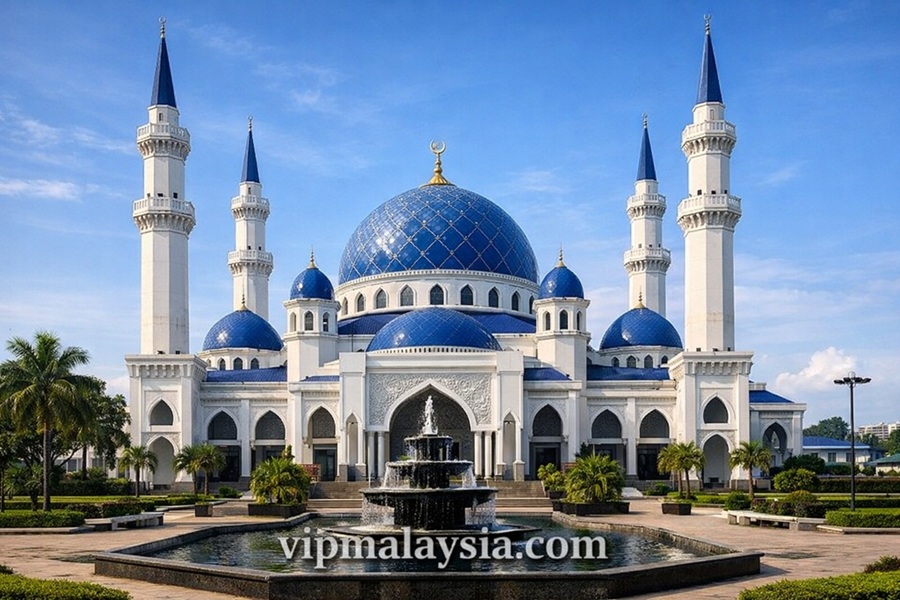
Sultan Ahmad Shah Mosque, Pahang
The Sultan Ahmad Shah Mosque in Kuantan, Pahang is more than a religious landmark—it is a cultural, architectural, and historical centerpiece of Malaysia. With its turquoise domes, towering minarets, and rich legacy, the mosque attracts worshippers, travelers, and history enthusiasts alike. This long-form guide explores its origins, highlights, attractions, adventure opportunities, and visitor experiences, offering a complete travel blog-style insight into one of Malaysia’s most iconic mosques.
Introduction
The Sultan Ahmad Shah Mosque stands proudly in Kuantan, the capital of Pahang, as the official state mosque. Completed in 1994, it represents both the spiritual devotion of the people and the architectural grandeur of Islamic design. Named after Sultan Ahmad al-Mu’azzam Shah, the first modern Sultan of Pahang, the mosque is a beacon of faith and heritage. Its turquoise domes and symmetrical minarets dominate the skyline, making it a must-visit destination for travelers exploring Malaysia’s east coast.
Sultan Ahmad al-Mu’azzam Shah (born 23 May 1836 – died 9 May 1914) was the sixth Raja Bendahara of Pahang and later became the founder and first modern Sultan of Pahang. Initially known as Tun Wan Ahmad, he seized power in 1863 after defeating his elder brother Tun Mutahir in the Pahang Civil War. In 1881, he formally assumed the title of Sultan Ahmad al-Mu’azzam Shah, marking the revival of Pahang as a sultanate after centuries of union with Johor. His reign was characterized by both internal conflicts and negotiations with British colonial authorities, eventually leading to Pahang’s incorporation into the Federated Malay States in 1895.
History
Early Foundations
The mosque’s origins trace back to the 1960s, when the first structure was inaugurated in 1964 by Sultan Abu Bakar Ri’ayatuddin Al-Mu’azzam Shah. This earlier mosque was notable for its futuristic geodesic dome design, a rarity in Malaysia at the time. However, structural issues led to its demolition in 1992.
Sultan Abu Bakar Ri’ayatuddin Al-Mu’azzam Shah Ibni Al-Marhum Sultan Abdullah Al-Mu’tassim Billah Shah (29 May 1904 – 5 May 1974) was the fourth modern Sultan of Pahang, reigning from 1932 until his death in 1974. Born in Pekan, he succeeded his father Sultan Abdullah Al-Mu’tassim Billah Shah and was formally installed in 1933. His 42-year reign spanned critical historical periods, including the Japanese occupation during World War II and Malaysia’s independence in 1957. He discreetly supported resistance movements against Japanese forces and later guided Pahang through the transition into the Federation of Malaya. Known for his approachable nature among subjects, he was less favored by other Malay rulers due to his marriages to commoners, which affected his candidacy for Yang di-Pertuan Agong. He was succeeded by his son, Sultan Ahmad Shah Al-Musta’in Billah.
Modern Reconstruction
Between 1991 and 1993, DZJ Architect and Associates designed a new mosque blending Arabian and Ottoman influences. The grand reopening in 1994 was officiated by Sultan Haji Ahmad Shah Al-Musta’in Billah, accompanied by Sheikh Muhammad bin Abdullah as-Sabil from Mecca. This marked the mosque’s transformation into a symbol of Islamic tradition and modernity.
DZJ Architect and Associates Sdn. Bhd. is a Malaysian architectural firm established in 1984 by Dato Hj. Dzulkifli bin Hj. Mohd Salleh and Dato Hj. Zulkifli bin Jaafar, whose initials form the acronym “DZJ.” The company has grown from a partnership practice into a corporate body offering services in architectural design, master planning, project management, building audits, and conservation. With over 38 years of combined experience, DZJ has contributed to housing developments, commercial centers, educational institutions, and landmark projects across Malaysia. The firm emphasizes blending traditional design values with modern technology, including three-dimensional computer simulations, and is headquartered at Damai Complex, Jalan Dato’ Haji Eusoff, Kuala Lumpur.
Sultan Haji Ahmad Shah Al-Musta’in Billah ibni Almarhum Sultan Abu Bakar Ri’ayatuddin Al-Mu’azzam Shah (24 October 1930 – 22 May 2019) was the fifth modern Sultan of Pahang, reigning from 1974 until his abdication in January 2019 due to health reasons. He also served as the seventh Yang di-Pertuan Agong of Malaysia from 1979 to 1984. Known as a “people’s sultan,” his reign emphasized accessibility and community welfare, while also supporting sports development as President of the Football Association of Malaysia. His abdication was a rare event in Malaysian royal tradition, paving the way for his son, Al-Sultan Abdullah Ri’ayatuddin Al-Mustafa Billah Shah, to succeed him. Sultan Ahmad Shah passed away in Kuala Lumpur in May 2019 and was buried at the Abdullah Mosque in Pekan, Pahang.
Highlights
Architectural Grandeur
The mosque features a central turquoise dome surrounded by four smaller domes, symbolizing unity and balance. Its four towering minarets rise majestically, visible from across Kuantan. Inside, the prayer hall is adorned with hypostyle columns, lancet arches, and clerestory windows that allow natural light to illuminate the space.
Cultural Significance
The mosque is not only a place of worship but also a hub for community activities. It hosts religious lectures, Quranic recitations, and festive gatherings during Ramadan and Eid. Its role as the state mosque makes it central to Pahang’s spiritual life.
Visitor Facilities
The mosque offers spacious prayer halls for men and women, a library, guest rooms for scholars, and administrative offices. Visitors can explore its serene courtyards and enjoy the peaceful atmosphere.
Facilities
| Facility | Description |
|---|---|
| Main Prayer Halls | Spacious halls for men and women, accommodating up to 10,000 worshippers at a time. |
| Library | Houses Islamic texts, scholarly works, and serves as a resource center for visitors and students. |
| Guest Rooms | Dedicated rooms for visiting scholars and dignitaries, supporting religious and cultural exchanges. |
| Administrative Offices | Offices and meeting rooms for mosque management and community coordination. |
| Dining & Pantry Areas | Facilities for communal meals, especially during Ramadan and festive occasions. |
| Mortuary Facilities | Equipped for funeral management, ensuring proper Islamic rites. |
| Ablution & Shower Areas | Clean, well-maintained spaces for ablution, showers, and baby care facilities. |
| Nikah Hall | Designated area for marriage ceremonies, reflecting the mosque’s role in community life. |
Festivals and Celebrations
During Ramadan, the mosque becomes a vibrant center of nightly prayers (Tarawih) and communal iftar meals. Eid celebrations draw thousands of worshippers, creating a festive and spiritual atmosphere.
Educational Programs
The mosque regularly organizes Islamic lectures, youth programs, and Quranic competitions, making it a hub for learning and spiritual growth.
Nearby Towns and Landmarks
Located near the Kuantan River, the mosque is surrounded by civic institutions and cultural attractions. Visitors can explore Kuantan town, known for its vibrant markets, seafood cuisine, and nearby beaches such as Teluk Chempedak.
Trekking and Adventure
Outdoor Exploration
While the mosque itself is a spiritual site, its location in Kuantan makes it a gateway to adventure. Travelers can trek through nearby forests, visit waterfalls like Sungai Pandan, or explore the lush landscapes of Taman Negara National Park.
Wildlife Encounters
Pahang is home to diverse wildlife, including Malayan tigers, tapirs, hornbills, and gibbons. Nature enthusiasts often combine mosque visits with eco-tours, experiencing both cultural and natural wonders.
Conclusion
The Sultan Ahmad Shah Mosque in Pahang is more than an architectural marvel—it is a living testament to faith, culture, and community. Its history reflects resilience, its design showcases grandeur, and its role in society highlights unity. For travelers, it offers not only a glimpse into Malaysia’s Islamic heritage but also access to nearby adventures and cultural experiences.
Visitor Reviews
Ahmad Faizal, Kuala Terengganu – ★★★★★ “The mosque’s turquoise domes are breathtaking. The prayer hall is spacious and serene, and the facilities are well-maintained. Truly a spiritual and architectural gem.”
Nur Aisyah, Johor Bahru – ★★★★☆ “I visited during Ramadan, and the atmosphere was incredible. The communal prayers and iftar meals made me feel part of the community. Parking can be crowded, but overall a wonderful experience.”
Daniel Wong, Penang – ★★★★★ “As a traveler, I was amazed by the mosque’s design. The minarets are stunning, and the interior is filled with light. It’s a must-see when in Kuantan.”
Siti Rahmah, Kota Bharu – ★★★★★ “The mosque is not only beautiful but also welcoming. The library and guest facilities show how it serves both worshippers and visitors. Highly recommended.”